
Simile vs Metaphor: Key Differences Explained
Do you often mix up similes and metaphors in your writing? Both are figures of speech that compare two different things, but they use different structures.
A simile uses “like” or “as” to make a comparison, while a metaphor asserts that one thing is another. Recognizing these distinctions can enhance your creative expression and improve your communication.
In this guide, we’ll break down Simile vs Metaphor, what makes similes and metaphors unique, enabling you to use them with confidence and clarity.
Quick Answer and TL;DR
Similes use “like” or “as” to make comparisons, while metaphors create direct comparisons without those words.
TL;DR
- Formation: Similes use “like” or “as”; metaphors make direct comparison without them.
- Identification: Look for “like” or “as” as a common signal of a simile.
- Similarity: Both are figures of speech used to compare different things.
- Key Structural Difference: Similes make the comparison explicit; metaphors state it directly.
- Emotional Effect: Metaphors can feel more direct, emotional and bold
- Clarity: Similes are clearer and easier for beginners to understand
What Is the Difference Between Simile and Metaphor?
Both similes and metaphors serve the purpose of comparing two different things, but they achieve this through distinct grammatical structures. Similes employ explicit comparisons, while metaphors imply a direct equivalence.
Simile: Clear and Direct Comparison
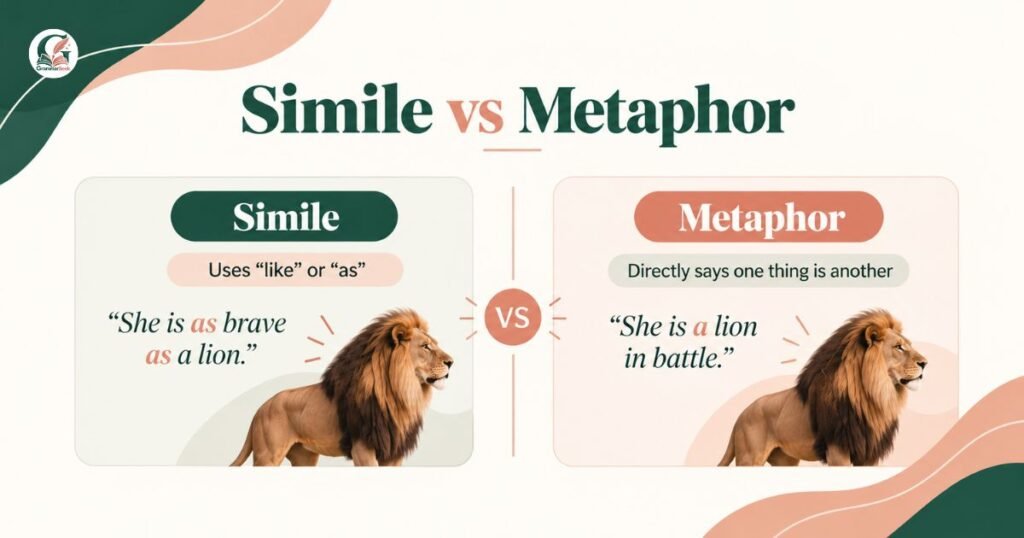
A simile compares two things using “like” or “as.” These words make the comparison easy to identify.
Examples:
- “She is as brave as a lion.”
- “He runs like the wind.”
Because the comparison is stated openly, you can usually recognize a simile by looking for “like” or “as.”
Metaphor: Strong and Implied Comparison
Metaphors create an implicit comparison that often adds layers of meaning or emotional depth.
Examples:
- “She is a lion in battle.”
- “Time is a thief.”
Metaphors can resonate on a personal level, making an emotional connection that similes may not always achieve.
Historical Origins of Similes and Metaphors
Similes and metaphors have been integral to human expression for centuries, serving as vital tools for enhancing communication. Their historical roots reveal deep connections to culture, philosophy, and linguistic evolution.
Ancient Roots in Greek Thought
The term “simile” originates from the Latin word similis, meaning “like” or “similar,” reflecting its essence of comparison.
The term “metaphor” comes from the Greek metaphora, which translates to “transfer.”
Ancient Greek philosophers like Aristotle recognized metaphors as central to rhetoric, arguing that they could elevate discourse and offer deeper insights into human experience.
Development in English Literature
Similes and metaphors continued to appear throughout the development of English literature.
- They became common features of poetry and prose, particularly in works from the medieval, Renaissance, and later periods.
- Writers such as William Shakespeare used both forms extensively, helping make them familiar features of English writing.
Today, similes and metaphors remain common in literature, everyday speech, advertising, and other forms of communication.
Simile vs Metaphor in American English Today
In everyday American English, both similes and metaphors appear in casual conversations, descriptions, social media, and other forms of communication.
Common Usage in Daily Language
In contemporary American English, similes and metaphors frequently enrich everyday conversation.
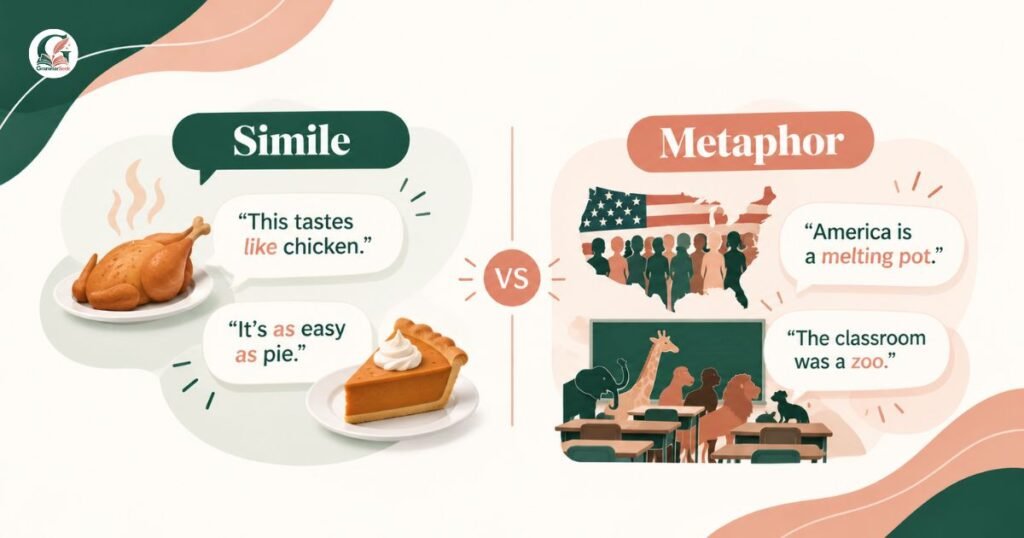
- “This tastes like chicken”
- “It’s as easy as pie”
Metaphors draw direct comparisons without using “like” or “as,” transforming one concept into another to convey a deeper meaning.
- “America is a melting pot”
- “The classroom was a zoo”
In Media and Advertising
In media and advertising, the strategic use of similes and metaphors captures attention and conveys messages succinctly.
- Similes help explain products simply
- Metaphors create strong emotional connections
By weaving similes and metaphors into their narratives, media and advertising effectively resonate with audiences, making messages memorable and impactful.
Simile vs Metaphor Examples Table
Below, you’ll find a table that captures this nuance across various contexts, providing practical similes and metaphors examples to enrich your understanding.
| Context | Simile Example | Metaphor Example | Meaning |
| Speed | He runs like the wind. | He is a cheetah on the track. | Very fast |
| Strength | Her muscles are as strong as iron. | She is a brick wall. | Very strong |
| Fear | He was as scared as a mouse. | He is a leaf in a storm. | Very scared |
| Happiness | She smiled like a child at Christmas. | Her smile was a bright window. | Very happy |
| Confusion | He felt as lost as a needle in a haystack. | Her thoughts were a tangled web. | Very confused |
| Tiredness | I’m as tired as a dog after a long walk. | He is a worn-out shoe. | Very tired |
| Noise | The crowd roared like thunder. | The room was a cacophony. | Very loud |
| Intelligence | She’s as wise as an owl. | He is a walking encyclopedia. | Very intelligent |
| Beauty | She shines like the sun. | She is the sun. | Very bright/beautiful |
Emotional and Psychological Impact
Similes and metaphors can affect the tone of a sentence and the way readers interpret a comparison.
How Similes Can Affect Tone
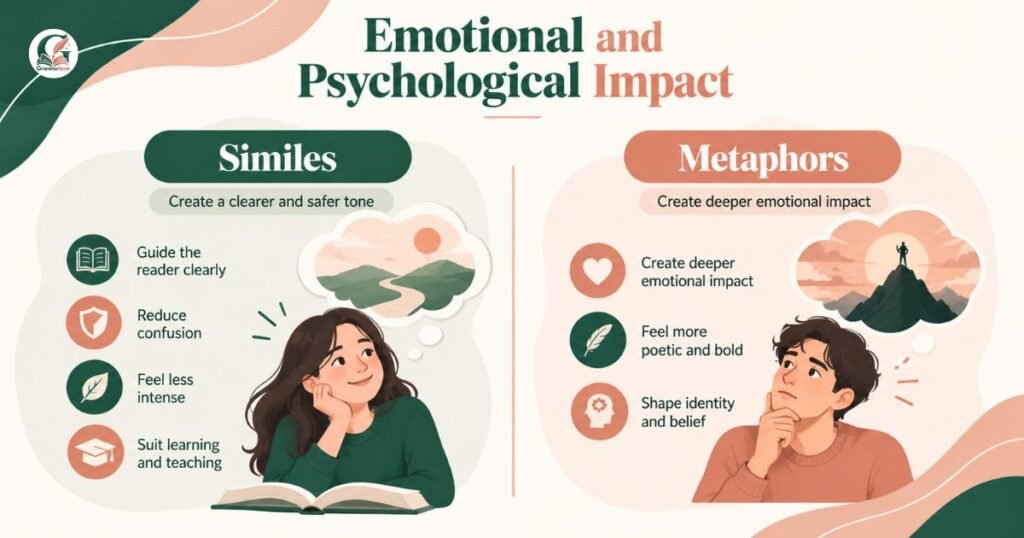
Similes, which use “like” or “as” to make comparisons, often create a sense of safety in communication.
Similes guide the reader clearly.
- They reduce confusion
- They feel less intense
- They suit learning and teaching
This explicit wording allows listeners or readers to grasp complex ideas through familiar benchmarks, easing them into new concepts.
How Metaphors Can Affect Interpretation
Metaphors rely on implicit connections, inviting deeper engagement and introspection.
- They create deeper emotional impact
- They feel more poetic and bold
- They shape identity and belief
By saying “time is a thief,” the metaphor transcends direct comparison.
Modern Usage in Social Media and Pop Culture
Similes and metaphors are common in social media posts, captions, comments, memes, and other forms of online communication.
Similes in Everyday Posts
Similes permeate our everyday posts, adding color and relatability to online communication.
- “This day feels like forever”
- “I’m as tired as a zombie”
Such similes effectively capture emotions, allowing users to express themselves in a relatable manner.
Metaphors in Identity and Trends
Metaphors in social media often shape our understanding of identity and current trends, acting as the brushstrokes that paint a digital self-portrait.
- “I’m in my villain era”
- “This is my battlefield”
Such expressions invite users to engage deeply with their own narratives, creating a shared dialogue that transcends mere surface interactions.
Cross-Cultural Perspectives
Similes and metaphors are found in many languages and cultures, although the specific comparisons people use can vary.
Shared Global Patterns
Metaphors and similes are universal linguistic tools that enrich communication.
- Similes appear in folk sayings
- Metaphors appear in religion and poetry
Differences Across Cultures
While the use of metaphors and similes is widespread, the specific expressions remain deeply rooted in cultural context, revealing unique values and worldviews.
- Some cultures favor indirect comparison
- Others use bold metaphors more often
Common Mistakes and Misunderstandings – Simile vs Metaphor
Similes and metaphors are easy to confuse because both compare different things. Knowing how each form is structured can help you identify and use them correctly.
Mixing Up Structure
Understanding the distinction between similes and metaphors is crucial in effective writing, yet many people often confuse their structures.
The most common mistake is:
- Using “like” in a metaphor by accident
- Forgetting it in a simile
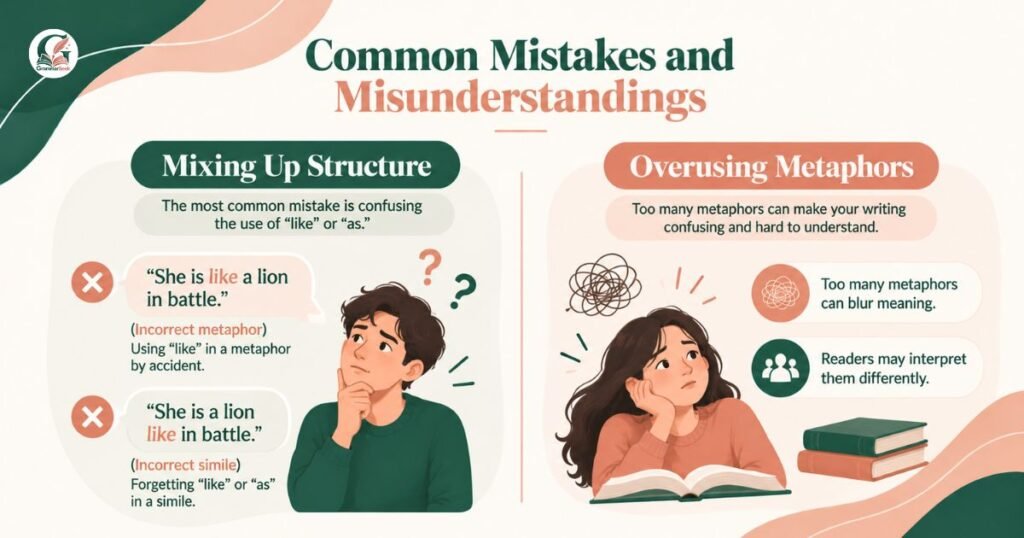
Overusing Metaphors
While metaphors can enrich language, overusing them can lead to confusion rather than clarity.
- Too many metaphors can blur meaning
- Readers may interpret them differently
Choosing the right moment to employ a metaphor can significantly enhance your writing, making it both evocative and accessible.
How Their Meanings Have Shifted Over Time
Similes and metaphors are no longer limited to literature and formal writing. They are now common in everyday conversations, text messages, social media posts, business communication, and other forms of modern communication.
From Formal to Everyday Use
Historically, similes and metaphors were reserved for poetry and scholarly writing, where their nuanced meanings enhanced the depth of the text. Today, they serve as linguistic shortcuts in our fast-paced digital lives, making complex ideas more relatable.
For example, saying “time is money” in a business meeting effectively communicates urgency, allowing for a quicker understanding of priorities.
This shift from formality to everyday application illuminates how language evolves to accommodate cultural changes, enabling more relatable and immediate forms of communication.
Blurring of Boundaries
The distinction between formal and colloquial speech has blurred, as metaphors have infiltrated professional jargon and casual dialogue alike.
This convergence allows for creative expression in environments once considered rigid and conservative, such as boardrooms or academic presentations.
Phrases like “think outside the box” not only stimulate creative thinking but also foster a sense of camaraderie among colleagues.
Conclusion
The differences between similes and metaphors lie in their methods of comparison and the emotional resonance they evoke.
Similes provide clarity and visual imagery by highlighting similarities through explicit language, while metaphors challenge readers to interpret deeper meanings through implicit connections.
Mastering both can elevate your writing and allow for a more nuanced expression of ideas and emotions. By recognizing when to use each, you can enhance your storytelling and captivate your audience more effectively.
FAQs
What Is The Main Difference Between Simile And Metaphor?
The main difference between similes and metaphors lies in how they convey comparisons. A simile explicitly uses the words “like” or “as” to draw parallels between two different things, making its comparison clear and easily understandable. A metaphor makes a more direct comparison without the use of “like” or “as.”
What Are Similes And Metaphors Called?
Similes and metaphors are called figures of speech or forms of figurative language.
Why Are Metaphors Considered Stronger Than Similes?
Metaphors are often considered stronger than similes due to their direct assertion of identity rather than mere comparison.
Are Similes Easier To Understand Than Metaphors?
Yes, similes are generally easier to understand than metaphors due to their explicit nature. A simile directly signals a comparison using phrases like “like” or “as,” making it clear that one thing is being compared to another. Metaphors imply a comparison without using comparative words, which can make them more nuanced or abstract.
Can A Sentence Have Both Simile And Metaphor?
Yes, a sentence can indeed incorporate both simile and metaphor, but it requires careful structuring to avoid confusion.
For example: “Her smile was like sunshine, warming everyone around her.” Here, the simile (“like sunshine”) complements the metaphor by providing a vivid comparison.
Do Americans Use Metaphors More Than Similes?
In the English language, both metaphors and similes are used frequently, but they serve slightly different purposes in communication.
In media, storytelling, and branding, metaphors are often preferred because of their ability to create powerful associations and resonate emotionally with audiences.
Are Similes And Metaphors Important In Writing?
Absolutely, similes and metaphors are essential tools in writing that add depth and richness to language. By comparing one thing to another, they create vivid imagery that allows readers to visualize and connect with the text on a deeper level.
