
Writing or Writting: Never Get Confused Again
Have you ever paused to consider the difference in “Writing or Writting”? While “writing” is the correct form recognized in English, “writting” is a frequent misspelling that can lead to confusion.
Understanding related forms such as “write” and “written” is also important for clear communication. In this guide, we will explain the differences between Writing and Writting, forms of write, provide practical examples, and offer helpful spelling tips to improve your writing skills.
Quick Answer – Writing or Writting
“Writing” is the correct spelling, while “writting” is incorrect. “Writing” is the -ing form of the verb “write,” created by dropping the silent “e”. “Written” refers to the past participle. For example, “He is writing a letter” showcases an ongoing action, whereas “He has written a letter” indicates completion.
Understanding the Word “Writing”
“Writing” serves a dual purpose in English, functioning as both a verb and a noun. As a verb, “writing” describes the act of composing text.
For example, when a student is writing an essay, they are actively putting their thoughts and ideas into written words. As a noun, “writing” refers to the result of that process, such as the words in a letter, story, or research paper.
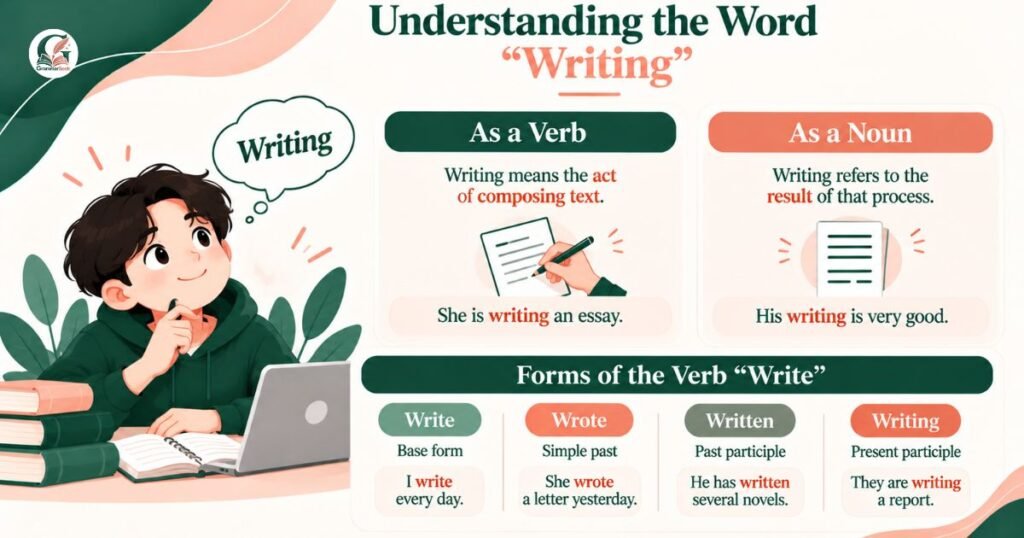
The main forms of the verb “write” are “write,” “wrote,” “written,” and “writing”.
- “Write” is the base form, as in “I write every day.”
- “Wrote” is the simple past tense, as in “She wrote a letter yesterday.”
- “Written” is the past participle, often used with auxiliary verbs, as in “He has written several novels.”
- “Writing” is the present participle, as in “They are writing a report.”
Other irregular verbs follow their own set of forms too, as shown in past tense of seek.
Why “Writting” is Incorrect
The spelling “writting” is incorrect because of the spelling rule for verbs ending in a silent “e.” The base form “write” becomes “writing” by dropping the silent “e” before adding the “-ing” suffix. Therefore, write + ing = writing, not “writting.”
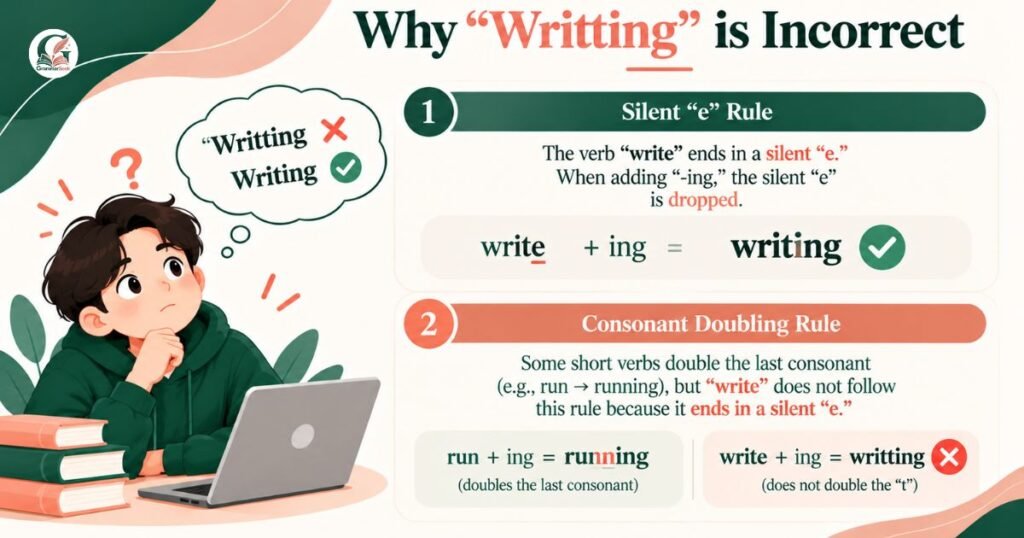
The confusion often comes from the consonant-doubling rule used with some short verbs, such as “run,” which becomes “running.” However, “write” does not meet the conditions for this rule because it ends in a silent “e.” Therefore, the “t” is not doubled, making “writing” the only correct spelling.
The consonant-doubling rule also causes mistakes in other words, as explained in targetted or targeted.
Writing vs Writting
Here is a quick comparison table between writing and writting to easily understand which one is correct, writing or writting.
| Feature | Writing | Writting |
| Spelling | Correct | Incorrect |
| Number of T’s | One t | Two t’s |
| Meaning | The act of composing text or written work | No recognized meaning as a standard English word |
| Grammar | Correct form of “write” + “-ing” | Incorrect formation |
| Spelling rule | Drops the silent “e” before adding “-ing” | Incorrectly doubles the “t” |
| Example | She is writing a letter. ✅ | She is writting a letter. ❌ |
| Usage | Used in academic, professional, and creative contexts | Should be avoided |
Writing is the correct spelling. When adding -ing to write, drop the silent e to form writing, not writting.
Synonyms and Related Words
The term “writing” encompasses a broad range of activities, and its related words convey different meanings depending on the context.
For example, “composition” often refers to the structured arrangement of ideas in a piece of writing, such as an essay or formal report. In contrast, “text” is a more general term that can refer to the content of anything from a novel to an article.

Similarly, “script” usually refers to written dialogue for plays, films, or other performances. “Authorship” refers to the individual or group responsible for creating a particular piece of writing, emphasizing creative ownership. “Document” typically refers to a formal written record, such as a legal contract or business proposal.
Related words like these can carry different shades of meaning, as explained in connotation vs denotation.
Real-Life Examples of Writing
The word “writing” is commonly used in academic, business, and creative contexts. Students may use it when working on essays, reports, or research papers.
In business settings, “writing” can describe tasks such as preparing emails, reports, or proposals.
In creative writing, the word can describe the process of creating stories, scripts, or other imaginative works.

For Example:
- Academic: I am writing a research paper for my history class.
- Business: She is writing an email to the client.
- Creative: He is writing a short story about a young detective.
Writing is also a key part of many job skill sets, as in skillset or skill set.
Exercises and Tips for Avoiding Spelling Errors
To reinforce the correct spelling of “writing,” try these fill-in-the-blank exercises:
- She enjoys __________ in her journal every night.
- The book was beautifully __________ by the renowned author.
Answers:
- writing
- written
To check your spelling, read your sentences carefully and use a spell-check tool when needed. You can also practice the forms write, writing, and written in different sentences. Regularly reviewing these forms can help you recognize and avoid the common misspelling “writting.”
Missing or extra letters cause similar mistakes in other words, as in forteen vs fourteen and moment vs momment.
Conclusion
“Writing” is the correct spelling, while “writting” is categorically incorrect. The word “writing” is derived from “write” by omitting the silent “e” and adding “-ing.” It’s also important to note the distinction between “writing,” which refers to the act of composing text, and “written,” which pertains to the completed work.
Keeping these guidelines in mind not only enhances clarity in your own writing but also upholds standards in academic and professional settings. Remember to always use “writing” to ensure accuracy in your written communications.
FAQs
Is Writting Ever Correct?
No. “Writting” is an incorrect spelling. The correct form is “writing.”
How Do I Remember The Correct Spelling Of Writing?
Remember the pattern write + ing = writing. Drop the silent “e” from “write” before adding “-ing.”
What Is The Difference Between Writing And Written?
Writing is the -ing form of “write” and usually describes an ongoing action. Written is the past participle, used for completed actions, such as “She has written a letter.”
Is Writing With One T Or Two?
Writing is spelled with one “t.” The spelling “writting” is incorrect.
Is It Written Or Writen?
Written is the correct spelling. “Writen” is incorrect and should be avoided.
How Do You Spell Writing?
The correct spelling is writing: W-R-I-T-I-N-G.
How Do We Use Writing?
Writing is used to describe the act of putting words into written form. For example, “She is writing an email.”
Why Is It Writing And Not Writting?
It is spelled writing because the base verb write ends in a silent e, so you drop the e and add -ing without doubling the t.
Which Is Right, Writting Or Writing?
Writing is the correct spelling. “Writting” is a common misspelling.