Targetted or Targeted: Which Spelling Is Correct?
Have you ever wondered why some words seem to have multiple spellings, leaving you second-guessing yourself? When it comes to the word “targeted,” many people mistakenly write it as “targetted.”
This guide will clarify the correct spelling of targeted and explain why “targeted” is the standard in both American and British English. By the end, you’ll understand whether to use targetted or targeted, the spelling rules behind this common confusion and be more confident in your writing.
Quick Answer – Targetted or Targeted
Targeted is the correct standard spelling while targetted is generally considered nonstandard spelling. Similarly targeting is the correct standard spellings and targetting is nonstandard spelling.
“Targeted” refers to efforts aimed at a specific person, group, or objective, ensuring clarity in communication and focus in messaging. Use the standard forms targeted and targeting for effective writing.
Targetted vs Targeted at a Glance
Here’s a helpful comparison table between Targeted and Targetted to highlight the differences:
| Word | Correct Spelling? | Meaning | Example |
| Targeted | Yes | Directed toward a specific person, group, or goal. | The company targeted young customers with its new campaign. |
| Targetted | No | A nonstandard spelling of “targeted.” | Incorrect: The advertisement targetted young customers. |
| Targeting | Yes | The act of directing attention or efforts toward someone or something. | The campaign is targeting new customers. |
| Targetting | No | A nonstandard spelling of “targeting.” | Incorrect: The campaign is targetting new customers. |
In modern English, targeted and targeting are the standard spellings in both American and British English. The forms targetted and targetting are generally considered misspellings. Remember to use one “t” before the endings -ed and -ing to spell these words correctly.
Which Spelling Is Correct: Targetted or Targeted?
The correct spelling is targeted, not targetted. This confusion often arises because English has many verbs that double consonants when forming their past tense, but “target” is not one of them.

The verb target means to set a goal or direct attention towards something and ends with a single “t.” When you add “-ed” to form the past tense, the single “t” remains unchanged, resulting in “targeted.”
For Example:
The marketing campaign targeted young audiences.
Using targetted is incorrect and deviates from standard English spelling rules.
Verbs like “plan” transform into “planned” by doubling the “n,” because they end in a single vowel followed by a consonant. However, since “target” has two vowels preceding the “t,” there is no need to double it when applying the “-ed” suffix.
What Does Targeted Mean?
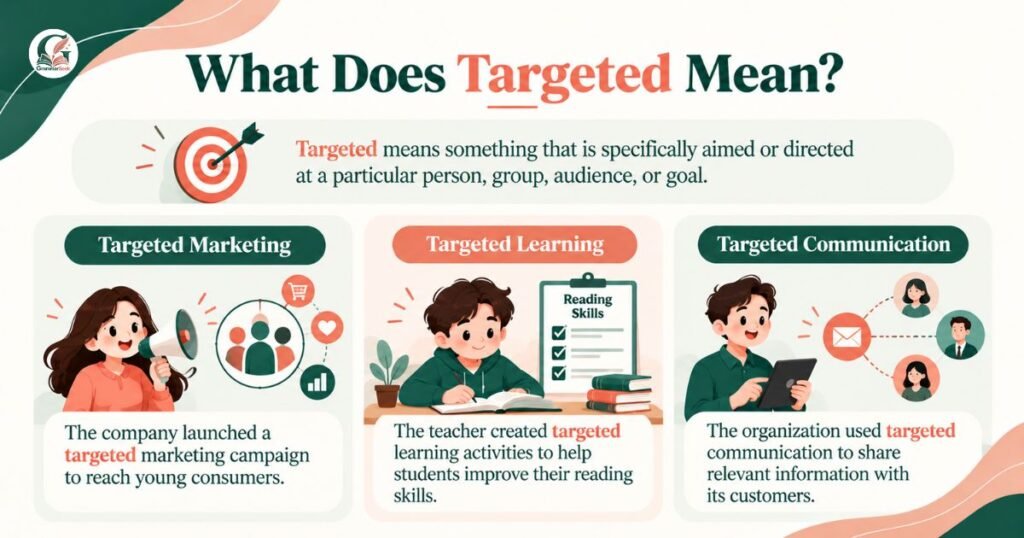
The term “targeted” refers to something that is specifically aimed or directed at a particular person, group, audience, or goal. It is commonly used in business, education, healthcare, advertising, and everyday communication.
Examples of Targeted:
- Targeted marketing: The company launched a targeted marketing campaign to reach young consumers.
- Targeted learning: The teacher created targeted learning activities to help students improve their reading skills.
- Targeted communication: The organization used targeted communication to share relevant information with its customers.
Understanding the targeted definition allows both businesses and individuals to approach their strategies with precision, leading to more meaningful interactions and outcomes. These examples highlight the importance of being mindful of one’s audience, ensuring that messages and efforts are not just broadcasted widely but honed to make a real impact.
Why Is Targeted Spelled with One T?
The reason “targeted” is spelled with one T comes down to the English consonant-doubling rule. In English, we often double the final consonant of a word when adding endings like “-ed” or “-ing,” but this rule typically applies only when the final syllable is stressed.
For comparison, consider words like:
- Stop → Stopped
- Plan → Planned
- Admit → Admitted
Here, the final syllables are stressed, prompting the doubling of the consonant.
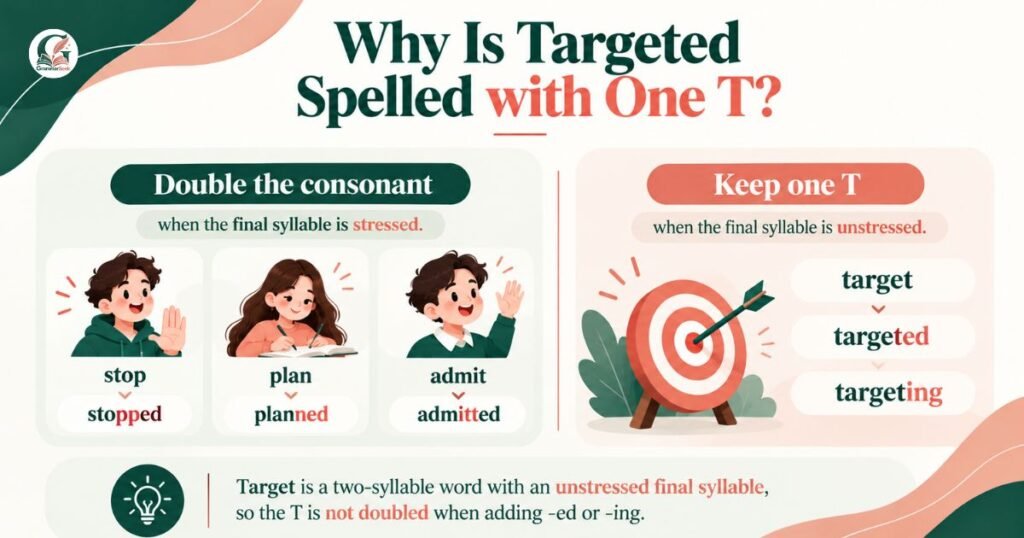
In the case of “target,” the final syllable is unstressed, which is why we don’t double the T when adding these endings:
- Target → Targeted
- Target → Targeting
Understanding these rules not only clarifies targeted spelling but also highlights the intricacies of English pronunciation and spelling conventions.
By recognizing the role of stress in determining letter doubling, you can better navigate the complexities of English spelling and enhance your written communication.
To see how other words change their endings, read about the past tense of run and the plural of chief.
Why Do People Write Targetted?
People often write “targetted” because they mistakenly apply the English consonant-doubling rule. Many writers assume that doubling the “t” adds emphasis or correctness, especially in the context of similar words that do follow this pattern, like “focussed” or “cancelled.” Such missteps can arise from a misunderstanding of when to double consonants, leading to a slip into this common error.
Exposure to misspellings on websites, social media, and other online platforms can also reinforce this common spelling mistake. With so many influences, individuals may see the incorrect form used frequently, which can reinforce the mistake in their own writing.
Comparisons such as:
- Focused vs Focussed
- Benefited vs Benefitted
- Canceled vs Cancelled
may add to the confusion because some spelling variations are accepted in particular varieties of English.
Unlike those regional variations, “targeted” is the standard spelling in both American and British English. Remembering this distinction helps you avoid the error and write with greater accuracy.
You can see another example of a US and UK spelling difference in traveler or traveller.
Targeting vs Targetting: Which Is Correct?
Targeting is the correct spelling, while targetting is a nonstandard misspelling. The word targeting means directing attention or effort toward a specific person, group, problem, or goal.
| Spelling | Correct? |
| Targeting | Yes |
| Targetting | No |
Examples of targeting in a sentence:
- Marketing: The campaign is targeting young adults.
- Sports: The coach is targeting the team’s weaknesses.
- Technology: The developers are targeting specific user needs.
Remember this simple pattern: target → targeted → targeting.
Both targeted and targeting use one T before their endings in standard American and British English.
Is Targetted Ever Correct in British English?
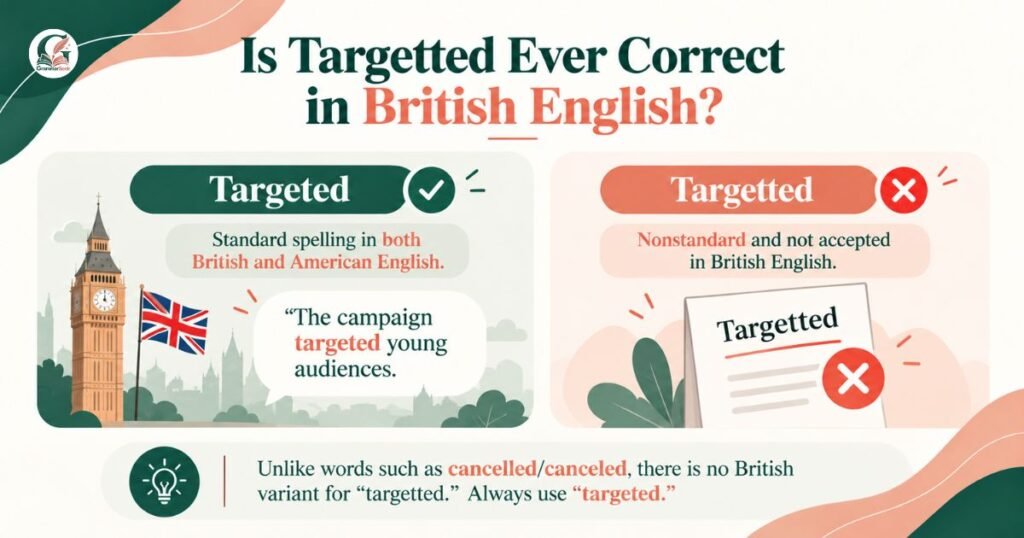
No. “Targeted” is the standard spelling in both British and American English, while “targetted” is considered nonstandard. Although the incorrect form may occasionally appear in informal writing or older sources, it is not an accepted British spelling variant.
Unlike words such as cancelled and canceled, which reflect differences between British and American spelling conventions, targeted is spelled the same way in both varieties.
For a closer look at one of those differences, see cancellation vs cancelation.
Whether you’re writing an essay or crafting a blog post, using “targeted” ensures your content reflects the precision expected in today’s communication.
Examples of Targeted in Sentences
Here are examples of how to use targeted in business, education, and everyday communication.
Business Examples
- The company launched a targeted advertising campaign to reach potential customers.
- The marketing team developed a targeted strategy to attract new clients.
- The brand used targeted communication to increase customer engagement.
Academic Examples
- Researchers conducted a targeted study on language development in children.
- The university introduced targeted support programs for struggling students.
- The teacher provided targeted feedback to help students improve their writing.
Everyday Examples
- The coach offered targeted advice to help the team prepare for the competition.
- The organization provided targeted assistance to families in need.
- The doctor recommended targeted treatment based on the patient’s specific condition.
These examples show that targeted can describe actions, strategies, services, and support designed for a particular purpose. Using the word this way makes your writing more precise and helps readers understand exactly what is being addressed.
Common Words Similar to Targeted
English spelling variations can confuse writers, especially when some words have accepted British and American forms. However, “targetted” and “targetting” are nonstandard spellings, while other variations are acceptable in certain English varieties.
| Spelling | Status |
| Targeted | Standard spelling |
| Targetted | Nonstandard |
| Targeting | Standard spelling |
| Targetting | Nonstandard |
| Focused / Focussed | Both accepted; focused is common in American English |
| Benefited / Benefitted | Both accepted; benefited is common in American English |
| Canceled / Cancelled | Both accepted; canceled is common in American English, while cancelled is common in British English |
To avoid common spelling mistakes, consult a reliable dictionary and follow one spelling style consistently throughout your writing. Remember that “targeted” and “targeting” are the standard forms in both American and British English.
For more commonly confused spellings, check out message vs messege.
Conclusion
When comparing targetted vs. targeted and targeting vs. targetting, the correct spellings are targeted and targeting. Both forms are standard in American and British English, while targetted and targetting are nonstandard.
Remember this simple rule: target → targeted → targeting. Using the correct forms helps keep your writing clear, accurate, and professional, whether you are writing an academic paper, a business document, or a blog post.
FAQs
Is Targetted a Real Word?
“Targetted” is not a standard or commonly accepted spelling; the correct form is “targeted.” While you might encounter “targetted” in some informal contexts, it is advisable to use “targeted” for clarity and correctness.
Why is Targeted Spelled With One T?
“Targeted” is spelled with one “T” because it follows the rule where you only double the final consonant if the last syllable is stressed. In this case, the stress is on the first syllable, so we only use a single “T.”
Is Targetted Accepted Anywhere?
“Targetted” is not widely accepted in modern English. Most grammar guides and dictionaries recommend using “targeted” instead.
How Do You Spell Targeting?
The correct spelling is “targeting.” It refers to the process of aiming at a specific audience or goal.
What is the Meaning of Targeted?
The term “targeted” refers to something that is aimed at a specific person, group, or objective. It often involves tailoring messages or actions to meet the needs or interests of that particular audience or goal.
Is Targeted Correct in Both American and British English?
Yes, “targeted” is correct in both American and British English. It is commonly used in various contexts, such as marketing and advertising, in both regions.
What Is the Difference Between Targeted and Targeting?
Targeted refers to something aimed at a specific group or audience, such as ads designed for particular customers. Targeting is the process of selecting that specific group to reach with your message or product.
What Is the Past Tense of Target?
The past tense of “target” is “targeted.” You use “targeted” when talking about something that was aimed at or focused on in the past.
How Do You Use Targeted in a Sentence?
Here are three examples of how to use targeted in a sentence:
The company created a targeted advertisement to reach young adults.
The teacher designed a targeted lesson plan for struggling students.
They launched a targeted campaign to raise awareness about recycling.
Why Do People Misspell Targeted as Targetted?
People misspell “targeted” as “targetted” because they mistakenly apply the consonant-doubling rule used in words like “stopped” and “planned.” However, “targeted” is the standard spelling in both American and British English.