
Cancellation vs Cancelation: The Correct Spelling (US vs UK)
Ever found yourself confused by the difference between cancellation and cancelation? You’re not alone, and this article aims to demystify the spelling variations.
When it comes to “cancellation vs cancelation”, understanding the distinction between American and British English can significantly affect your writing clarity.
While “cancellation” is the standard and widely accepted form, “cancelation” remains a rare variant used in specific contexts. In formal writing, knowing which spelling to use is crucial for maintaining professionalism.
Quick Answer
The terms “cancellation” and “cancelation” often create confusion due to their similar meanings and spellings. “Cancellation” with a double L is the correct and standard form in both American and British English. “Cancelation” is a rare variant that lacks widespread acceptance and usage.
For formal writing, it’s advisable to stick with “cancellation” to ensure clarity and adherence to accepted norms. Using the preferred spelling not only aligns with conventional standards but also enhances the professionalism of your writing. When in doubt, remember that “cancellation” is your safest bet for clear communication.
Cancellation vs Cancelation – Key Differences at a Glance
When comparing “cancellation” and “cancelation,” it’s essential to note that “cancellation” is the standard and more widely accepted spelling. This form consistently appears in various contexts, such as “flight cancellation” and “order cancellation,” making it the preferred choice in both written and spoken language.
Its widespread usage solidifies its status as the go-to option for anyone communicating about the cessation of an event or order.
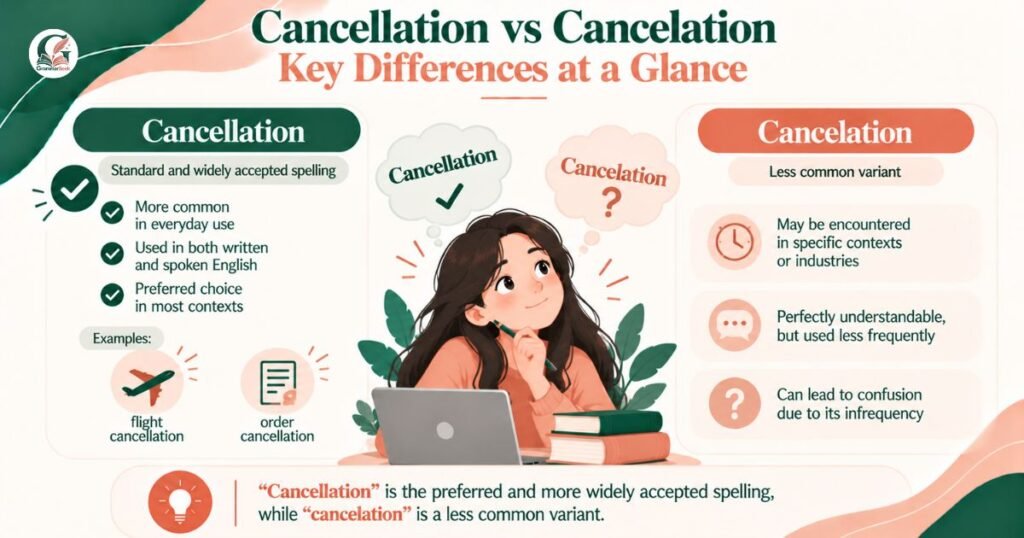
“Cancelation” serves as a less common variant and may still be encountered occasionally, primarily in specific contexts or industries. While it’s perfectly understandable, its infrequency means that many people may be unfamiliar with it, potentially leading to confusion.
In practical terms, if you’re looking to avoid misunderstanding and ensure clarity, opting for “cancellation” is advisable to align with common usage. The difference between cancelation and cancellation mainly lies in frequency, with “cancellation” taking the lead in everyday language.
American vs British English: The Real Difference
The spelling differences between US and UK English often come from history, reflecting the evolution of the languages on either side of the Atlantic.
Webster’s Spelling Reforms
No discussion on American English can overlook Noah Webster’s influence. In the early 19th century, Webster championed simplified spellings to distinguish American English from its British counterpart.
His reforms included:
- colour → color
- centre → center
- travelled → traveled
These changes were part of a broader movement towards linguistic independence and clarity, impacting various terms but not specifically the nuances of cancellation or cancelation.
US Spelling Trends
When it comes to spelling, Americans often prefer shorter versions, leading to notable differences between American and British English.
For instance, words such as “canceled,” “canceling,” “labeled,” and “modeling” reflect this trend, where the omission of the second ‘l’ streamlines the text. However, this trend isn’t entirely consistent; intriguing exceptions arise, such as “cancellation,” which preserves the double ‘l.’
Global Publishing Standards
The spelling cancellation is widely used in both American and British English and is the form readers are most likely to encounter. Cancelation, with one L, also exists as a less common variant. For most writing, cancellation is the more familiar and widely used form.
What Major Dictionaries Say
When exploring the nuances between American and British English, leading dictionaries provide crucial insights into spelling preferences.
- Merriam-Webster: Lists cancelation as a variant but prefers cancellation.
- Oxford: Uses cancellation as the main spelling.
- Cambridge: Uses cancellation.
While “cancelation” may exist, its secondary status in these dictionaries underscores a broader theme: American English tends to embrace variations, whereas British English often preserves established forms.
Word choice also differs between American and British English, as with everyday terms like “trash,” “garbage,” and “rubbish” in trash vs garbage.
Why Is Cancellation Spelled with Two Ls?
“Cancellation” is spelled with two Ls primarily because of its formation from the base word “cancel” combined with the suffix “-ation.”
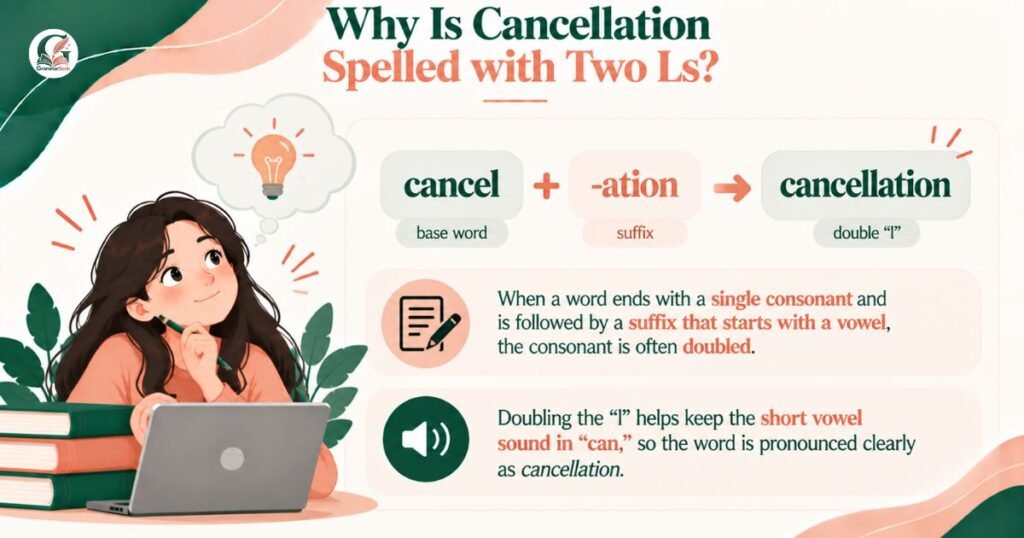
In English, when words like “cancel” that end in a single consonant are extended with suffixes that begin with a vowel, the consonant is often doubled to preserve the word’s pronunciation.
This spelling pattern helps maintain the short vowel sound in “can,” ensuring that when we say “cancellation,” the emphasis remains clear and distinct.
Is Cancelation Ever Correct?
When exploring the question of whether cancelation is a correct spelling, it’s essential to understand both terms. Yes, cancelation is a recognized spelling, but it is much less common than cancellation.
Both forms refer to the same word, but cancellation is the standard spelling most readers will encounter. “Cancelation” is recognized in some dictionaries, particularly in American English, but it’s far less common than “cancellation.” Most people and publications prefer cancellation, making it the standard spelling.
For everyday use, sticking with “cancellation” is advisable, as it’s the term most readers will expect and understand. While “cancelation” might pop up occasionally, using “cancellation” not only enhances clarity but also aligns with the widely accepted conventions of English.
When deciding between cancellation or cancelation, go with cancellation for consistency and ease of comprehension.
Real Examples of Cancellation in Sentences
Understanding the term “cancellation” can make everyday conversations easier. Here are a few examples showing its usage in various contexts.
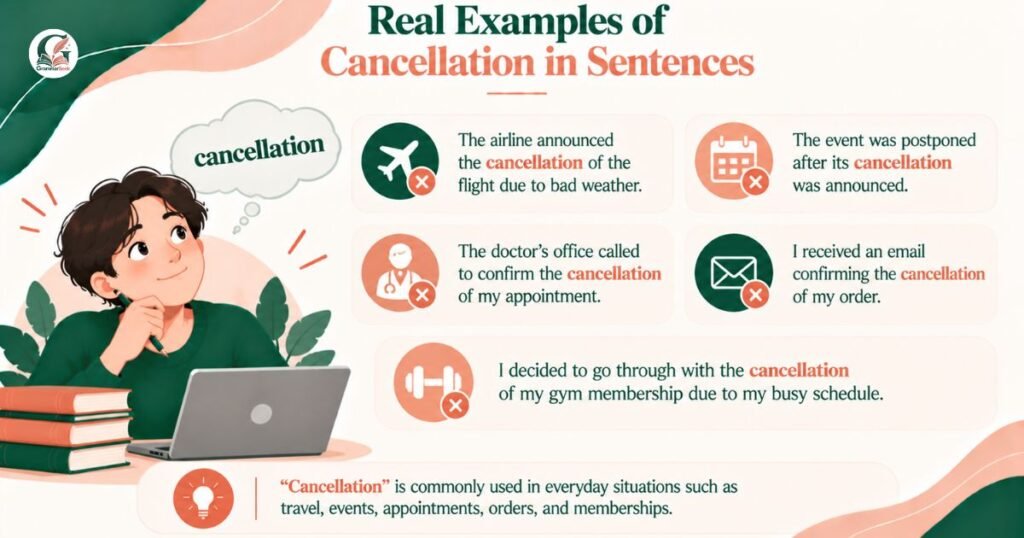
- The airline announced the cancellation of the flight due to bad weather.
- The event was postponed after its cancellation was announced.
- The doctor’s office called to confirm the cancellation of my appointment.
- I received an email confirming the cancellation of my order.
- After reviewing my options, I decided to go through with the cancellation of my gym membership due to my busy schedule.
These examples illustrate how “cancellation” fits seamlessly into everyday language. Remember, when you wonder how to spell cancellation, it’s always spelled with two “Ls.”
Is Cancelation Spelling Ever Acceptable?
“Cancelation” is indeed a recognized spelling variant, though “cancellation” is the preferred form in most contexts.
You might stumble upon “cancelation” in certain American English publications or niche discussions, but its usage is fairly rare.
However:
- It looks unusual.
- Many readers think it’s a typo.
- It may trigger spellcheck warnings.
Rare Acceptance Cases
You might see cancelation in older American texts or informal writing. But it is not common in professional or global communication. The variant “cancelation” may also appear in specific technical or legal documents where brevity is paramount. In these contexts, writers may opt for the shorter spelling to maintain a concise tone.
Why It Looks Wrong to Most Readers
For most readers, seeing “cancelation” could feel jarring, as standard English conventions strongly favor the double “l” version.
Another spelling that is recognized but less common is covered in hoodie or hoody.
Common Grammar Pattern: Traveling vs Travelling & Double-L Words
American and British English differ in how they spell some words that end in -l when a suffix is added. Here’s a simple comparison:
| American English | British English |
| traveling | travelling |
| labeled | labelled |
| modeling | modelling |
| canceled | cancelled |
One notable exception in this is the word “cancellation,” which is spelled with two Ls in both American and British English. Unlike forms such as “canceled” and “canceling,” which drop the second L in American English, “cancellation” maintains the double L regardless of the variant.
Why This Pattern Matters
Recognizing this pattern makes it easier to avoid similar mistakes with:
- cancelled vs canceled
- cancelling vs canceling
- cancellation vs cancelation
Once you familiarize yourself with the rules governing these double-L words, you’ll find yourself writing with greater confidence and precision.
The single-L versus double-L pattern for travel words is covered in traveler or traveller.
Common Mistakes & How to Avoid Them
One of the most common mistakes is confusing “cancellation” with “cancelation.” While both can technically be correct, “cancellation” is the more commonly accepted form, especially in standard written English.
Another common mistake is mixing American and British spelling conventions, such as using “canceled” (American) alongside “cancelled” (British).

How to Avoid Mistakes
To sidestep these common errors:
- Always use “cancellation” as the standard noun form.
- For verb forms, choose either “canceled” or “cancelled,” depending on your audience’s location, American or British English.
- Settle on one variant and stick with it throughout your document.
- If you find yourself uncertain, consider using a writing tool or spell checker set to your preferred language version.
Quick Comparison Table – Cancelation vs Cancellation
Here’s a quick comparison table that highlights key features and differences.
| Feature | Cancellation | Cancelation |
| Spelling | Standard spelling | Less common variant |
| Number of Ls | Two Ls | One L |
| American English | Widely used | Occasionally found |
| British English | Widely used | Much less common |
| General usage | Far more common | Rare |
| Academic Writing | Yes | Not recommended |
| Business Writing | Yes | Avoid |
| Recommended Choice | Yes | Generally avoid when the standard form is expected |
Cancellation vs Cancelation – Which Should You Use?
When it comes to the choice between “cancellation” and “cancelation”, always choose “cancellation”. Cancellation is the standard and far more widely accepted form.
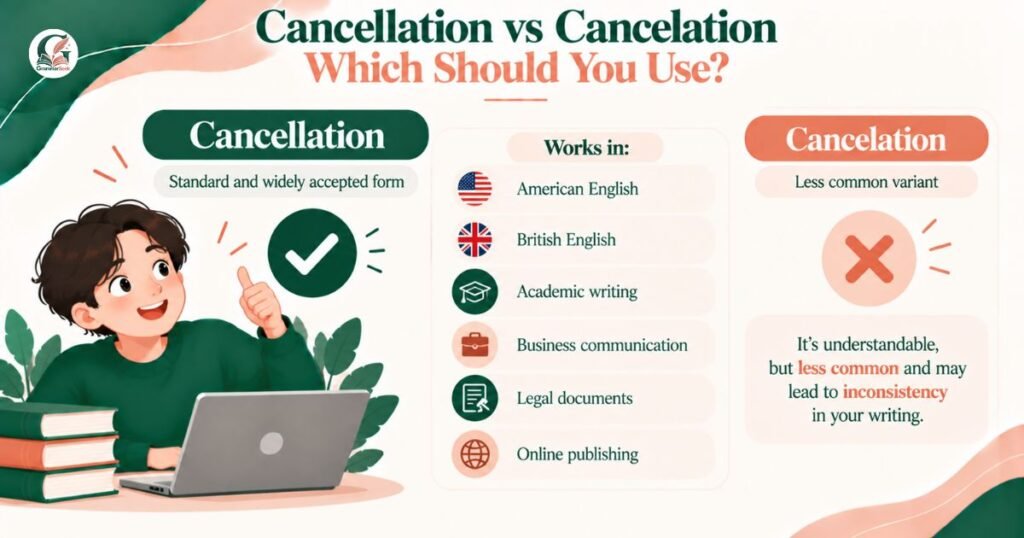
Cancellation works in:
- American English
- British English
- Academic writing
- Business communication
- Legal documents
- Online publishing
While “cancelation” is certainly acknowledged, it remains a less common variant and may lead to inconsistency in your writing.
Understanding spelling differences is just one part of improving your English skills. You can also learn how to use which of the following correctly in questions and explore the differences between a simile vs metaphor to strengthen your understanding of English grammar and figurative language.
Conclusion
Understanding the difference between cancellation and cancelation can enhance both your writing and communication skills. “Cancellation” is the preferred spelling in both American and British English, while “cancelation” is a less common variant that is still recognized in certain contexts, particularly in American English.
This distinction illustrates the nuances of language and how regional variations can lead to different preferences. Knowing which form to use can help you present yourself as a more polished and knowledgeable writer.
FAQs
Is Cancelation Wrong?
“Cancelation” is not wrong but it is a less common variant and is rarely used. “Cancellation” is the standard spelling and is widely accepted in both written and verbal communication.
Why Is Cancellation Spelled With Two Ls?
The spelling of “cancellation” with two Ls can be attributed to the rules of English phonetics and syllable structure. When forming nouns from verbs by adding the suffix “-ation,” the spelling of the base verb can influence the final form. In this case, the verb “cancel” ends with a single L. However, when the suffix “-ation” is added, the final consonant is typically doubled to maintain the integrity of the preceding vowel sound, resulting in “cancellation.”
Which Spelling Is More Common?
“Cancellation” is the more commonly used spelling in both American and British English.
Is Cancelation Used In American English?
Yes, “cancelation” is used in American English, though its usage is less common compared to “cancellation.” While both terms refer to the act of calling off or nullifying something, “cancellation” is the preferred spelling in most contexts and is widely recognized in American dictionaries.