

Vagrant vs Hobo: Meaning, Differences, and Complete Comparison
Choosing between vagrant and hobo can be tricky because the words describe different things. A hobo traditionally traveled to find work, while vagrant is a more formal, sometimes legal term for someone without a fixed home.
This guide explains the vagrant vs hobo distinction, their historical background, and how each word is used today, including the difference between hobo and vagrant and key hobo vs. vagrant differences.
Quick Answer – Vagrant vs. Hobo
- Vagrant is a formal or legal term for someone without a fixed home or regular work.
- Hobo is a historical American term for a traveling worker who moved from place to place seeking temporary jobs.
In short, vagrant or hobo comes down to the difference between a legal or formal status and a historical traveling-worker lifestyle.
What Is a Vagrant?
A vagrant is someone without a permanent home or stable employment. This is the basic vagrant meaning, while a vagrant definition may also include a person who moves from place to place without regular work or a settled home.
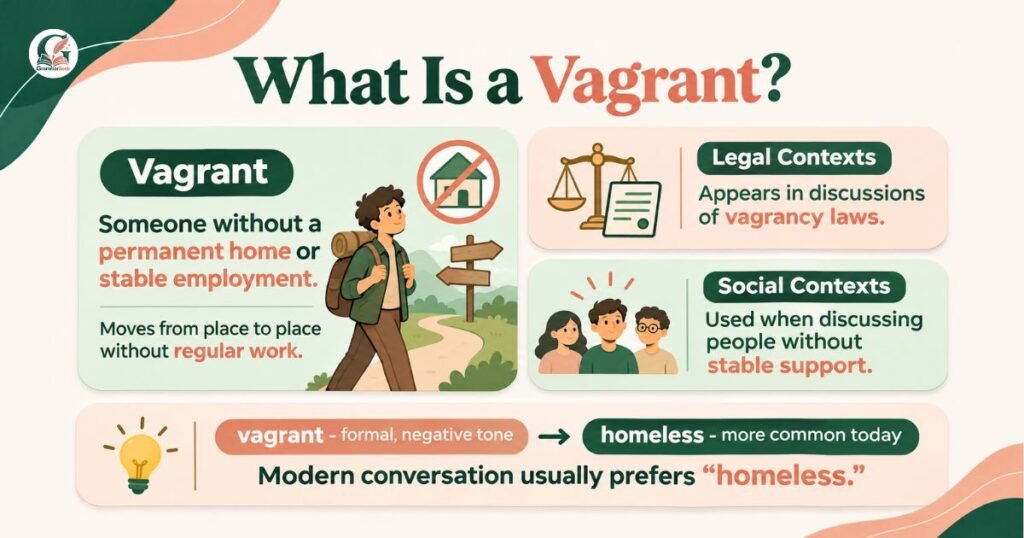
The word appears in legal and social contexts, especially in discussions of vagrancy laws. These laws have addressed people without homes or stable means of support.
Because vagrant can sound formal and carry a negative tone, homeless is more commonly used in modern conversation to describe someone who does not have a home.
What Is a Hobo?
A hobo was a person who traveled from place to place in search of temporary or seasonal work. In the United States, the term is linked to the late 1800s and early 1900s, when people often rode railroads to find jobs.
Hoboes were part of working-class life, where travel and resourcefulness could help people earn a living and get by.
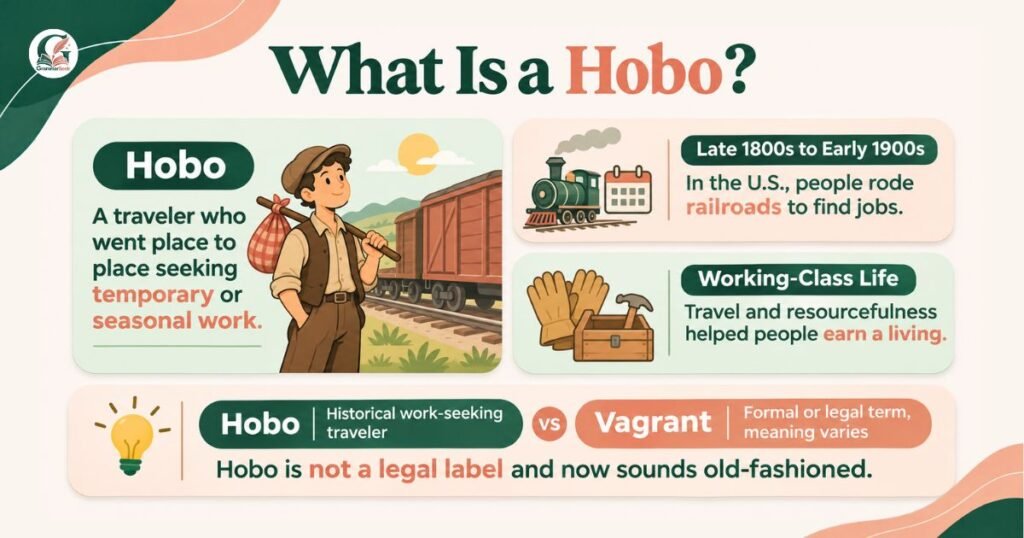
The hobo meaning is therefore more specific than simply describing someone without a home. The hobo and vagrant difference is that hobo refers to a historical work-seeking traveler, while vagrant has been used as a formal or legal term, with meanings that can vary.
Hobo is not a legal label and is now considered old-fashioned, though it remains useful in historical discussions.
If you are writing about people who travel, it is also useful to know the regional spelling difference between Traveler and Traveller.
Vagrant vs Hobo (Key Differences Explained)
The key difference between hobo and vagrant is about work and travel. A vagrant is a formal or sometimes legal term for someone without stable housing or employment; its meaning can vary by context and jurisdiction. A hobo traditionally meant a person who traveled while seeking temporary work.
In a vagrant and hobo comparison, the hobo’s travel was linked to finding jobs, while vagrant does not, by itself, explain why someone is moving or lacks stable housing.
Historically, hobo was used for traveling workers, while vagrant has appeared in formal and legal language. Today, hobo is mostly outdated, and vagrant may sound formal or carry legal meaning.
So if you are wondering, are hobo and vagrant the same? No. The hobo vs vagrant difference is meaningful, and the terms should not be used interchangeably.
Understanding the difference between a word’s literal meaning and its associated feelings can make word choice clearer. Learn more in our guide to Connotation vs Denotation.
Comparison Table: Vagrant vs Hobo
Use this vagrant vs. hobo comparison table to see the distinction at a glance.
| Feature | Vagrant | Hobo |
| Meaning | Someone without stable housing or employment | A traveling worker seeking temporary jobs |
| Usage | Formal, and sometimes legal | Informal and historically specific |
| Historical origin | A term used in social and legal settings | Linked to railroad-era America |
| Connotation | May sound judgmental or suggest legal trouble | Often associated with the era of mobile railroad workers |
| Modern usage | Still found in some formal or legal contexts | More common in historical or cultural references |
Historical Background You Should Know
Hobo culture developed in late 19th- and early 20th-century America, when railroad travel helped people move between regions for seasonal employment.
Some workers followed jobs as they became available; others faced economic hardship and had few choices about where to live. During the Great Depression, widespread hardship made the search for work and shelter especially difficult for many people.
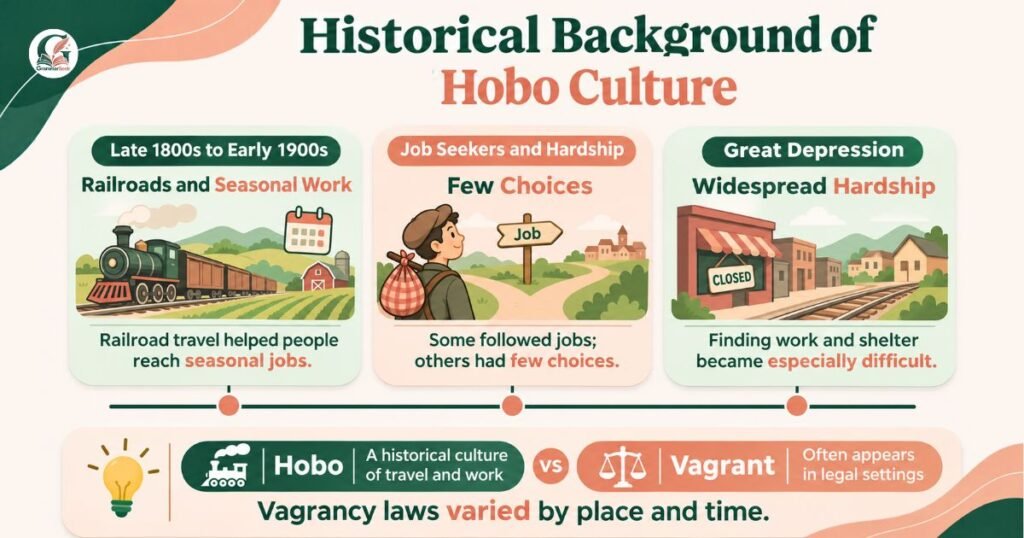
The vagrancy law meaning comes from older legal rules addressing people without stable housing or employment. In the United States, laws and their use varied by jurisdiction and time. This creates an important difference between hobo and vagrant: one term reflects a historical culture shaped by travel and work, while the other often appears in legal settings.
Knowing the hobo vs vagrant difference offers useful context for understanding how ideas about mobility, poverty, and public order have changed.
Modern Usage of Vagrant and Hobo Today
In modern English, vagrant may still be used in legal or formal settings to describe someone considered to be without a settled home. Outside those settings, it can sound outdated and may be taken as insulting. So, is vagrant offensive? It can be, depending on the context, particularly when used as a label for a person.
Hobo is mostly associated with historical American culture and people who traveled in search of work. The modern meaning of hobo is therefore not a neutral everyday term for someone without housing. Is hobo a slang word? Yes; it is informal and can carry dated associations. Homeless is generally preferred because it refers more plainly to a person’s housing situation.
A homeless person is not necessarily a migrant worker: migrant workers travel for employment, while homelessness concerns a lack of stable housing. Vagrant vs hobo meaning today depends on context: one may appear in formal language, and the other is mainly historical.
Vagrant vs Homeless vs Hobo (Common Confusion)
The vagrant vs. homeless vs. hobo comparison comes down to meaning, history, and usage. Although all three terms can relate to people without stable housing or those who move from place to place, they are not interchangeable.
Homeless describes someone without stable housing. Vagrant is a formal or sometimes legal term whose meaning depends on context. Hobo traditionally describes a historical traveling worker seeking temporary jobs, rather than simply anyone without a home.
| Feature | Homeless | Vagrant | Hobo |
| Meaning | Person without stable housing | Person described as lacking a settled home or regular means of support | Traditionally, a traveling worker seeking temporary jobs |
| Usage | Common modern English | Formal or sometimes legal | Informal and historical |
| Context | Housing status | Legal or social context | American working-class history |
| Connotation | Generally neutral and respectful | Can sound judgmental or outdated | Old-fashioned and culturally specific |
| Modern use | Commonly used today | Limited, depending on context | Mostly historical or cultural |
Takeaway: Use homeless for someone without stable housing, hobo when discussing historical traveling workers, and vagrant when referring to its specific formal or legal context.
English has many words that seem interchangeable but carry different meanings depending on context. Explore Trash vs Garbage to see another example of commonly confused terms.
Common Misconceptions About Hobo and Vagrant
Although people sometimes assume hobo and vagrant are the same, the terms are not exact synonyms. Historically, a hobo was a person who traveled, often in search of work. “Vagrant” has been used as a broader, formal description of a person without stable housing or employment and, in some contexts, as a legal term.

- A hobo is not simply another word for a homeless person. The historical term often emphasized travel and looking for work, not only a lack of a permanent home.
- A vagrant is not automatically a criminal. The vagrant definition can describe a person’s circumstances; it does not, on its own, say that the person has broken the law.
- Hobo is not a common neutral label today. It is dated and can be offensive when applied to people in modern conversation.
Learning to recognize differences between commonly confused language concepts can improve clarity in writing. You can also explore Simile vs Metaphor to understand how these two figures of speech differ.
Real-Life Examples of Hobo and Vagrant
For a clear vagrant vs hobo explanation for students, first ask whether the sentence describes a historical traveling worker or refers to a person without stable housing. Here are a few examples of Vagrant and Hobo.
- “The hobo rode from one town to another, looking for seasonal work.” This is a historical usage.
- “A hobo took a temporary job repairing fences before moving on.” The sentence connects travel with short-term employment.
- “The court record used the word ‘vagrant’ when describing an old vagrancy charge.” This reports formal wording without presenting it as a modern label.
- “The article describes services for people experiencing homelessness.” This is a more considerate way to discuss the issue today.
- “The character is called a vagrant in the story, a word that reflects the narrator’s view.” The term can carry judgment.
- “Students read about hobos who traveled in search of work during an earlier period.” This keeps the word in a historical context.
Together, these hobo and vagrant usage in sentences provide a practical hobo vs vagrant difference: use hobo for historical context and handle vagrant carefully. These differences between hobo and vagrant examples can help readers choose precise, respectful language.
Conclusion
The difference between vagrant and hobo comes down to history and context: vagrant is a broader formal or sometimes legal term, while hobo refers to a traveling worker seeking temporary jobs.
Both are less common today, and homeless is generally preferred in everyday English for someone without stable housing. When choosing a word, consider its meaning and use respectful, accurate language.
FAQs
What is the Difference between Vagrant and Hobo?
A vagrant is a broad term for someone without a settled home or regular means of support, and it has also been used in legal language. A hobo traditionally refers to a traveling worker who moves from place to place, often in search of work.
Is Hobo a Slang Word?
Hobo is an informal, historically rooted word, and it can sound dated. It is not simply another word for every person who lacks housing.
Is Vagrant a Legal Term?
It has been used as a legal term, but its meaning and application vary by jurisdiction and time. Check the relevant local law for a specific legal meaning.
Is Vagrant a Derogatory Term?
It can sound judgmental or stigmatizing, especially when used to label a person rather than describe a legal category. More neutral wording is usually preferable when discussing someone’s housing situation.
Why Can’t You Say “Hobo”?
There is no universal rule that the word cannot be used, but some people consider it disrespectful because it can reduce a person to a stereotype. Context matters, so use more specific and respectful language when referring to real people.
Are Hobos Homeless People?
Some people described as hobos may lack a stable home, but the terms are not identical. Historically, a hobo was associated with traveling for work, not just with housing status.
Is Jack Reacher a Vagrant or a Hobo?
Jack Reacher is best described as a drifter because he travels from place to place without a permanent home. Although he shares some characteristics with a vagrant or hobo, he is not a traditional hobo, since that term historically referred to someone who traveled while looking for work.
Why is Jack Reacher a Hobo?
Jack Reacher is sometimes called a hobo because he lives a nomadic lifestyle and travels without settling in one place. However, drifter is more accurate because he does not necessarily travel in search of temporary work, which was a defining feature of the traditional hobo lifestyle.
Which Term is More Offensive Hobo or Vagrant?
Neither word has the same effect in every context, but vagrant can sound especially stigmatizing, while hobo can sound dismissive or stereotyped. When referring to a person, describe the situation more specifically and respectfully.