
Trash vs Garbage: Meaning, Differences, and Real-Life Usage
When you’re deciding what belongs in the kitchen bin, understanding trash vs garbage can make the choice clearer. In American English, the terms are often interchangeable, but trash generally means dry waste, such as wrappers or paper, while garbage often refers to food scraps and other wet waste.
This guide explains the distinction between trash and garbage, and how people use both words in everyday conversation.
Quick Answer
The difference between trash and garbage is usually the type of waste. Trash generally means dry items, such as paper, plastic, and packaging. Garbage usually means wet waste, such as food scraps and kitchen leftovers. In American English, people often use the two terms interchangeably.
What Does Trash Mean?
Trash is the common American English word for unwanted, generally dry, non-food waste. It can include paper, cardboard, plastic bottles, wrappers, packaging, and broken objects. A used wrapper or a damaged mug, for example, may be called trash.
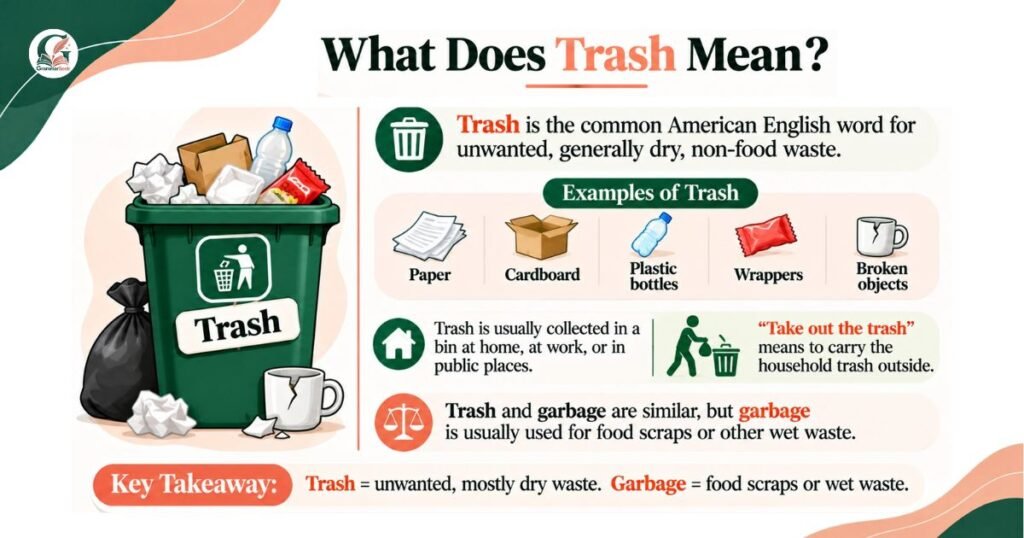
Trash is usually collected in a bin at home, at work, or in public places. The phrase “take out the trash” means to carry the household trash outside, usually to a larger bin.
The trash definition is close to the meaning of garbage, but garbage is used for food scraps or other wet waste. This is the basic garbage vs trash difference in everyday use.
Words can have related meanings while still carrying different associations depending on how they are used. Learn more about Connotation vs Denotation to understand the difference between a word’s literal meaning and its associated meaning.
What Does Garbage Mean?
Garbage is a common word for food-related waste in American homes. Its garbage meaning includes leftovers, vegetable peels, spoiled food, and other organic scraps. These items might go into a kitchen garbage can after a meal or while cooking.
You may hear someone say,
- Please throw the garbage away.
- It’s time to empty the garbage can.
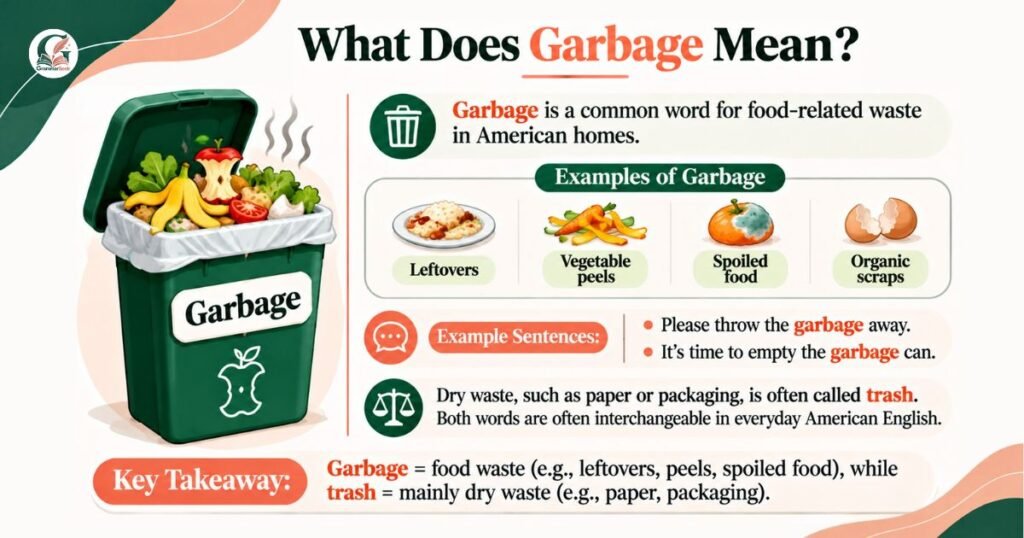
Dry waste, such as paper or packaging, is often called trash. This is a useful way to understand the trash or garbage difference, though the two words are often interchangeable in everyday American English.
Trash vs Garbage – Key Differences (Comparison Table Explanation)
In everyday use, trash often describes dry waste, while garbage often describes wet or food-related waste. A newspaper, plastic wrapper, or cardboard package is commonly called trash. Leftover food or vegetable peels are commonly called garbage.
This distinction can help explain the difference between garbage or trash, especially when discussing household waste.
Trash is generally cleaner and less likely to have a strong smell than food waste. Some dry items, including paper and certain plastics, may be recycled; food scraps are different from recyclable packaging. However, these words do not always mark separate categories.
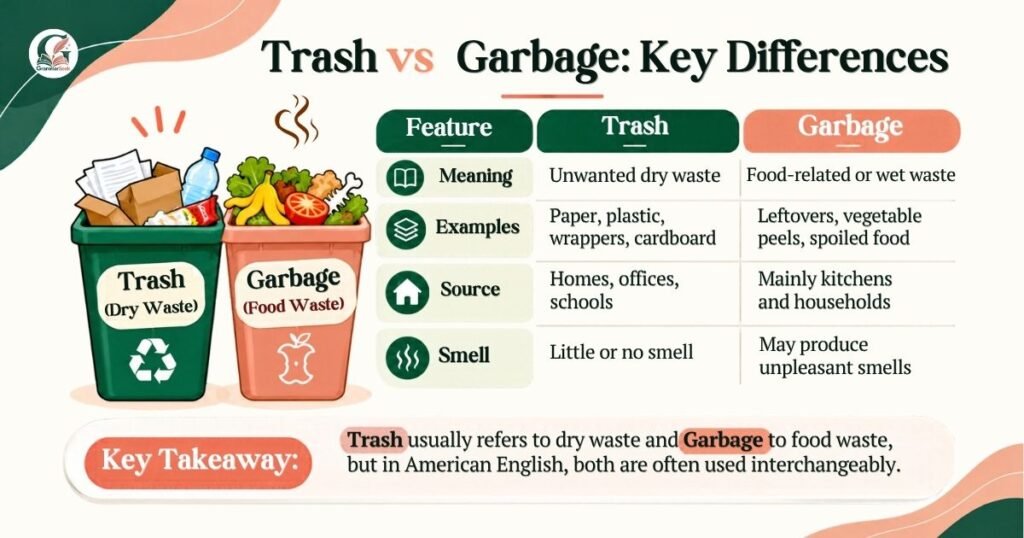
In modern American English usage, garbage and trash are often interchangeable, so a person might say “take out the trash” even when the bin contains food scraps. In many situations, the exact meaning depends on context.
| Feature | Trash | Garbage |
| Meaning | Unwanted dry waste | Food-related or wet waste |
| Common Examples | Paper, plastic, wrappers, cardboard | Leftovers, vegetable peels, spoiled food |
| Source | Homes, offices, schools | Mainly kitchens and households |
| Condition | Usually dry | Often wet or moist |
| Smell | Usually has little or no smell | May produce unpleasant smells |
| Recycling | Some items can be recycled | Some food waste can be composted |
| Common Expression | Take out the trash | Throw the garbage away |
| American English Usage | Often used for waste in general | Often used for waste in general |
Although trash generally refers to dry waste and garbage to food-related waste, Americans often use both words interchangeably in everyday conversation. The exact meaning usually depends on the context.
Are Trash and Garbage the Same?
Some people distinguish “trash” from “garbage” by the kind of waste: trash is traditionally dry, while garbage is often food-related or wet. This distinction can be useful, but it is not a strict rule in American English.
In everyday speech, the words are commonly used interchangeably. For example, a person might say “take out the trash” even if the bin holds kitchen waste. In most situations, either word sounds natural.
Trash vs. Garbage in American English vs British English
The word people use for household waste often depends on the variety of English they speak.
In the United States, “trash” and “garbage” are both common, and speakers sometimes use them interchangeably. A typical American expression is “take out the trash.”
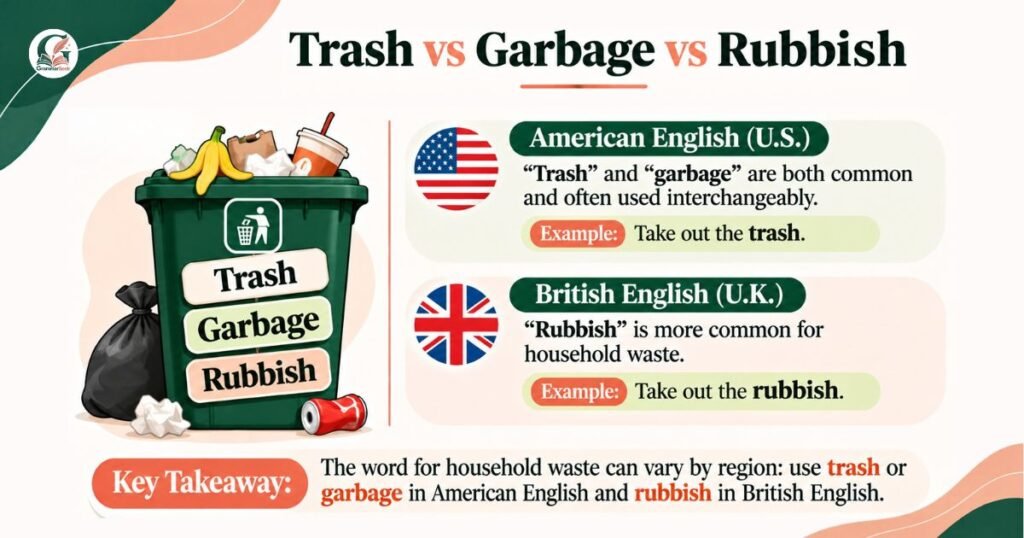
In the United Kingdom, “rubbish” is more common for household waste, as in “take out the rubbish.”
Knowing these regional differences helps English learners follow everyday speech and adapt their word choice when speaking with people from different English-speaking regions.
Regional differences can affect many everyday English words, not just terms for household waste. Explore Traveler or Traveller and cancellation vs cancelation to understand another spelling variation between American and British English.
Real-Life Examples of Trash and Garbage in Sentences
Use “trash” for dry household waste such as paper or empty packaging. Use “garbage” for food scraps and other kitchen waste in these examples.
- “Please put the junk mail in the trash.” Here, “trash” means dry paper waste.
- “I tossed the empty cereal box in the trash.” Here, “trash” means used packaging.
- “Please throw away the empty bottle with the trash.” “Trash” means household packaging in this sentence.
- “The banana peel goes in the garbage.” Here, “garbage” means a food scrap.
- “I put the leftover rice in the garbage.” Here, “garbage” means food waste from the kitchen.
In everyday conversation, people often use garbage and trash interchangeably. The garbage and trash examples show common patterns, but either word may sound natural depending on the speaker and situation.
Trash Can vs Garbage Bin – Are They Different?
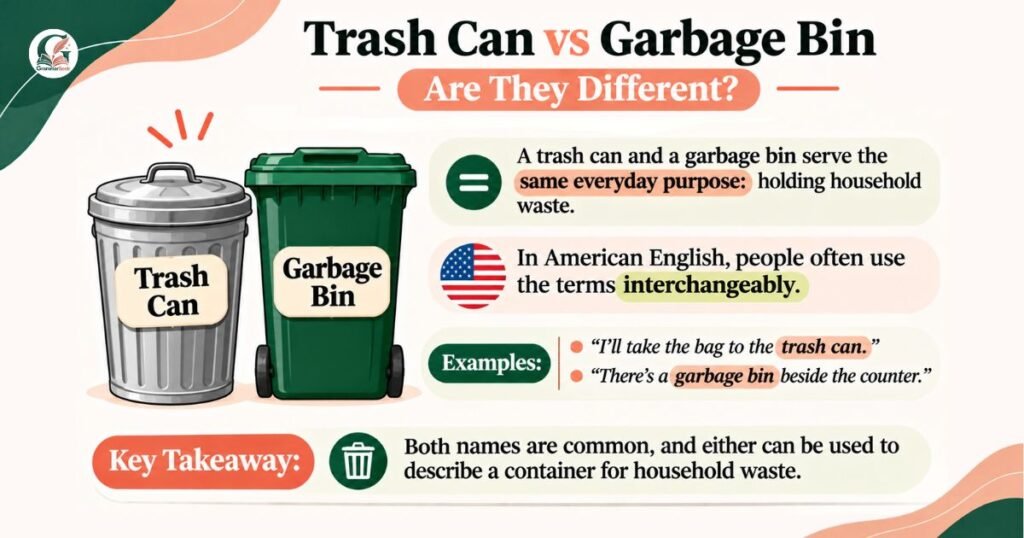
A trash can and a garbage bin serve the same everyday purpose: holding household waste. In American English, people often use the terms interchangeably, including for containers that hold mixed waste.
- “I’ll take the bag to the trash can.”
- “There’s a garbage bin beside the counter.”
Recognizing both names helps English learners understand common household conversations and describe familiar items at home.
What Happens After You Throw Trash or Garbage?
Waste management begins with waste collection. Trucks pick up household waste and take it to a facility where workers or machines sort it by type. Paper and some plastics may be separated for recycling. Food scraps can be sent for composting, where they break down into material that can be used to improve soil.
Waste that cannot be recycled or composted is usually sent to a landfill, a site designed to hold waste. Proper disposal helps keep waste from spreading into the surrounding environment and allows useful materials to be recovered. Sorting at home can help these steps work more smoothly.
Types of Household Waste
The four common household waste categories describe different ways to sort items.
- Dry waste includes paper, plastic packaging, glass, and metal. It is often called “trash,” although everyday English speakers may use “trash” for many kinds of waste.
- Wet waste includes food scraps, such as leftover vegetables and fruit peels. It is often called “garbage.”
- Recyclable waste includes materials such as paper, glass, and metal, as well as some plastic packaging accepted by local services.
- Non-recyclable waste includes items that cannot go into the available recycling system, such as used tissues or certain mixed-material packages.
A single item can fit more than one category: a metal can is dry waste and may also be recyclable. “Trash” and “garbage” are often interchangeable in everyday English, so context matters. Sorting household waste by material and local guidance supports proper recycling and waste disposal.
When asking about different types of waste, you may wonder whether to say “what kind” or “what kinds,” as explained in what kind of vs what kinds of.
Common Mistakes People Make When Using Trash or Garbage
A common mistake in American English is assuming that trash always means dry waste and garbage always means food waste.
In everyday conversation, the words are often interchangeable. People may use either one for things they are throwing away, so the difference is not a strict rule.
Context helps make the meaning clear. For example, “take out the trash” usually means carrying the household waste outside, which may include food scraps and other items.
When learning English vocabulary, focus on common usage and familiar phrases like this rather than trying to assign each word one fixed type of waste.
Context also plays an important role when choosing between words that express different relationships or meanings. Read And vs Or to understand how these two common conjunctions are used differently.
Conclusion
Garbage vs. Trash often comes down to context: trash usually means dry items like paper and packaging, while garbage often means food scraps and kitchen waste.
In everyday American English, people frequently use the words interchangeably. English learners can listen for context and notice how each word is used to make their speaking and writing sound natural.
FAQs About Trash vs Garbage
Are Trash And Garbage The Same?
They often mean the same thing in everyday American English. “Trash” can refer to dry waste, while “garbage” often refers to food-related waste. Still, people frequently use either word to describe household waste.
What Is The Main Difference Between Trash And Garbage?
The usual distinction is that trash often refers to dry waste, while garbage often refers to food-related waste. In everyday American English, though, these meanings overlap, and the words are frequently used interchangeably.
Is Garbage Only Food Waste?
No. Although “garbage” often refers to food-related waste, it can also be used more broadly. In everyday American English, people frequently use “garbage” and “trash” interchangeably rather than limiting garbage to food waste.
What Is Used In British English for Trash?
Rubbish is more commonly used for household waste in British English. American English more often uses “trash” or “garbage.” The latter two terms are also frequently interchangeable in everyday American conversation.
Can I Use Trash And Garbage Interchangeably?
Yes. Americans frequently use “trash” and “garbage” interchangeably in everyday speech. While “trash” often suggests dry waste and “garbage” often suggests food-related waste, those meanings are not always kept separate.
What Is The Difference Between A Trash Can And A Garbage Bin?
A trash can and a garbage bin are both containers used to hold household waste. In everyday English, the terms are generally interchangeable, and neither name necessarily refers to a specific type of waste.
Is Trash Or Garbage More Common In American English?
Both trash and garbage are common in American English. Their use can depend on the speaker, region, and context. For example, “take out the trash” is a very common everyday expression.