

Faring vs Fairing: Meaning, Differences, and Correct Usage
Choosing between faring or fairing can change the meaning of your sentence. These homophones sound alike but have different uses: faring describes how someone is doing or progressing, while a fairing is a protective structure used in vehicles and engineering.
This guide explains the faring meaning, the fairing meaning, and the difference between faring vs fairing, with tips for correct usage.
Quick Answer
“How are you faring?” is correct when asking about someone’s wellbeing or progress. Faring means getting along, coping, or progressing, so the question asks how a person is managing or doing.
In faring vs fairing, fairing refers to an aerodynamic protective covering on a vehicle. The correct spelling for a question about someone’s situation is faring.
Faring vs Fairing at a Glance
At first glance, faring and fairing look and sound almost identical, but they have completely different meanings and uses. Faring describes how someone is doing, coping, or progressing, while fairing refers to an aerodynamic structure designed to reduce air resistance on vehicles. The following table highlights their key differences.
| Feature | Faring | Fairing |
| Part of Speech | Verb (present participle of fare) | Noun |
| Meaning | Doing, coping, managing, or progressing | An aerodynamic covering or structure |
| Refers To | A person’s condition or the progress of a situation | A physical component of a vehicle |
| Common Usage | Everyday English | Engineering and transportation |
| Common Contexts | Wellbeing, performance, and progress | Motorcycles, aircraft, boats, and vehicles |
| Example Sentence | How are you faring after the move? | The motorcycle’s fairing reduces wind resistance. |
| Memory Trick | Faring = Doing | Fairing = Vehicle Part |
The easiest way to remember the difference between faring vs fairing is to consider the context. If you are talking about someone’s wellbeing, performance, or how a situation is developing, use faring.
For example, “How are sales faring this year?” asks about business progress.
On the other hand, use fairing when referring to a physical vehicle component designed to improve aerodynamics.
For example, “The aircraft’s fairing was damaged during maintenance.”
Remember this simple distinction:
- Faring = Doing, coping, or progressing
- Fairing = Aerodynamic vehicle part
This simple memory trick makes it easier to choose the correct spelling whenever you use these commonly confused words.
What Does Faring Mean?
Definition of Faring
Faring is a form of the verb fare, meaning to do, cope, manage, or progress. The faring meaning depends on the subject: it can describe a person’s wellbeing or condition, or the success, performance, or progress of a business, group, or project.
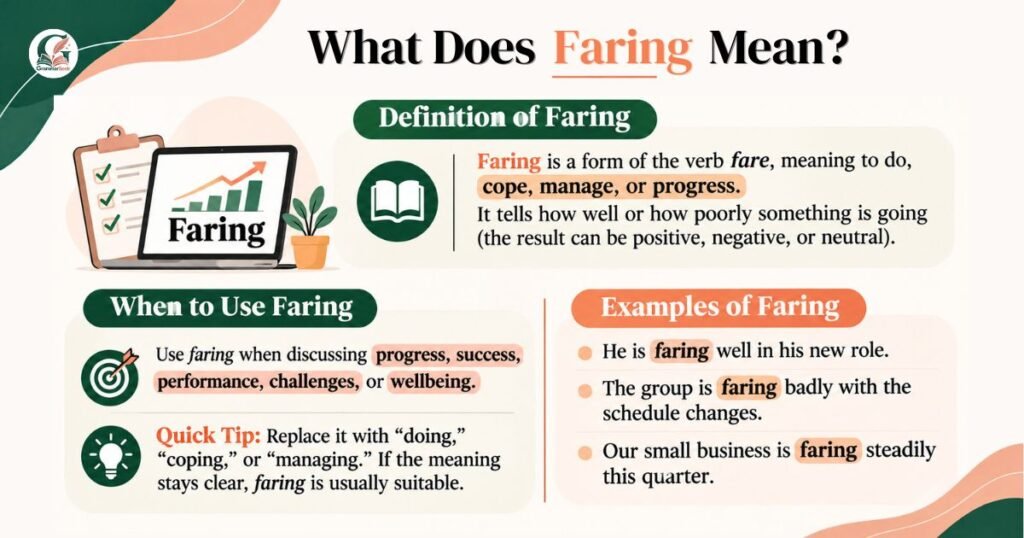
So, what does faring mean in a sentence? It tells how well or how poorly something is going. The definition of faring does not imply a positive result; the outcome can be positive, negative, or neutral.
When to Use Faring
Use faring when discussing progress, success, performance, challenges, personal wellbeing, or development. A simple tip for how to use faring: replace it with “doing,” “coping,” or “managing.” If the meaning stays clear, faring is usually suitable.
Examples of Faring:
- He is faring well in his new role.
- The group is faring badly with the schedule changes.
- Our small business is faring steadily this quarter.
- How are the students faring in the course?
- The renovation project is faring better than expected.
These examples of faring show that the word works for people and organized efforts alike.
What Does Fairing Mean?
Definition of Fairing – Fairing Meaning in Engineering and Transportation
The fairing meaning is a shaped, physical covering or structure that guides airflow around a vehicle or component. In this context, the definition of fairing is an aerodynamic structure designed to reduce drag, manage airflow, and support performance.
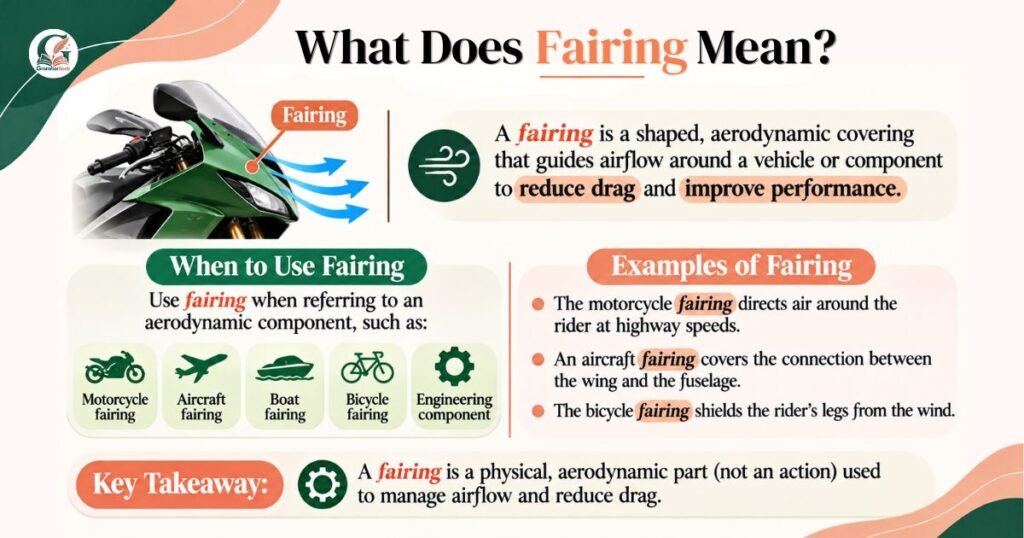
If you’re curious what fairing means, it refers to a part of a machine, not an action or a person’s progress. That distinguishes fairing from faring, which describes doing, coping, or progressing, as in “How are you faring?”
When to Use Fairing
Fairings are used in aviation, motorcycles, racing vehicles, boats, and bicycles. By guiding air around exposed parts, they can help improve speed, fuel efficiency, and aerodynamic efficiency. Their design and effect depend on the vehicle and its use; a fairing is not a guarantee of a particular performance result. Use fairing when discussing:
- Motorcycle fairings
- Aircraft fairings
- Boat fairings
- Bicycle fairings
- Aerodynamic structures
- Engineering components
Examples of Fairing in Sentences:
- The motorcycle fairing directs air around the rider at highway speeds.
- An aircraft fairing covers the connection between the wing and the fuselage.
- The racing car’s fairing helps manage airflow around its body.
- A boat designer added a fairing to smooth the shape near the hull.
- The bicycle fairing shields the rider’s legs from the wind.
How Are You Faring or Fairing?
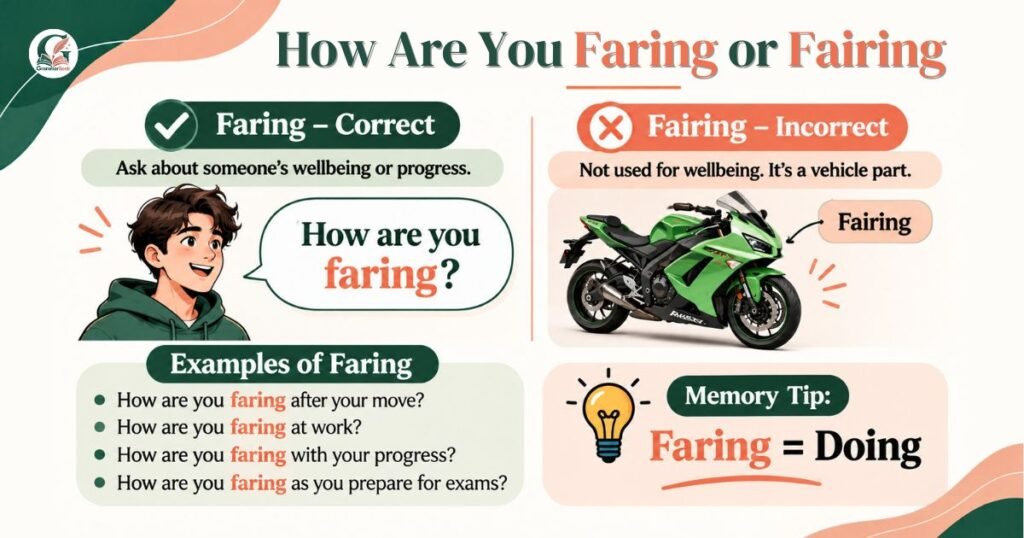
“How are you faring?” is correct when you ask about someone’s wellbeing, progress, or ability to cope. “How are you fairing?” is incorrect in this context.
The words sound alike, which is why they are easy to confuse. The faring meaning is about how someone is doing. By contrast, a fairing is an aerodynamic component on a vehicle.
Examples:
- How are you faring after your move?
- How are you faring at work with the new schedule?
- How are you faring as you adjust to life with a new baby?
- How are you faring with your progress on the project?
- How are you faring as you prepare for your exams?
For faring vs fairing, use this memory tip: Faring = Doing. If you are asking how someone is doing, write “How are you faring?”
Another traditional greeting you may hear is explained in top of the morning.
Faring vs. Fairing: Key Differences
The key differences between faring and fairing come down to meaning and use. The words sound alike, but “faring” describes how someone or something is doing, while “fairing” names a structure used in vehicles and engineering.
Meaning
“Faring” is the present participle of “fare.” The meaning of faring is doing, progressing, or coping. The meaning of fairing is an aerodynamic covering or structure.
Part of Speech
“Faring” is the present participle of the verb “fare”. “Fairing” is a noun. Knowing the part of speech helps you choose the correct usage.
Context
Use “faring” when describing progress or how someone is managing. Use “fairing” when referring to a physical covering or structure on a vehicle or in engineering.
Example
- “The new team is faring well in its first season.”
- “She is faring better after a few days of rest.”
- “The motorcycle’s fairing helps reduce wind resistance.”
- “Engineers inspected the aircraft fairing.”
Understanding this distinction helps writers choose the correct word.
Since “faring” is a form of the verb “fare,” you can see how another verb changes its forms in past tense of seek.
Examples of Faring in Sentences
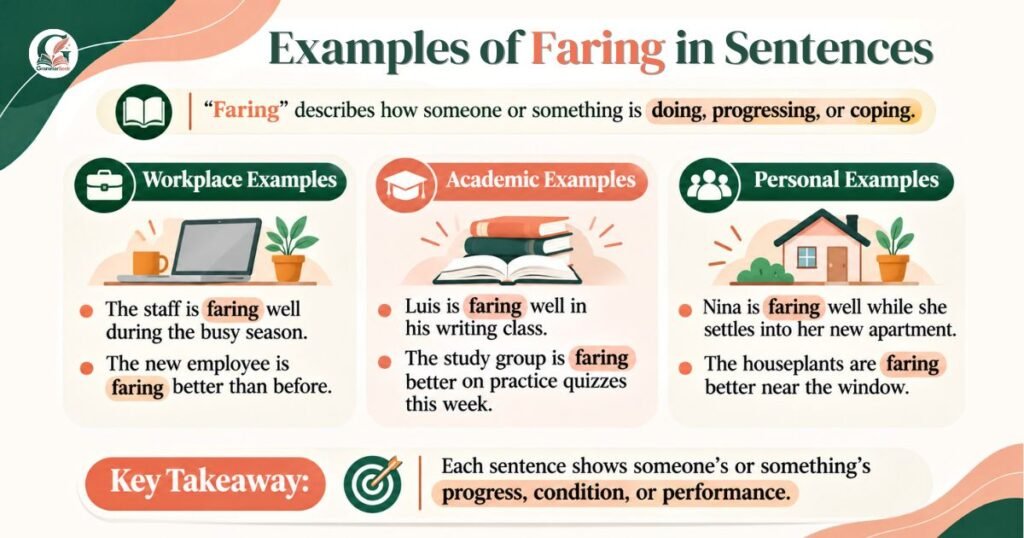
“Faring” describes how someone or something is doing, progressing, or coping. The examples of faring in sentences below show how to use faring, with its meaning clear from each situation.
Workplace Examples
- The staff is faring well during the busy season.
- With clearer instructions, the new employee is faring better than before.
- The department is faring well as it adjusts to the new process.
Academic Examples
- Luis is faring well in his writing class.
- The study group is faring better on practice quizzes this week.
Personal Examples
- Nina is faring well while she settles into her new apartment.
- The houseplants are faring better near the window.
- How is your family faring during the renovation?
Each sentence describes someone’s or something’s progress, condition, or performance.
Examples of Fairing in Sentences
Fairing is a noun for a physical covering or aerodynamic structure used in vehicles and engineering. For a quick guide to how to use fairing, see these examples of fairing in sentences.

Motorcycle Examples
- The motorcycle fairing shields the rider from wind while the bike is moving.
- A repair shop fitted a new motorcycle fairing after the original panel was damaged.
Aviation Examples
- The aircraft fairing smooths the airflow where two sections of the plane meet.
- A streamlined fairing around the landing gear can help reduce drag.
Engineering Examples
- The rocket’s fairing encloses and protects its payload during launch.
- A protective fairing covers the machinery’s exposed joint.
Fairing names a structure, not a person’s progress or condition.
Why Do People Confuse Faring and Fairing?
The main reason faring vs fairing can be confusing is that these homophones have the same pronunciation but different spellings and meanings. When people ask why do people confuse faring and fairing, the answer often comes down to sound, familiarity, and writing habits.
- Since the words sound alike, pronunciation does not help distinguish them.
- Their spelling patterns differ, but the distinction may be easy to overlook.
- “Faring” is used less often in everyday writing and may be less familiar.
- Spell-check may accept either word, even when the choice does not fit the sentence.
- Fast typing can cause an accidental substitution.
Many readers recognize “fairing” from vehicle and engineering contexts, while “faring” is less common in everyday writing. Check the context before choosing the correct spelling: use “faring” for progress, wellbeing, or coping, and “fairing” for an aerodynamic vehicle component.
Understanding why similar-sounding or similarly spelled words cause confusion can help you avoid other common spelling mistakes. Read our guide on Writing vs Writting and moment vs momment to learn which spelling is correct and why.
Is Fairing Ever Correct When Referring to People?
No. In standard English, “fairing” does not describe a person’s wellbeing, emotions, condition, or success. Use “faring” to ask how someone is doing or to describe the progress of a person, project, or situation. Although the words sound alike, they have different meanings and cannot be used interchangeably.
- Correct: “How are you faring today?”
Incorrect: “How are you fairing today?” - Correct: “She is faring better this week.”
Incorrect: “She is fairing better this week.” - Correct: “The plan is faring well.”
Incorrect: “The plan is fairing well.”
“Fairing” names a physical aerodynamic component used in engineering and transportation. For people and their progress, use “faring,” the word that fits the faring meaning in these examples.
Synonyms and Related Words
Synonyms for Faring
Use these faring synonyms to describe how a person or thing is doing or developing:
- coping
- managing
- progressing
- doing
- succeeding
- advancing
- thriving
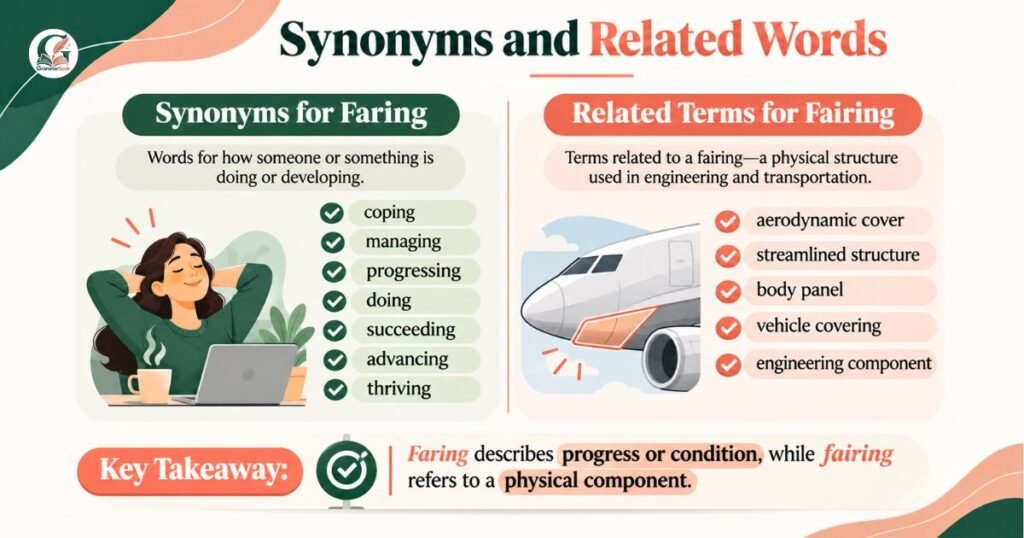
Related Terms for Fairing
Fairing related terms include:
- aerodynamic cover
- streamlined structure
- body panel
- vehicle covering
- engineering component
These terms are related, not exact synonyms: fairing refers to a physical structure used in engineering and transportation. Remember, faring describes progress or condition, while fairing refers to a physical component.
Memory Trick to Remember the Difference
Here is a quick memory trick to remember the difference between fairing and faring.
Faring = Fare = Doing
Think of “How are you doing?” The word faring can take the place of doing when asking about a person’s condition, progress, or wellbeing.
For example: “How are the students faring on the project?” This is how faring is used when describing someone’s progress or condition.
Fairing = Vehicle Part
Think of motorcycles, airplanes, and racing vehicles. A fairing is a physical vehicle part associated with aerodynamic design. When a sentence is about transportation or a vehicle component, fairing is the right choice. That is the fairing meaning.
To remember faring and fairing, connect faring with people doing and fairing with vehicles. This quick contrast makes the difference between faring and fairing easier to recall.
Common Mistakes to Avoid
The words faring and fairing sound alike, but they do not have the same use. A common source of mistakes with faring and fairing is choosing by sound instead of meaning:
- Incorrect: “How are you fairing after your promotion?”
Correct: “How are you faring after your promotion?”
Use faring because the question is about a person’s wellbeing. - Incorrect: “The aircraft faring reduced drag.”
Correct: “The aircraft fairing reduced drag.”
Use fairing because it names an aircraft component. - Incorrect: “Students are fairing well this semester.”
Correct: “Students are faring well this semester.”
Use faring because the sentence describes how students are doing.
Remember to use faring when discussing progress, performance, or wellbeing, and fairing when referring to an aerodynamic vehicle component. Checking the context before choosing the spelling will help you avoid these common mistakes.
Confusing words because of their spelling is a common writing problem. You can also learn how to avoid another frequent spelling mistake in our guide to Message vs Messege.
Fairing vs Faring vs Fare vs Fair
Faring vs. fairing vs fare vs fair can be tricky because the words look and sound alike. The difference between fare and fair is that fare refers to performance or a transportation price, whereas fair means just, impartial, reasonable, or acceptable.
Fare
Fare can mean to get along or perform, and it can also mean the price paid for transportation.
- How did the candidates fare in the debate?
- The train fare includes the seat reservation.
Fair
Fair means just or reasonable, and it can also describe an impartial decision or an acceptable arrangement.
- Everyone deserves a fair chance to speak.
- The mechanic offered a fair estimate for the repair.
Quick Comparison
| Word | Part of Speech | Meaning | Example Sentence |
| Fare | Verb / Noun | As a verb, it means to get along or perform. As a noun, it means the price paid for transportation. | How did you fare in the interview? / The bus fare was affordable. |
| Faring | Present participle of a verb | Describes how someone or something is doing, coping, or progressing. | The students are faring well this semester. |
| Fair | Adjective / Noun / Adverb | As an adjective, it means just, impartial, or reasonable. | The teacher made a fair decision. |
| Fairing | Noun | An aerodynamic covering or structure designed to manage airflow and reduce drag. | The motorcycle’s fairing reduces wind resistance. |
Use fare for performance or a transportation cost, fair for something just or reasonable, faring for the ongoing action of doing or progressing, and fairing for an aerodynamic physical structure. These distinctions make it easier to choose the correct word.
Choosing the right word also depends on understanding its exact meaning and how it is used in context. Explore Connotation vs Denotation to understand the difference between a word’s literal meaning and its associated meaning.
Pronunciation Guide
The fairing vs. faring pronunciation is the same for both words: FAIR-ing, with stress on the first syllable. Faring and fairing are homophones, so they have the same pronunciation but different spellings and meanings.
- Faring: FAIR-ing. Use it for someone’s wellbeing, performance, or progress.
- Fairing: FAIR-ing. Use it for an aerodynamic vehicle component.
Since pronunciation cannot distinguish these words, sentence context is the key to the difference between faring and fairing. Even native English speakers sometimes mix them up in writing. Read the entire sentence to determine which spelling fits.
Faring and fairing are not the only words that can cause confusion because of similar pronunciation. Check out Trailer or Trailor and Channel vs Chanel to learn how to distinguish other pairs of commonly confused words.
Conclusion
When deciding between faring vs fairing, focus on what you mean. The faring meaning relates to how a person or thing is doing, progressing, performing, or coping as in the familiar question, “How are you faring?” The fairing meaning is a physical, aerodynamic part fitted to a motorcycle, aircraft, boat, or another vehicle to manage airflow or reduce drag.
For correct usage, check whether your sentence describes progress or names a vehicle component. Understanding this distinction will help you choose the correct spelling confidently in everyday writing.
FAQs
Is It Fairing Or Faring?
Both are correct words, but they have different meanings. Use “faring” to describe how someone or something is doing, and “fairing” for a streamlined cover or structure; the right choice in faring vs fairing depends on context.
What Does Faring Mean?
“Faring” is the present participle of “fare,” meaning to get along, do, or progress. For example, “How are you faring?” asks how someone is doing.
What Does Fairing Mean?
A “fairing” is a structure or covering that reduces air resistance, manages airflow, and improves aerodynamic efficiency. The fairing meaning often comes up in discussions of vehicles, aircraft, and motorcycles.
Are Faring And Fairing Homophones?
Yes. “Faring” and “fairing” are homophones in standard US English: they sound alike but have different meanings and spellings.
Is “How Are You Fairing?” Grammatically Correct?
Not if you mean to ask how someone is doing. The correct phrase is “How are you faring?” because “faring” comes from the verb “fare.”
What Is A Motorcycle Fairing?
A motorcycle fairing is a body panel or cover fitted to a motorcycle, often around the front or sides. It helps reduce wind resistance, improve wind protection for the rider, and create a more streamlined shape.