Past Tense of Seek Made Easy With Clear Examples
If you’re unsure whether to write “seeked” or “sought,” the correct past tense of seek is “sought.” Seek is an irregular verb, so it does not take the usual “-ed” ending.
This guide explains the seek past tense, the past participle of seek, and the verb forms of seek (V1, V2, and V3), with examples and common mistakes to avoid.
Quick Answer
The past tense of seek is sought. Its three forms are seek (V1), sought (V2), and sought (V3). “Seeked” is incorrect in standard English.
Example: She sought help with her homework.
What Is the Past Tense of Seek?
The past tense of seek is sought, not seeked. Seek is an irregular verb, so it does not form its past tense by adding -ed, as regular verbs do. The same form, sought, is also the past participle of seek.
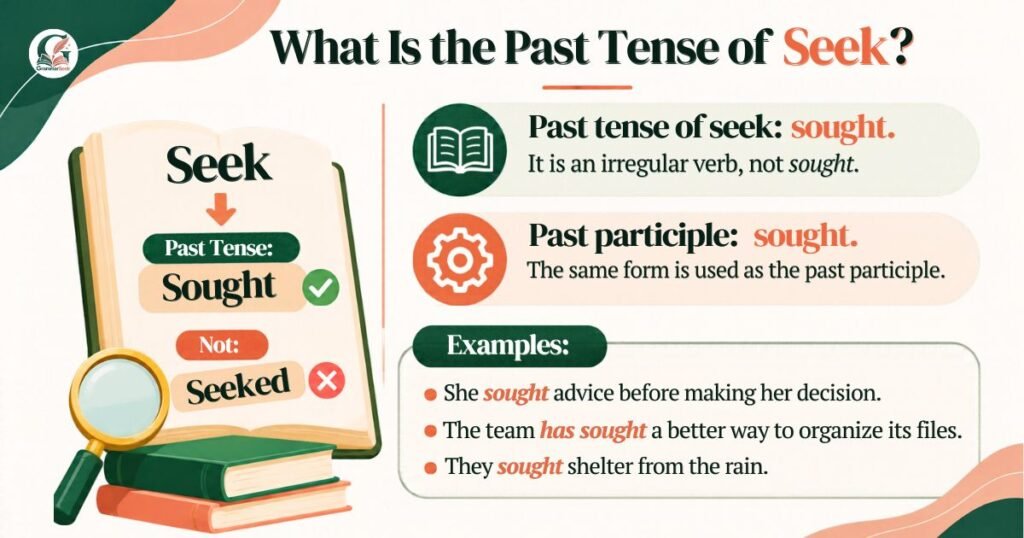
Use sought to describe a completed past action or with a helping verb such as have to form a perfect tense. For example:
- She sought advice before making her decision.
- The team has sought a better way to organize its files.
- They sought shelter from the rain.
Verb Forms of Seek (V1, V2, V3)
The verb forms of seek are simple: seek is the base form (V1), sought is the simple past tense (V2), and sought is the past participle (V3). The V2 and V3 forms are identical. This is the basic conjugation of seek.
- Present: I seek advice before making a decision.
- Simple past: She sought help yesterday.
- Present perfect: They have sought a quieter place to work.
Use sought for the seek past tense, and use the past participle of seek with helping verbs such as have.
Many English verbs have irregular past forms that need to be learned rather than formed by adding “-ed.” You can also explore the Past Tense of Run to see how another common verb changes in the past tense.
What Does “Seek” Mean?
The meaning of seek is to try to find or get something. You can seek practical things, such as help or advice, as well as information or answers. “Seek” is a little more formal than “look for,” so it often appears in writing and professional settings.
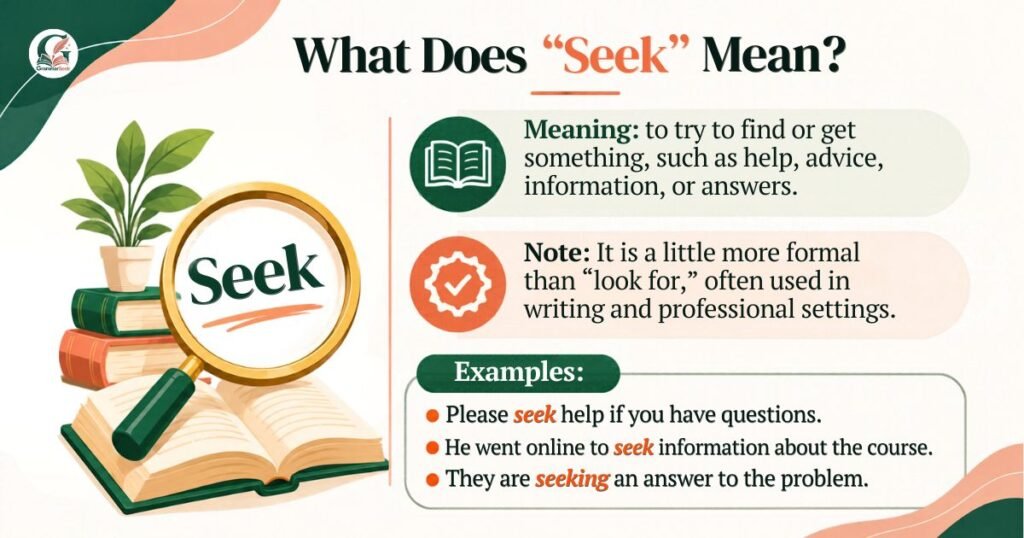
Examples:
- Please seek help if you have questions about the form.
- He went online to seek information about the course.
- They are seeking an answer to the problem.
How to Use “Sought” in Sentences
Sought means tried to find, obtain, or get something in the past. It is both the simple past form of seek and the past participle of seek. When considering how to use sought in a sentence, match the tense to when the search or effort happened.
Simple Past Examples:
- Jordan sought a new apartment near work.
- The family sought information about local schools.
- I sought a second opinion before making a decision.
- The hikers sought a safe route down the hill.
Perfect Tense Examples:
- The company has sought feedback from its customers.
- He had sought approval before starting the project.
Use has, have, or had before sought to form perfect tenses.
Seek vs Sought (Quick Comparison)
The main difference between seek and sought is the tense in which they are used. Seek is the base form, used for actions happening now or in general. Sought is the simple past form and the past participle, used for past actions and perfect tenses.
| Feature | Seek | Sought |
| Verb form | Base form (V1) | Past form (V2) |
| Usage | Present, habitual, or general actions | Past actions |
| Past participle | — | Sought (V3) |
| Example | I seek advice. | I sought advice. |
- I seek advice when I face a difficult choice. (A general action)
- I sought advice yesterday. (A past action)
- I have sought advice from my teacher. (A perfect tense)
These seek vs. sought examples show how the verb changes depending on the tense. Using the correct form helps you communicate clearly and avoid grammatical mistakes.
Is “Seeked” Correct or Wrong?
“Seeked” is not accepted as the standard form of the verb “seek.” The past tense of seek is “sought,” and “sought” is also its past participle. If you are asking “is seeked correct,” use “sought” in standard English.
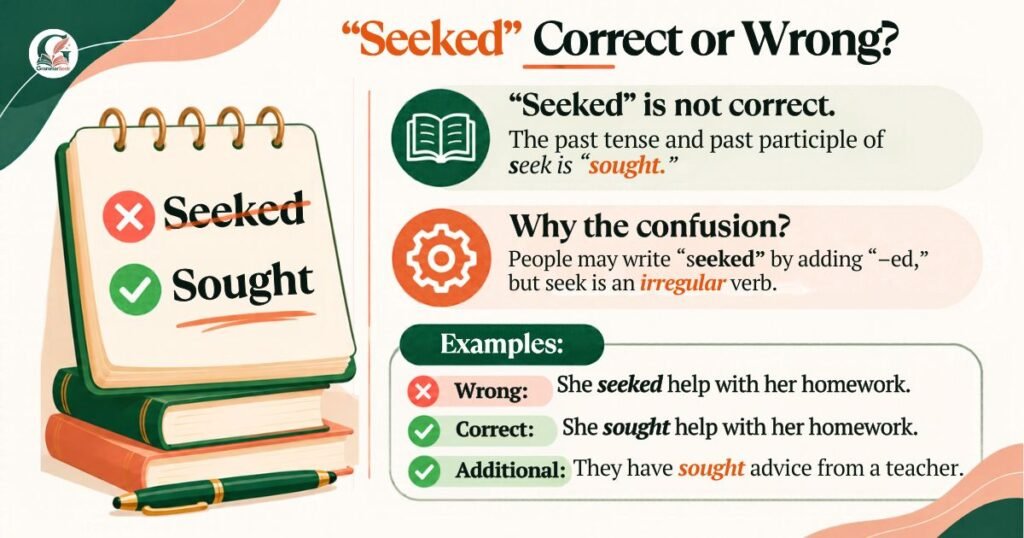
Learners may write “seeked” because they apply the regular rule of adding “-ed” to form the past tense. But “seek” is an irregular verb, so its form changes. When comparing seeked vs. sought, remember that sought is the correct form in standard English.
- Wrong: She seeked help with her homework.
- Correct: She sought help with her homework.
- Additional Example: They have sought advice from a teacher.
Applying the regular “-ed” rule to the wrong word is a common trap, as in targetted or targeted.
Why Does Seek Become “Sought”?
The seek past tense is sought because seek is an irregular verb. Regular verbs usually form the past by adding -ed, but irregular verbs do not follow that rule. So, “why does seek become sought?” Because ‘sought’ is the established irregular past form of ‘seek,’ so it must be learned rather than created by adding ‘-ed.’
Other common irregular verbs also change their vowel or spelling in the past tense:
- think → thought
- bring → brought
- teach → taught
Learning these forms helps you recognize that irregular verbs can follow different patterns.
Common Mistakes with Seek
When choosing between seek and sought, check when the action happens. Seek is used for present or general actions, as in “They seek answers.” Sought describes an action in the past.
A common mistake is adding -ed to make “seeked”; the correct past tense of seek is sought. Another is using seek with a past-time word such as yesterday.
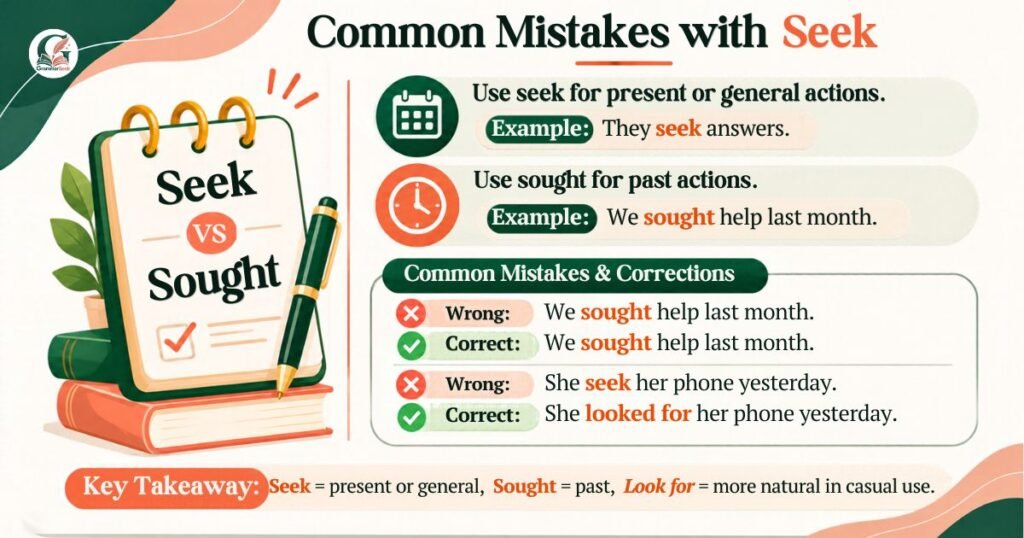
These common mistakes with seek are easy to spot by checking the time and the situation. In formal contexts, seek can work well; in casual conversation, look for often sounds more natural. Try these corrections:
- Wrong: “We seeked help last month.”
- Correct: “We sought help last month.”
Use sought for a completed past action.
- Wrong: “She seek her phone yesterday.”
- Correct: “She looked for her phone yesterday.”
Looked for is a natural choice for an everyday search.
Seek vs sought depends on whether you mean the present or the past, while look for can make informal speech sound more natural.
Adding an unnecessary letter is another common spelling mistake in English. For example, see Writing or Writting to learn which spelling is correct.
Past, Present, and Future of Seek
Understanding the conjugation of seek is simple once you know its tense patterns. In the present tense, use seek with I, you, we, and they, and seeks with he, she, or it. The seek past tense is sought, an irregular form. To talk about the future, use will + the base form seek.
Using the same subject and goal makes the differences clear:
- Present: Maya seeks advice from her teacher.
- Past: Maya sought advice from her teacher.
- Future: Maya will seek advice from her teacher.
These patterns show how seek in present tense, seek past tense, and seek in future tense change the timing of an action.
Quick Practice (Test Yourself)
Fill in each blank with the correct form of seek. Pay attention to the time clues to choose between seek and sought, including the past participle of seek.
- Last week, Jordan ___ a new doctor. (seek)
- My parents have ___ help with the garden. (seek)
- By noon, the hikers had ___ a safe trail. (seek)
- We often ___ information at the library. (seek)
- Before she called me, Rosa had ___ directions from a neighbor. (seek)
Answer Key:
- sought
- sought
- sought
- seek
- sought
Remember that sought is both the simple past tense and the past participle of seek. Use seek for present or habitual actions.
Final Summary (Quick Recap)
The past tense of seek follows the pattern seek → sought → sought. Seek is an irregular verb, and sought is both its simple past tense and past participle; “seeked” is not correct in standard English.
Use seek for present or general actions, and sought for past actions and perfect tenses. For a quick review of seek vs. sought, write a few everyday sentences using each form.
FAQs
Is Seek A Regular Or Irregular Verb?
Seek is an irregular verb because its past forms do not follow the usual pattern of adding “-ed.” Its simple past and past participle are both “sought,” not “seeked.”
What Is The Past Tense Of Seek?
The past tense of seek is sought. Use it for an action that happened in the past: “She sought advice from her teacher.” “Seeked” is not the standard past-tense form in modern English.
What Is The Past Participle Of Seek?
The past participle of seek is sought. It usually appears with a helping verb, such as “has” or “had”: “They have sought a quieter place to work.”
Is Seeked A Real Word?
“Seeked” is sometimes encountered, but it is not the standard form in modern English. For the past tense and past participle of seek, use sought: “He sought help.”
How To Use Sought In A Sentence?
Use “sought” as the past tense of seek, or with a helping verb as its past participle. For example: “The team sought a solution” or “The team has sought a solution.”
Is It Seeked Or Sought?
“Sought” is the standard choice. The phrase “seeked or sought” is resolved by using “sought” for both the simple past and past participle: “I sought an answer” and “I have sought an answer.”
What Does “Sought” Mean?
The meaning of “sought” is “looked for” or “tried to obtain”; it is the past form of “seek.” For example, “They sought shelter” means they looked for shelter.
What Are The Three Forms Of Seek?
The three forms of seek are seek, sought, and sought: the base form, simple past, and past participle. Example: “I seek answers,” “I sought answers,” and “I have sought answers.”