Top of the Morning: Meaning, Origin, Usage, and Examples
“Top of the Morning to You” may sound familiar from books and movies, but what does this Irish greeting mean in real life? It is a traditional way to say “good morning,” though it is less common in modern conversations.
Explore the Top of the Morning meaning, its connection to Irish culture, whether Irish people still use it, and how to respond with examples.
Quick Answer
The Top of the Morning meaning is “good morning” or, more literally, “the best part of the morning to you.” It is an old-fashioned Irish greeting with a cheerful, friendly tone.
The phrase is not common in everyday modern conversations. People sometimes use “Top of the Morning to You” humorously or to add Irish charm, rather than as a routine greeting.
What Does Top of the Morning Mean?
The phrase “Top of the Morning” is more than just another way to say “good morning.” It carries a warm and cheerful meaning, with the word “top” suggesting the best or finest part of the morning. Understanding its simple definition and figurative meaning makes it easier to see why this traditional greeting expresses such a positive wish.
Simple Definition
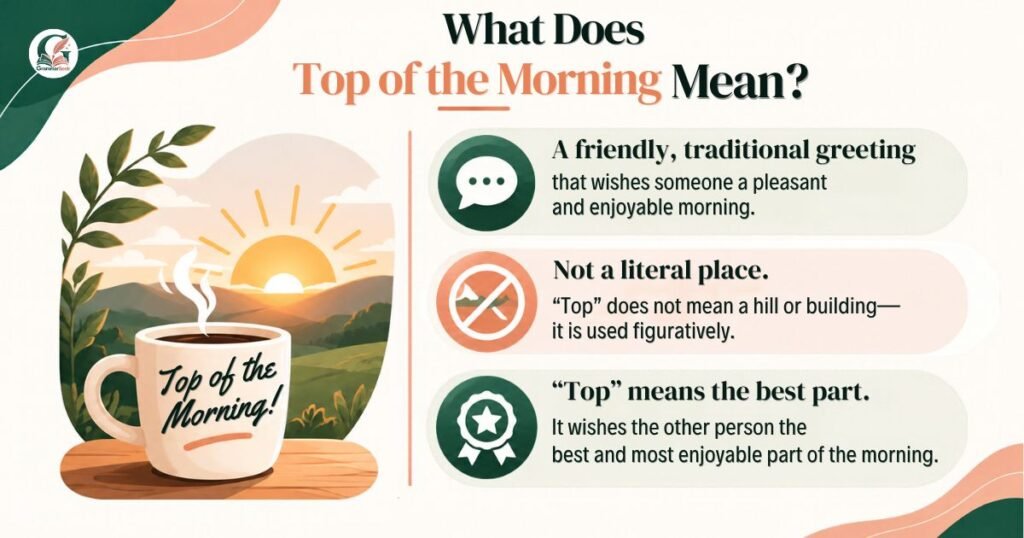
It is a friendly, traditional greeting used to wish someone a pleasant and enjoyable morning. It is similar to saying “good morning,” but it adds a warm wish for the day’s early hours.
If you are asking, “What does Top of the Morning mean?” The simple answer is that it is a cheerful way to greet someone and hope their morning goes well.
Literal Meaning of the Phrase
The phrase is not usually meant as a literal description of a place. “Top” does not refer to a hill, a building, or a particular spot. Instead, it is used figuratively to suggest something especially good.
The meaning of Top of the Morning is tied to the idea of wishing someone the most pleasant part of the morning.
Why “Top” Means “Best Part”
In everyday English, “top” can describe the highest quality or most desirable part of something. For example, someone might use “top” to mean “best.”
This sense gives the greeting its meaning: it wishes another person the best part of the morning, rather than simply noting that morning has arrived.
The meaning of an expression can also depend on the ideas and associations behind its words. Learn more about Connotation vs Denotation to understand how words can carry different shades of meaning.
What Does Top of the Morning to You Mean?
The expression “Top of the Morning to You” is the complete version of the shorter greeting “Top of the Morning.” It adds a direct personal touch by addressing the listener and expressing a warm wish for their morning. Although both versions share the same basic meaning, the longer phrase has a more traditional and familiar sound.
Full Phrase Explained
“Top of the Morning to You” is a friendly, polite greeting that offers someone a cheerful start to the day. The full expression means that you wish the person the best or most pleasant part of the morning.
Put simply, the Top of the Morning to You meaning is close to “good morning to you,” though it may feel a little more formal or playful. It is a way to show goodwill, not just to say hello.
Modern Interpretation
In modern use, the phrase is more familiar as a traditional, charming, or humorous greeting than as an everyday expression. People may recognize it from movies, books, and popular culture, even if they rarely hear it in ordinary conversation.
Its distinctive wording gives it a memorable quality, making it recognizable even among people who never use it themselves.
Origin and History of Top of the Morning
The history of this phrase has two parts: earlier English uses of similar wording and its later, strong association with Ireland. Keeping these parts separate helps explain the origin of Top of the Morning without treating its popular image as a complete account of its past.
Earliest Recorded Uses
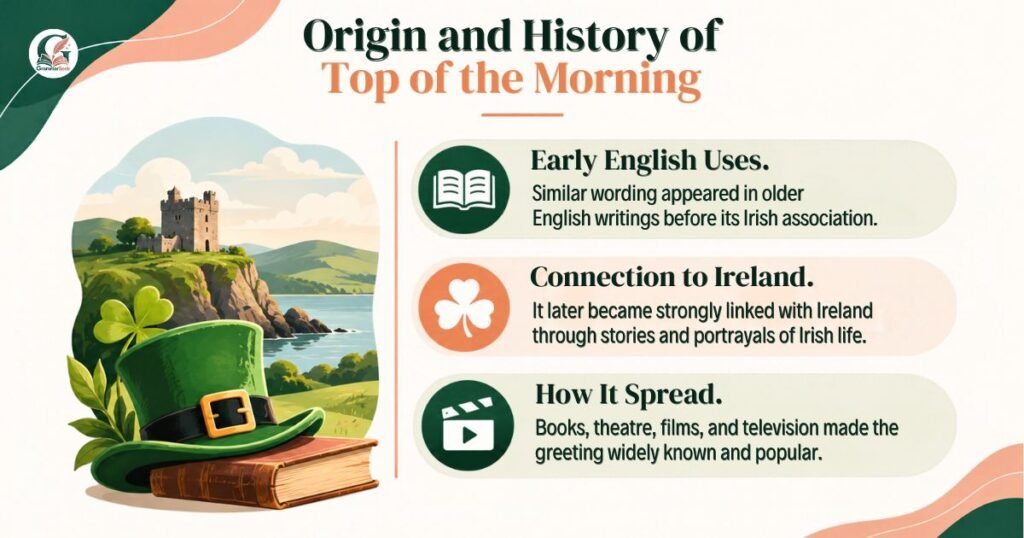
Similar forms of the expression appeared in older English writings before it became strongly associated with Ireland. Those literary examples show that the wording existed in English before it became closely associated with Irish identity.
They do not establish one exact moment when the phrase began, so it is more accurate to describe its early history as a gradual development in written English.
Connection to Ireland
Writers and storytellers increasingly placed the greeting in the speech of Irish characters. As it appeared in stories and portrayals of Irish life, the expression became tied to an idea of Irish voice and cultural identity.
This explains the popular belief in its Irish origin, while preserving an important distinction: its Irish association became powerful over time, but similar wording was already found in older English writing. Today, many people recognize it as a traditional Irish greeting.
How the Expression Spread
Books and theatre helped circulate the phrase, and films, television, and other popular entertainment brought it to international audiences. Each new portrayal made the greeting more familiar and strengthened its place in popular ideas about Irish speech.
These cultural uses help explain why the phrase remains recognizable, even though its history is more layered than its familiar Irish image may suggest.
Is Top of the Morning Really an Irish Saying?
Is Top of the Morning Irish? It is widely known as an Irish greeting and is strongly associated with Irish culture. But recognition and origin are not the same thing. The phrase’s reputation grew through popular portrayals, while its linguistic history points to a wider background.
Popular Belief vs Historical Reality
Many people refer to this phrase as an Irish saying. Yet similar wording also appeared in older English usage, so the expression is not exclusively Irish in origin.
The origin of this phrase should be considered separately from its familiar cultural image: its linguistic history is broader than the Irish identity it later acquired.
Why the Phrase Became Associated with Ireland
Writers and storytellers used the phrase in depictions of Irish characters, while theatre performers helped make those portrayals familiar to audiences.
Films and television later repeated the expression. This continued use linked it more closely with Irish identity and helped make it recognizable around the world.
Do Irish People Still Say Top of the Morning Today?
The phrase is known in modern Ireland, but knowing it and using it are not the same. It is more often associated with an old-fashioned image of Irish speech than with the way people typically communicate today.
Modern Usage in Ireland
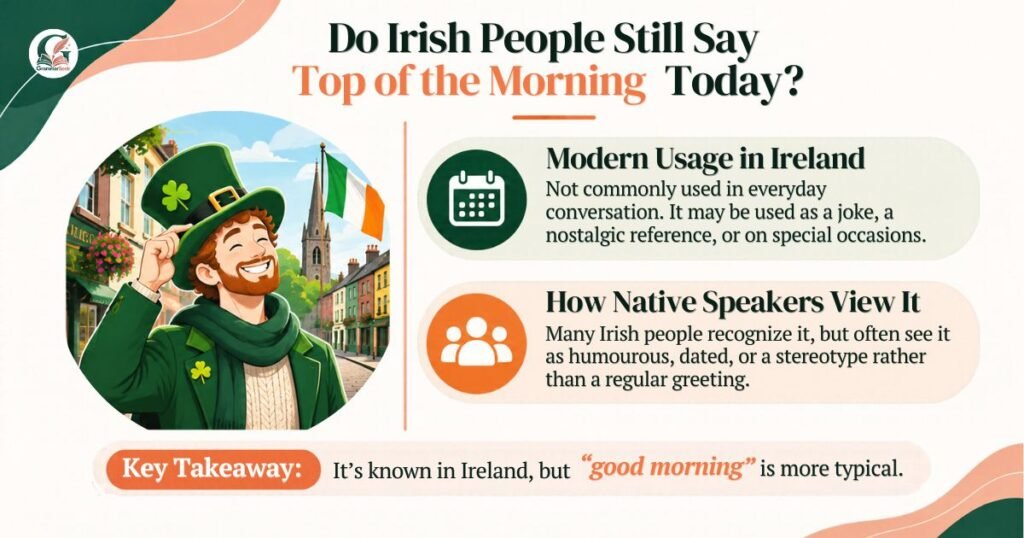
In everyday conversation, people generally choose “good morning” or another natural expression. “Top of the Morning” may still come up as a joke, a nostalgic reference, or part of a special occasion.
Some people might also use it with tourists who expect traditional Irish expressions, but it is not commonly used as an everyday greeting.
How Native Speakers View the Phrase
Many Irish people recognize the phrase and may find it humorous or dated. Some connect it with popular stereotypes of Irish speech, not with how they usually greet friends, colleagues, or strangers.
So while it remains recognizable, that does not mean it is a regular Irish greeting. A straightforward “good morning” is more typical.
How to Use Top of the Morning
To understand how to use this phrase, think of it as a cheerful phrase for a relaxed start to a conversation. It may sound old-fashioned to some people, so consider your audience and the setting. These examples show when it can feel natural and when it works best as a playful choice.
Casual Conversations
You can use the phrase with friends, family members, coworkers, or acquaintances in relaxed, informal conversations. It suits an informal moment, such as arriving at work or meeting someone in the morning.
For example: “Top of the morning, Sam! How was your weekend?”
Friendly Greetings
A Top of the Morning greeting can make someone feel warmly welcomed. Say it with a friendly tone when you want to begin the day on a cheerful note.
For example: “Top of the Morning to You, Elena! It’s good to see you.”
Humorous Situations
Because the expression can sound old-fashioned today, people sometimes use it in humorous situations to make a conversation more memorable.
For example: “Top of the morning, team, let’s get this meeting started.” Use it playfully, rather than assuming it is everyone’s usual greeting.
Examples of Top of the Morning in Sentences
Looking at Top of the Morning examples can help you understand how to use this traditional greeting in different situations. Whether you’re speaking with friends, greeting coworkers, or writing a story, the phrase can add a cheerful and welcoming tone.
Everyday Examples
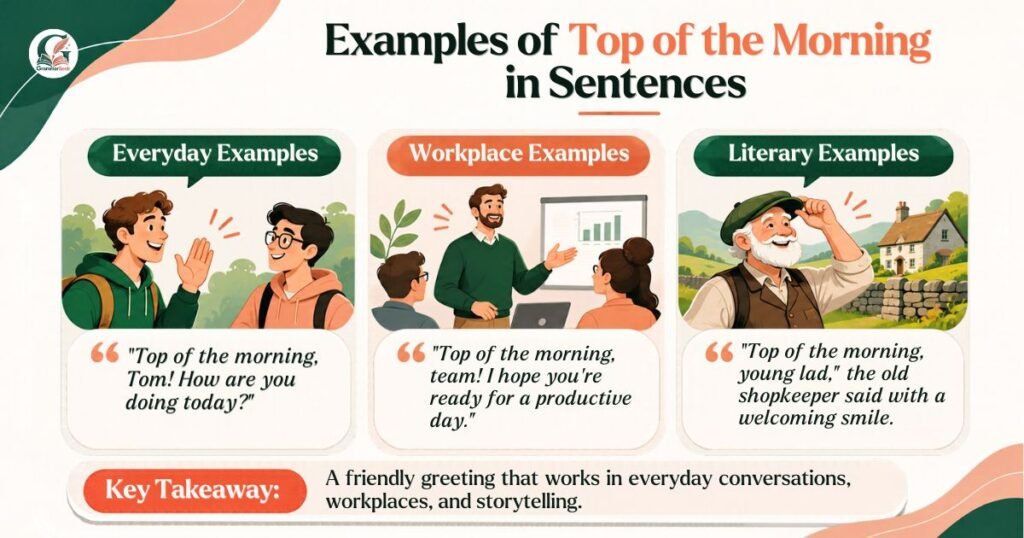
In everyday conversations, it can be used to greet friends, family members, or acquaintances in a warm and friendly way.
- “Top of the morning, Tom! How are you doing today?”
- “Top of the morning to you and your family. I hope you have a wonderful day.”
- “Top of the morning, everyone! It’s lovely to see you all.”
Workplace Examples
The expression can also be used in relaxed workplace settings, especially when addressing colleagues or starting a morning meeting.
- “Top of the morning, everyone. Let’s get started with today’s meeting.”
- “Top of the morning, team! I hope you’re ready for a productive day.”
- “Top of the morning, Sarah. How was your weekend?”
Literary Examples
In stories and creative writing, the phrase can help establish a character’s cheerful personality or create a traditional, old-fashioned atmosphere.
- “The cheerful farmer greeted the travelers with a hearty, ‘Top of the morning to you!’”
- “Top of the morning, young lad,” the old shopkeeper said with a welcoming smile.
These examples show how this expression works as a friendly greeting in everyday conversations, workplaces, and storytelling.
How to Respond to Top of the Morning
If you are wondering how to respond to Top of the Morning, keep it simple and match the speaker’s tone. A polite greeting works in most settings, while a warmer or playful reply can suit a more casual conversation. Choose words that feel natural to you.
Traditional Responses
Traditional responses return the greeting without adding much. Use:
- “And the top of the morning to you!”
- “Good morning to you as well.”
Both are polite ways to return the greeting in professional or everyday settings.
Friendly Replies
For a relaxed exchange, friendly replies can keep the conversation warm.
You could say,
- “Thanks! Hope you have a great day too.”
- “Morning! Nice to see you.”
These options sound casual and welcoming while giving the other person a little more than a simple greeting.
Funny Responses
Funny responses can work when the conversation is informal and the speaker is clearly joking.
Keep the humor light:
- “Only if coffee comes with it!”
- “I’ll gladly take the top of the morning.”
If you are unsure how the greeting is meant, a traditional response is a safe choice.
Choosing the right response can make a greeting feel more natural and polite. For another example of how wording affects a friendly exchange, see Thank You Both vs Thanks to Both of You.
Is Top of the Morning Formal or Informal?
It is usually an informal greeting, best suited to relaxed settings rather than official or highly professional ones. Its tone is cheerful and familiar, so the right choice depends on who you are speaking to and the setting.
Formal Contexts
In professional settings, it may sound too casual or playful. A standard formal greeting, such as “Good morning,” is more neutral, appropriate, and professional.
For example, use “Good morning, Ms. Lee” when opening a client meeting.
Informal Contexts
The phrase works better in casual conversations with friends, family members, and coworkers you know well. It has a cheerful, friendly, and slightly old-fashioned tone.
For example: “Top of the morning! How was your weekend?”
Situations to Avoid
Avoid it in highly formal business meetings, legal settings, serious professional discussions, or other interactions that require a strictly professional tone. In these situations, a conventional greeting is less likely to distract from the conversation and helps keep the tone appropriate.
Common Misconceptions About the Phrase
The common misconceptions about this phrase often come from taking the phrase too literally or assuming it reflects how people speak today. Its strong association with Irish culture makes it familiar to many readers, but familiarity does not mean it is a typical Irish greeting in everyday conversation.
It Is Not Commonly Used by Most Irish People
Although the expression is widely recognized, it is not a common modern greeting in Ireland. That does not mean no Irish people use it; rather, it is not a phrase most people should expect to hear regularly in everyday conversation.
It Does Not Literally Mean “Top”
The meaning of this phrase is not about a place or an object’s upper part. Here, “top” has a figurative meaning, suggesting the best or most pleasant part of the morning. The expression is used as a cheerful greeting, wishing someone a pleasant start to the day.
Another expression whose meaning goes beyond its literal words is explained in count your days.
Similar Morning Greetings
The best morning greeting depends on your setting and the tone you want. These similar morning greetings include a neutral option, casual morning expressions, and friendly ways to say good morning as someone starts the day.
Good Morning
“Good morning” is the most common and widely accepted morning greeting. It is neutral and suitable for both formal and informal situations.
Morning!
“Morning!” is a shorter, more casual version of “Good morning.” It is commonly heard in relaxed, everyday conversations.
Rise and Shine
“Rise and shine” encourages someone to wake up, get out of bed, or begin the day with energy. It has a playful, positive tone.
Have a Great Day
“Have a great day” expresses a wish for someone to enjoy a positive day. It is commonly used when wishing someone well before they leave or begin their day. Together, these alternative greetings make it easy to match your words to the moment.
English has many expressions for greeting people or wishing them well. You can also explore How Long Is Soon? to learn how another everyday expression communicates an idea related to time.
Top of the Morning vs Good Morning
When choosing between these two phrases, consider the setting and the impression you want to make. The difference between Top of the Morning and Good Morning is not whether either one is understood, but how familiar and natural it sounds in everyday conversation. Each has a distinct tone.
Key Differences
“Good Morning” is a neutral, modern greeting that suits formal and informal situations alike. “Top of the Morning” sounds more traditional, cheerful, and playful. It is a distinctive choice, though less common in everyday speech than the simpler greeting.
Which Sounds More Natural Today?
Most people would normally choose “Good Morning” for modern everyday communication. “Top of the Morning” is more likely to appear in humorous exchanges, cultural references, nostalgic settings, or playful situations. Both expressions are understandable; the difference is their tone and how often they are used.
Why the Phrase Remains Popular in Pop Culture
Top of the Morning in pop culture remains recognizable because it carries a clear, cheerful tone and an established link to Irish identity. Its appearance across familiar forms of entertainment and online humor keeps the phrase in circulation, even for people who rarely hear it in everyday conversation.
Movies and Television
In movies and television, writers may use the phrase to suggest an Irish setting or character, or to give someone a cheerful, traditional, or humorous manner. Repeated appearances help audiences recognize it as an expression commonly associated with Irish culture.
Internet Memes
Internet memes, social media posts, and online jokes often use the phrase for its old-fashioned sound and playful tone. Its nostalgic appeal makes it easy to adapt, while online sharing introduces the expression to newer audiences.
Irish Stereotypes
The phrase’s strong association with popular Irish stereotypes helps maintain its place in popular culture. This familiar image can be useful shorthand in entertainment, but it does not necessarily reflect how Irish people speak in everyday life.
Conclusion
The meaning of Top of the Morning is a warm, cheerful morning greeting. The phrase, often said as “Top of the Morning to You,” has a historical association with Irish culture. In present-day English, it is more likely to sound playful, nostalgic, or humorous than like an ordinary daily hello.
Consider your audience before using it, since its old-fashioned tone may stand out. A simple “good morning” suits most routine exchanges. It endures as a memorable expression that preserves a little of the English language’s history in modern conversation.
FAQs
Is Top Of The Morning Old-Fashioned?
Yes. It is an old-fashioned greeting with a cheerful tone. In modern conversation, it often sounds humorous, playful, or nostalgic, rather than like a standard everyday way to say good morning.
Is Top Of The Morning An Idiom?
It is best described as a greeting phrase or set expression rather than a strict idiom. It has a familiar, fixed form and is used to offer someone a cheerful morning greeting.
Do Irish People Really Use This Phrase?
Not commonly. Although the phrase is strongly associated with Irish culture, it is not a greeting commonly used by Irish people in everyday conversation today.
Is Top Of The Morning Still Commonly Used Today?
It is still recognized, but it is not commonly used as a regular daily greeting. People may say this phrase for humor, playfulness, or a nostalgic effect.
What Does Top Of The Morning To You Mean?
It means “Good morning” and serves as a cheerful greeting. It is an old-fashioned expression strongly associated with Irish culture, though it is often used playfully today.