Antithesis vs Juxtaposition Key Differences Explained
Understanding the nuances of contrast in writing is essential for effective communication, particularly when differentiating between antithesis and juxtaposition.
Antithesis presents opposing ideas in a balanced structure, while juxtaposition places contrasting elements side by side to highlight their differences. Knowing how to utilize these techniques can enhance your writing and enrich your readers’ experience.
This guide will clarify antithesis vs juxtaposition, the key differences between antithesis and juxtaposition and provide you practical insights for applying these powerful rhetorical tools.
Quick Answer: Antithesis vs Juxtaposition
Antithesis and juxtaposition are both literary techniques used to create contrast, but they work differently. Antithesis presents opposing ideas in a balanced or parallel structure, while juxtaposition places contrasting ideas, characters, images, or elements side by side. In simple terms, antithesis is a specific rhetorical device, whereas juxtaposition is a broader literary technique.
Antithesis vs Juxtaposition – Quick Side-by-Side Comparison Table
Antithesis and juxtaposition serve as powerful tools for creating contrast, yet they operate differently within a narrative.
The key difference between antithesis and juxtaposition lies in their structure. Antithesis employs balanced or parallel opposing ideas, creating a rhythmic tension that emphasizes the dichotomy. Juxtaposition simply places contrasting elements side by side, allowing them to speak for themselves without a rigid format.
Here is a quick comparison table to understand the difference between Antithesis and Juxtaposition.
| Feature | Antithesis | Juxtaposition |
| Definition | A rhetorical device that presents opposing ideas in a balanced or parallel structure | A literary technique that places contrasting elements side by side |
| Structure | Usually follows a balanced or parallel structure | Has no fixed structural pattern |
| Purpose | Emphasizes opposing ideas through clear, structured contrast | Highlights differences by placing contrasting elements together |
| Scope | Usually focuses on opposing ideas or concepts | Can involve ideas, characters, images, objects, or situations |
| Placement | Often appears within the same sentence or phrase | Can occur across sentences, paragraphs, or scenes |
| Example | “Speech is silver, but silence is golden.” | A wealthy character living beside a poor family |
| Main Focus | Contrast through balanced language | Contrast through side-by-side placement |
Key Differences at a Glance
The key differences between antithesis and juxtaposition primarily lie in their structure, scope, and usage. Antithesis employs balanced or parallel opposing ideas, such as in the famous phrase:
“It was the best of times, it was the worst of times.”
This specific structure creates a rhythmic tension that emphasizes the conflicting concepts within a single statement, making it highly effective for persuasion and dramatic impact.
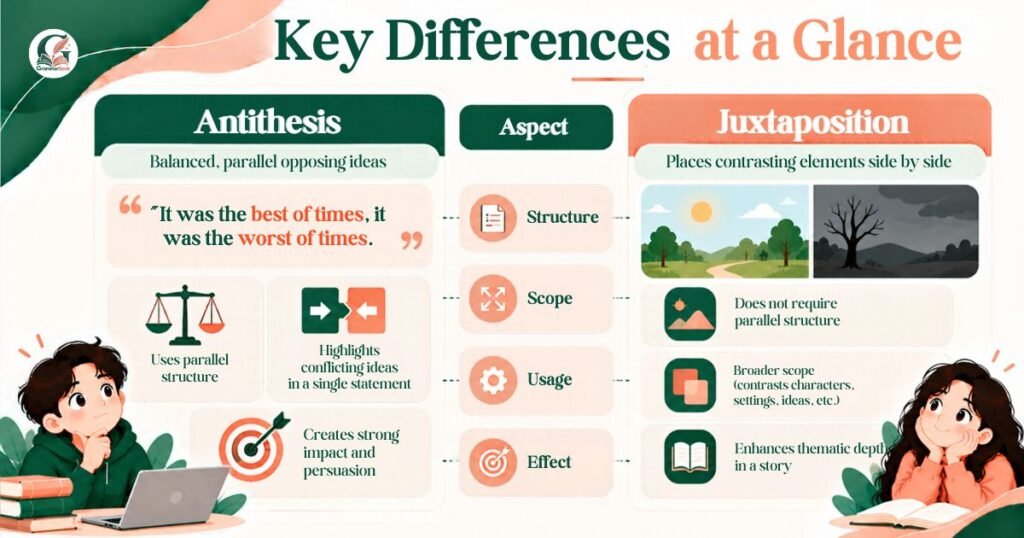
Juxtaposition in literature moves beyond a tight framework to broadly place contrasting elements alongside each other without the necessity of parallelism.
This technique can encompass a wider scope, showing stark differences between characters, settings, or ideas across different contexts, enhancing thematic depth.
While antithesis can be viewed as a particular, structured form of contrast, juxtaposition allows for a more expansive exploration of relationships and oppositions in storytelling.
By understanding these key differences between antithesis and juxtaposition, writers can better utilize these tools to enrich their narratives and engage readers on multiple levels.
What Is Antithesis?
Antithesis is a rhetorical device that presents opposing ideas within a balanced or parallel structure. This structured contrast highlights differences between two distinct concepts, making the message clearer and more emphatic.
Antithesis is commonly used in:
- Literature
- Speeches
- Persuasive Writing
to strengthen an argument or make an idea more memorable.
For example, “It was the best of times, it was the worst of times” contrasts two opposite experiences within a balanced structure.
Another example is “To err is human; to forgive, divine.” Here, the contrast between human fallibility and forgiveness emphasizes the difference between two ideas in a captivating way.
Purpose of Antithesis in Writing
The purpose of antithesis in writing is to create a strong contrast between opposing ideas, making key points clearer, more memorable, and persuasive.
By presenting balanced opposing ideas, antithesis can sharpen arguments, emphasize important concepts, and improve the rhythm of writing. This contrast helps readers understand complex ideas more easily and keeps them engaged.
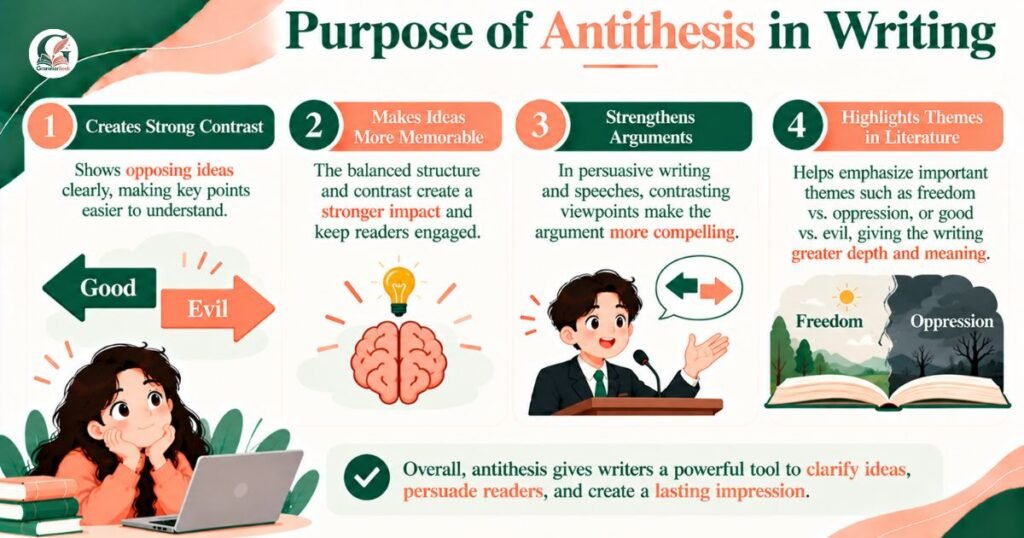
Antithesis is also useful for strengthening arguments and highlighting themes. In persuasive writing and speeches, contrasting viewpoints can make an argument more compelling, while antithesis in literature can emphasize themes such as good versus evil or freedom versus oppression. By placing opposing ideas in a structured contrast, writers can give their central messages greater clarity, impact, and thematic depth.
Famous Examples of Antithesis in Literature
Many famous writers have used antithesis in literature to create strong contrasts and make their ideas more memorable.
Here are some well-known antithesis examples:
1. Charles Dickens – A Tale of Two Cities
- “It was the best of times, it was the worst of times.”
Dickens contrasts best with worst in a balanced structure, emphasizing the conflicting experiences and conditions of the era.
2. “Speech Is Silver, but Silence Is Golden”
This proverb contrasts speech with silence, suggesting that remaining silent can sometimes be more valuable than speaking. Its parallel structure makes the contrast clear and memorable.
3. William Shakespeare – Hamlet
- “To be, or not to be, that is the question.”
This famous line presents the opposing ideas of existence and non-existence, reflecting Hamlet’s internal conflict and uncertainty about life.
These examples of antithesis in literature show how contrasting ideas can add emphasis, rhythm, and depth to writing.
Many antithesis examples rely on small connecting words such as “but” and “or,” and you can see how “and” and “or” differ in and vs or.
Definition of Juxtaposition
The definition of juxtaposition refers to a literary technique that places different or contrasting elements side by side to highlight their differences. These elements can include ideas, characters, images, settings, or situations. Unlike antithesis, juxtaposition does not require a balanced or parallel sentence structure; the contrast comes from placing the elements close together.
For example, a writer might describe a wealthy neighborhood beside a poor area to emphasize the difference between the two communities. This simple contrast helps readers notice social differences and understand the writer’s message more clearly.
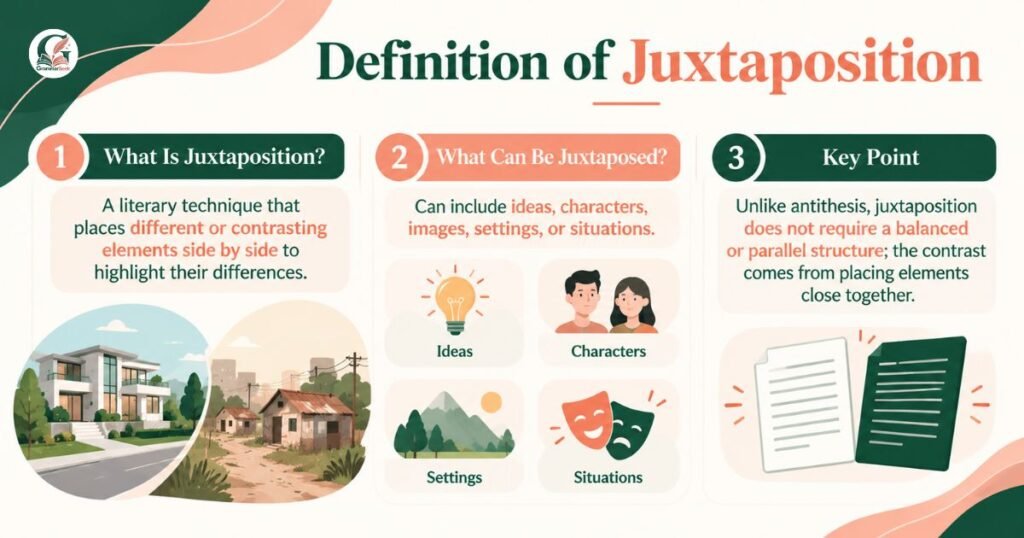
Juxtaposition examples can reveal conflicting emotions, social differences, and opposing themes. As a literary device, juxtaposition adds depth to writing by encouraging readers to compare different elements and consider their relationship.
Purpose of Juxtaposition in Writing
The purpose of juxtaposition in writing lies in its ability to highlight contrasts that reveal deeper meanings within the narrative. By placing opposing ideas, characters, images, or situations side by side, writers can create emphasis and draw attention to specific themes or conflicts.
This technique often amplifies irony and emotional tension, transforming the reader’s experience and encouraging them to engage critically with the material.
For example, in Shakespeare’s Romeo and Juliet, the vibrant love between the titular characters is juxtaposed against the dark feud of their families, enhancing the tragedy of their situation.
Juxtaposition in literature not only enriches character development but also heightens the stakes of the narrative. It invites readers to consider the complexity of human experiences through the lens of contrast. This technique is not limited to novels; it thrives in poetry, films, and speeches as well.
In Robert Frost’s “The Road Not Taken,” the contrasting paths symbolize pivotal life choices, illustrating the significance of decisions we face.
By utilizing juxtaposition as a literary technique, creators can evoke emotional responses and provoke thought, making their work resonate on multiple levels.
Contrasting images affect readers partly because words carry feelings beyond their dictionary meanings, as explained in connotation vs denotation.
Examples of Juxtaposition in Literature
Many writers use juxtaposition in literature to place contrasting characters, settings, or ideas side by side. These juxtaposition examples make differences more noticeable and can reveal deeper themes.
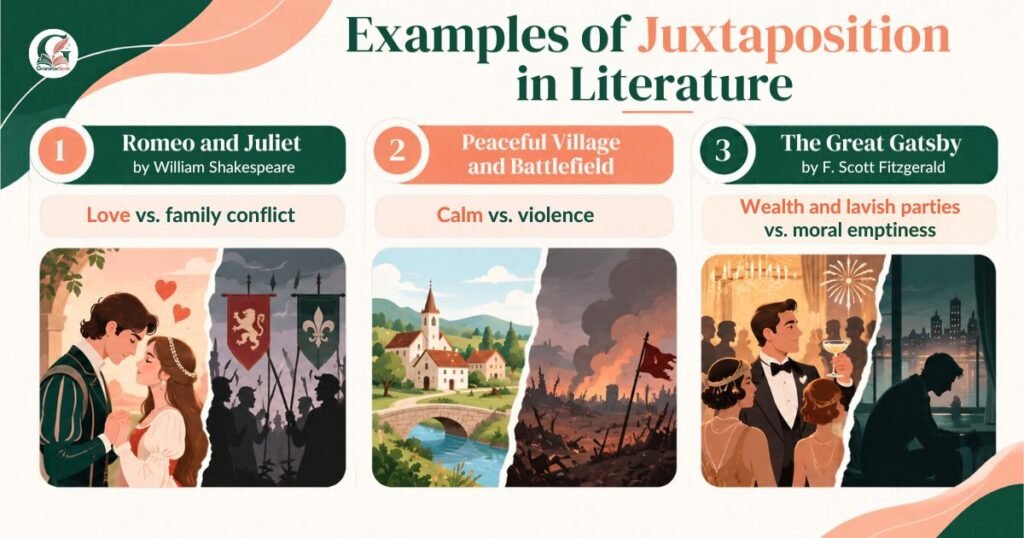
1. Romeo and Juliet by William Shakespeare
Shakespeare contrasts the love between Romeo and Juliet with the conflict between their families. This juxtaposition makes their relationship more tragic and highlights the destructive effects of the family feud.
2. Peaceful Village and Battlefield
A writer might describe a peaceful village beside a battlefield to contrast calm with violence. Placing these opposing settings together can emphasize the effects of conflict and make the surrounding danger more striking.
3. The Great Gatsby by F. Scott Fitzgerald
Fitzgerald contrasts the wealth and lavish parties of Gatsby’s world with the moral emptiness beneath that lifestyle. This juxtaposition helps reveal the gap between outward success and inner dissatisfaction.
These examples of juxtaposition in literature show how the juxtaposition literary device can make contrasts clearer, strengthen themes, and add meaning to a story.
Key Differences Between Antithesis and Juxtaposition
One of the key differences between antithesis and juxtaposition is that antithesis employs opposing ideas structured in a balanced manner, often using parallel phrasing to elucidate the contrast. For example, famous antithesis examples like “It was the best of times, it was the worst of times” showcase this balanced structure, making the opposition more memorable and impactful.
Juxtaposition places contrasting elements side by side without the need for any parallel wording. This broader literary technique allows writers to explore deeper contrasts in literature, inviting readers to draw their own conclusions from the powerful imagery created by the proximity of these elements.
While antithesis is narrow and focused, ideally suited for emphasizing contradictions, juxtaposition opens a wider narrative space where multiple layers of meaning can coexist, enriching the overall reading experience.
Understanding these key differences can enhance both writing and analysis, deepening one’s appreciation for the nuances of literary expression.
Contrast Technique
The contrast technique works differently in antithesis and juxtaposition. Antithesis creates a striking contrast through balanced or parallel sentence structures, often encapsulating ideas in succinct phrases.
Juxtaposition presents opposing elements side-by-side, allowing them to enhance each other’s meaning through placement. This technique can extend beyond single sentences to encompass whole descriptions, scenes, or even characters.
By understanding the distinctions between these two techniques, one can appreciate how they both serve to deepen the reader’s understanding of thematic complexities and emotional nuances.
Is Antithesis a Type of Juxtaposition?
Yes, antithesis can be considered a type of juxtaposition, but it is more structured in its approach.
Antithesis specifically highlights contrasting ideas within a balanced grammatical framework, often using parallelism to enhance the impact. A classic example of antithesis is found in the phrase, “It was the best of times, it was the worst of times.” This structured contrast emphasizes the extremes of a situation, making the statement memorable and thought-provoking.
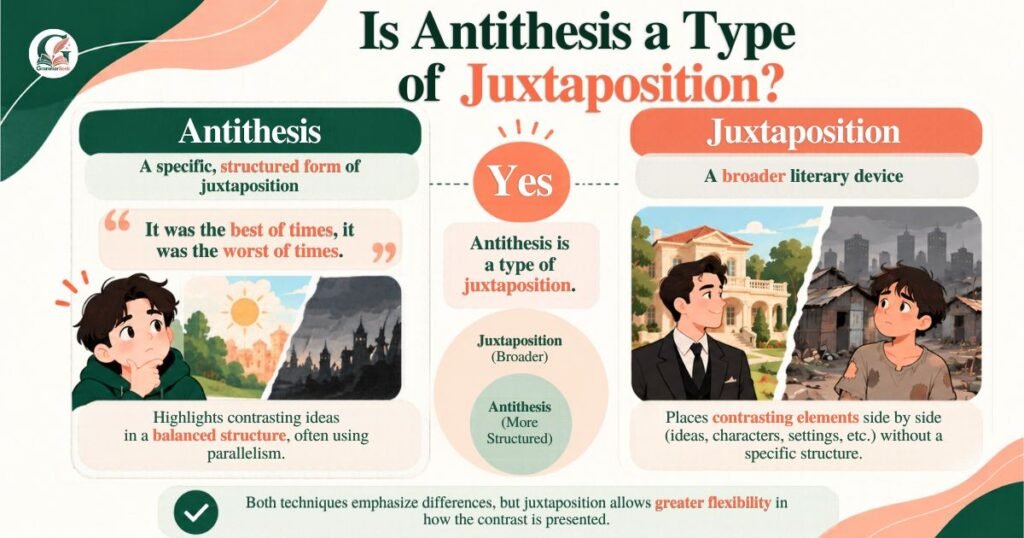
Juxtaposition is a broader literary device that places two or more ideas, characters, or settings side by side to highlight their differences or similarities, without the rigid structure that defines antithesis. For example, in a story, a wealthy character and a struggling one may be juxtaposed to show the disparities in their lives without following a specific formula.
In simple terms, antithesis uses structured contrast, while juxtaposition uses contrast through placement. Both techniques help writers emphasize differences, but juxtaposition allows greater flexibility in how the contrast is presented.
Juxtaposition vs Foil
In exploring “juxtaposition vs foil,” it’s essential to understand that while both techniques involve contrast, they serve distinct purposes in narrative structure.
A foil is specifically a character crafted to highlight the traits of another character, often by providing a stark contrast in personality or motivations.
For example: in many classic tales, the hero’s moral complexities become more pronounced when viewed alongside a morally ambiguous counterpart. This targeted contrast makes the protagonist’s qualities more vivid and relatable.
Juxtaposition functions as a broader literary device that contrasts not just characters, but also settings, ideas, or events. Through juxtaposition, authors can create layers of meaning that enhance thematic depth.
For example: juxtaposing a bustling metropolis against a desolate landscape can emphasize themes of isolation and chaos.
A foil relationship can be established through juxtaposition by placing two characters in different contexts or scenarios that accentuate their differences even further. This multifaceted interplay enriches storytelling and engages readers on a deeper level.
Juxtaposition vs Contrast
The difference between juxtaposition and contrast is mainly their scope. Contrast is the broader concept of highlighting differences between two or more elements, such as character traits, settings, ideas or themes that deepen the narrative.
For example, a story may feature a vibrant city alongside a desolate countryside, showing the stark disparity in lifestyles and emotional states.
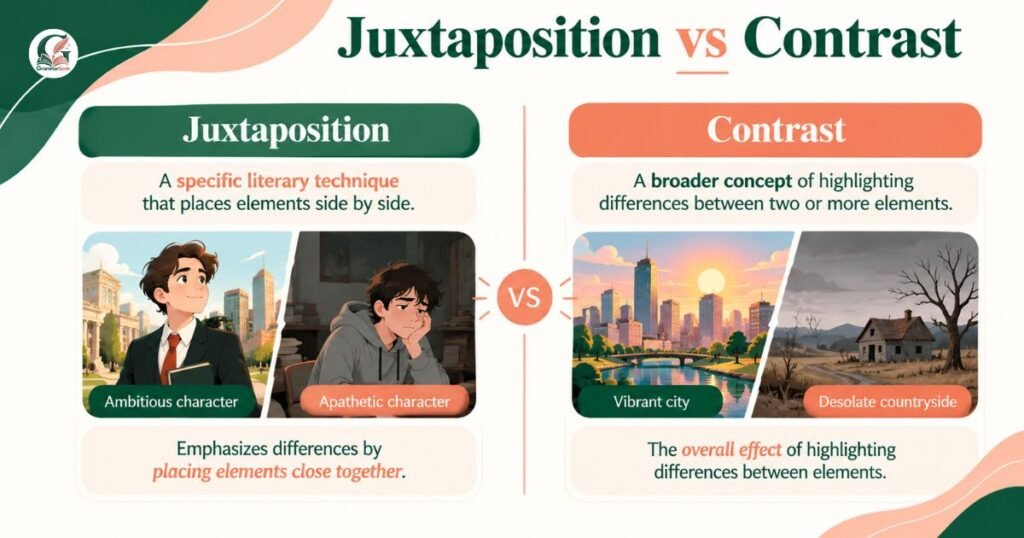
Juxtaposition serves as a specific literary technique that emphasizes these differences by placing elements side by side. For example, a writer might juxtapose a character filled with ambition against one marked by apathy within the same scene.
This technique not only intensifies the contrast but also invites readers to draw deeper insights about the characters’ motivations and decisions.
While contrast is the effect that enhances the understanding of differences, juxtaposition is the technique that orchestrates these elements for maximum impact.
Where these devices highlight differences, similes and metaphors highlight similarities, as explained in simile vs metaphor.
Conclusion
The difference between antithesis and juxtaposition lies primarily in their structural approaches. Antithesis employs balanced and parallel opposing ideas, offering a more rigid format that emphasizes contrast within a defined structure.
Juxtaposition thrives on flexibility, presenting contrasting elements side by side without the need for balance. This broader method allows for a richer exploration of ideas and themes, enhancing the depth of meaning.
Understanding the nuances of antithesis vs juxtaposition enriches our analytical skills and appreciation of literary techniques, encouraging deeper engagement with the text.
FAQs
What Are 5 Examples of Antithesis?
Five common examples of antithesis are:
“It was the best of times, it was the worst of times.” – Charles Dickens
“To err is human; to forgive, divine.” – Alexander Pope
“Speech is silver, but silence is golden.”
“Many are called, but few are chosen.”
“Give every man thy ear, but few thy voice.” – William Shakespeare
Each example places opposing ideas in a balanced or parallel structure to emphasize their contrast.
What Is the Difference Between Antithesis, Oxymoron, and Juxtaposition?
Antithesis presents opposing ideas in a balanced or parallel structure. An oxymoron combines two seemingly contradictory words, such as “deafening silence.” Juxtaposition places contrasting elements side by side, such as a wealthy character beside a poor character. In short, antithesis uses structured opposition, oxymoron combines contradictory terms, and juxtaposition creates contrast through placement.
What’s the Difference Between a Juxtaposition and an Oxymoron?
Juxtaposition places two contrasting elements close together, while an oxymoron combines contradictory words or terms in a single expression. For example, a rich neighborhood beside a poor neighborhood is a juxtaposition, while “bittersweet” is an oxymoron. Juxtaposition is broader and can involve characters, settings, ideas, or events.
What Is the Difference Between an Antithesis and a Dichotomy?
Antithesis is a rhetorical device that presents opposing ideas in a balanced or parallel structure. A dichotomy is a division between two contrasting or mutually exclusive ideas, categories, or concepts. For example, “It was the best of times, it was the worst of times” uses antithesis, while good versus evil represents a dichotomy.
Is Antithesis a Type of Juxtaposition?
Antithesis can be viewed as a more specific and structured form of contrast related to juxtaposition. However, juxtaposition is broader and does not require balanced or parallel wording. Antithesis focuses on structured opposing ideas, while juxtaposition creates contrast through placement.
What Is the Main Difference Between Antithesis and Juxtaposition?
Antithesis creates contrast through balanced or parallel opposing ideas, while juxtaposition creates contrast by placing different elements side by side. Antithesis is more structured, whereas juxtaposition is broader and more flexible.
Is an Oxymoron a Type of Antithesis?
No. An oxymoron and antithesis are different literary devices. An oxymoron combines contradictory words, while antithesis presents opposing ideas in a balanced or parallel structure.
Why Do Writers Use Antithesis?
Writers use antithesis to emphasize opposing ideas, strengthen arguments, improve rhythm, and make statements more memorable. It is common in literature, speeches, and persuasive writing.