
 Verb Forms Finder
FREE ENGLISH TOOL
Enter a verb to find its past tense, past participle, and -ing form.
Find the right form
Search for a verb above to see its forms and example sentences.
Results come from a built-in dictionary of common English verbs. Some rare verbs, specialist uses, or dialect variations may not be included.
What Is a Verb Form Finder?
A verb form finder helps you look up the different forms of an English verb in one place. It shows the base form (V1), past tense (V2), past participle (V3), and -ing form (V4). Together, these English verb forms support verb conjugation across tenses and sentence patterns.

Knowing the right form helps you build grammatically correct sentences and express when or how an action happens. Students and English learners can use our verb forms finder to review regular and irregular verbs, while teachers and writers can quickly check forms as they work. Example sentences make it easier to see how each form is used in context.
How to Use the Verb Forms Finder
- To find English verb forms, enter an English verb in the search box
- Then click Find Forms.
- The Verb Forms Finder displays four forms: the base form (V1), past tense (V2), past participle (V3), and -ing form (V4). Each form includes an example sentence to show how it is used.

To look up another verb, choose one of the suggested verb options or open the Browse Verbs dropdown. Follow these simple steps to use our verb form finder and make it easy to explore forms and examples for different verbs.
Understanding the Four Main Verb Forms
The four forms of verbs show how a verb changes to fit different grammatical uses.
V1 – Base Form
V1 is the base form, used in the simple present with subjects such as I, you, we, and they, and after the infinitive marker to. “I write every day” and “I want to write.”
V2 – Past Tense
V2 is the past-tense form: “I wrote yesterday.” These patterns are part of English verb conjugation, though the exact form depends on the verb and sentence.
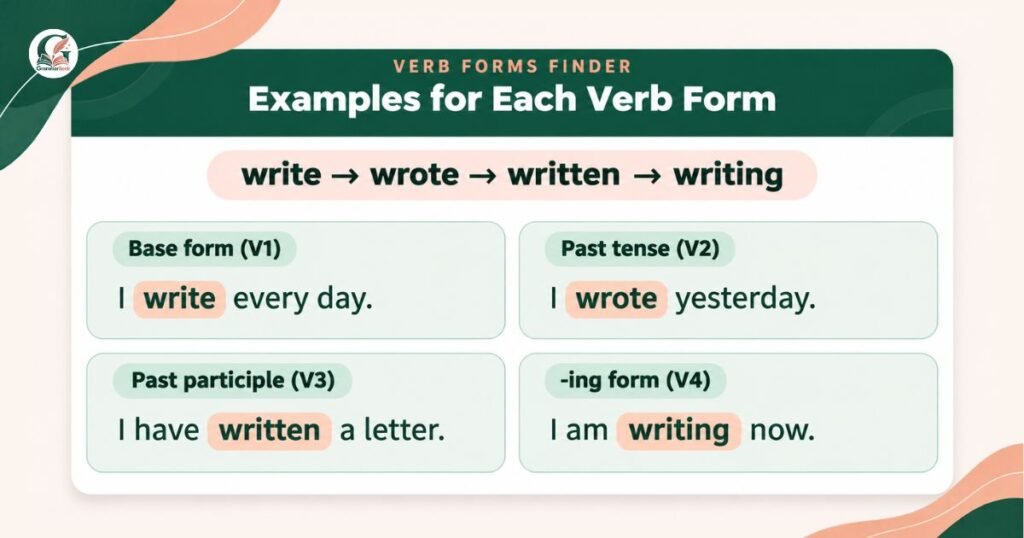
V3 – Past Participle
V3 is the past participle. It is used with helping verbs such as have to form perfect tenses (“I have written a letter”) and with be in passive constructions (“The letter was written”).
V4 – -ing Form
V4 is the -ing form, also called the present participle. It appears in continuous tenses (“I am writing now”) and can function as a noun (“Writing takes practice”).
For more details about the correct spelling of this form, read our guide to Writing or Writting.
| Form | Name | Example Verb | Example Use |
| V1 | Base Form | write | Write your name at the top of the page. |
| V2 | Past Form | wrote | She wrote a letter to her friend abroad. |
| V3 | Past Participle | written | He has written two novels. |
| V4 | -ing Form (Present Participle) | writing | They are writing a report. |
Learning how each form works makes the pattern of V1 V2 V3 V4 easier to recognize in everyday sentences.
Regular and Irregular Verbs
The difference between regular and irregular verbs is how they form the past tense (V2) and past participle (V3).
What Are Regular Verbs?
Regular verbs in English generally add -ed or -d:
- play → played
- work → worked
- accept → accepted
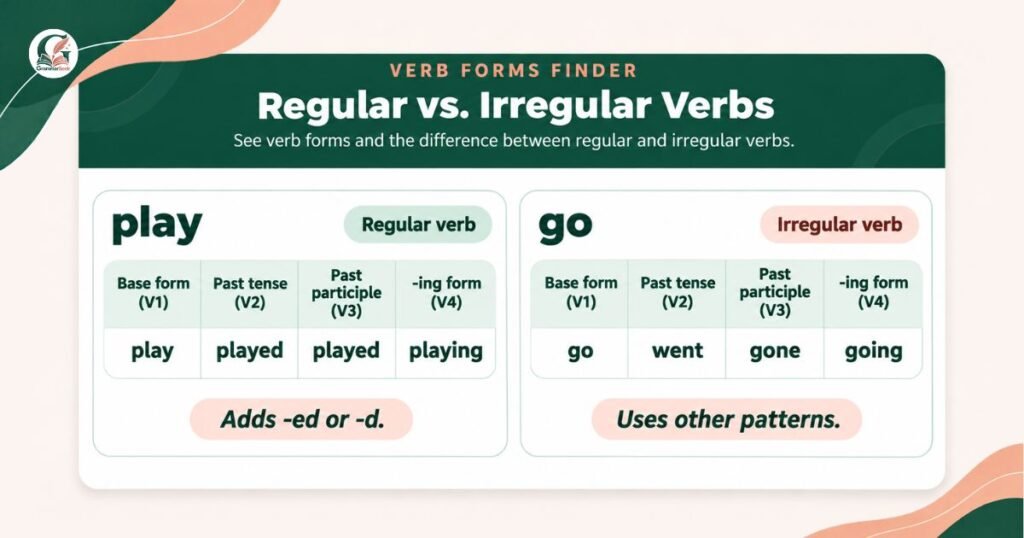
Some need spelling adjustments, such as adding only “-d” to verbs ending in “e” (like → liked) or changing “consonant + y” to “-ied” (try → tried).
Some verbs also involve other spelling considerations when adding endings. Learn why Targetted or Targeted is the correct spelling.
What Are Irregular Verbs?
Irregular verbs use other patterns instead of the usual “-ed” ending. Their forms may change completely, as in
- go → went → gone
- write → wrote → written
Some forms are identical, such as
- bring → brought → brought
- bend → bent → bent
- become → became → become
. Paying attention to these patterns makes it easier to recognize and use irregular verb forms.
How to Find the Past Tense and Past Participle of a Verb
When you look up a verb’s forms, check both V2 and V3: they do not always match. V2 is the past tense of a verb, used for a completed past action, as in “She saw the bird.”
V3 is the past participle of a verb, commonly used with “have” or “be”, as in:
“She has seen the bird” or “The bird was seen.”
| Base Form (V1) | Past Tense (V2) | Past Participle (V3) | V2 and V3 |
| go | went | gone | different |
| see | saw | seen | different |
| eat | ate | eaten | different |
| bring | brought | brought | same |
| make | made | made | same |
| find | found | found | same |
A verb forms finder makes it easy to identify both forms quickly and choose the one your sentence needs.
For more examples of irregular verb forms, explore our guides to the past tense of run and the past tense of seek.
Final Thoughts on Finding Verb Forms
Understanding English verb forms V1, V2, V3, and V4 helps you build grammatically correct sentences and communicate clearly. Regular and irregular verbs follow different patterns, so knowing how a verb changes in the past tense and past participle can help you avoid common mistakes.
When you need to find verb forms, use the Verb Forms Finder to check a verb quickly and learn from examples. It’s a helpful way to confirm the right form as you write.
FAQs
What Is a Verb Form Finder?
A verb form finder helps you look up the forms of an English verb. It shows V1 (base form), V2 (past tense), V3 (past participle), and V4 (-ing form) along with examples.
How Do I Find the Forms of a Verb?
Type a verb in the search box, then click Find Forms. Or choose one of the suggested verbs or select a verb from the Browse Verbs dropdown.
What Are V1, V2, V3, and V4 in English Grammar?
These labels refer to four English verb forms: V1 is the base form, V2 the past tense, V3 the past participle, and V4 the -ing form. For play, they are play, played, played, and playing.
What Is the Difference Between V2 and V3?
V2 names an action in the past: “They went home.” V3 is used with a helping verb: “They have gone home.”
What Is the Difference Between Regular and Irregular Verbs?
Regular verbs usually make V2 and V3 by adding -ed, as with clean, cleaned, cleaned. Irregular verbs change in other ways, such as go, went, gone.
Does the Verb Forms Finder Show Irregular Verbs Correctly?
Yes. The Verb Forms Finder displays the correct forms of irregular verbs, including their past tense (V2) and past participle (V3). For example, searching for “go” shows “went” and “gone.”
Is the Verb Forms Finder Free to Use?
Yes. The Verb Forms Finder is free to use. You can look up English verb forms, check examples, and explore different verbs without paying.
Can I See Examples of Verb Forms in Sentences?
Yes. The Verb Forms Finder provides example sentences to show how each verb form is used in context. These examples help you understand how different English verb forms work in everyday sentences.