
Lead vs LEED: Meaning, Pronunciation & Differences
Confused about whether to write lead or LEED? The difference matters: lead is an English word with several meanings and two common pronunciations, while LEED stands for Leadership in Energy and Environmental Design, a green building certification.
This guide to Lead vs LEED explains their meanings, capitalization, pronunciation, and usage, with practical examples and common spelling mistakes to help you choose the right term.
Quick Answer
Lead vs LEED comes down to meaning. Lead is an English word that can mean to guide, refer to a person or thing in front, or name a metal. LEED stands for Leadership in Energy and Environmental Design, a green building certification program.
Are Lead and LEED Pronounced the Same?
The lead pronunciation changes with its meaning: the verb rhymes with “seed,” while the metal rhymes with “bed.” LEED always rhymes with “seed.” This distinction is central to the lead or leed meaning and helps readers choose the correct spelling.
One-Sentence Rule You’ll Never Forget
Rule of thumb: Use lead for the English word and LEED for the green building certification.
What is the Difference Between Lead and LEED?
The difference between lead and LEED comes down to how each word is used. “Lead” is an everyday English word: it can mean to guide or direct (“She will lead the team”), to be in first place (“Their runner took the lead”), or the heavy metal (“The old pipe contains lead”).
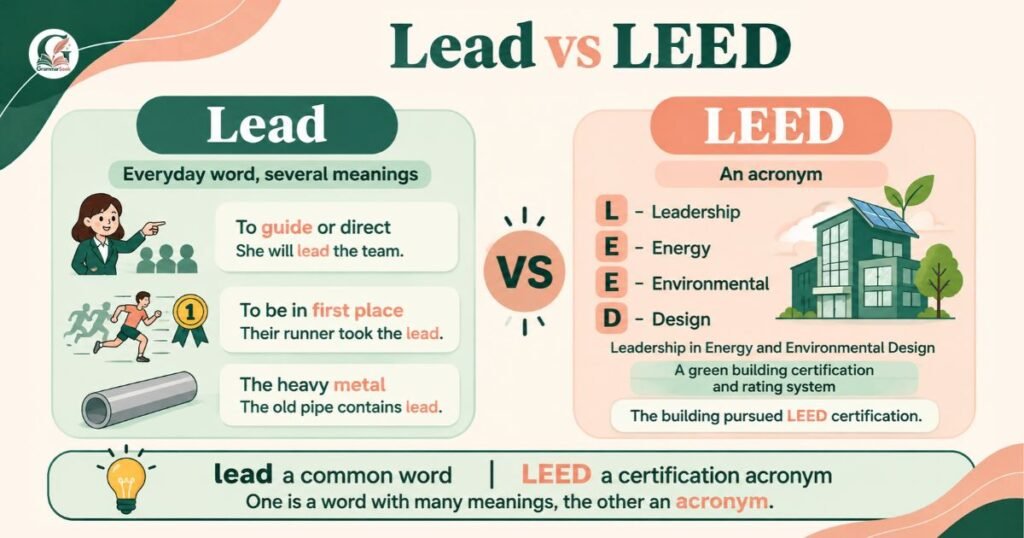
“LEED” stands for Leadership in Energy and Environmental Design. It is a green building certification and rating system used to evaluate sustainable buildings. For example, a project may pursue LEED certification, or a building may be evaluated under the LEED system.
Lead vs LEED is a choice between a common word with several meanings and an acronym for a green building certification and rating system.
Lead vs LEED vs Led: Quick Summary
Before exploring each term in detail, use this table to understand the differences between lead, LEED, and led. Although they look or sound similar, each has a distinct meaning and purpose.
| Word | Pronunciation | Meaning | Example |
| Lead (verb) | Leed | To guide, direct, or be in charge | She will lead the meeting. |
| Lead (metal) | Led | A heavy, soft chemical element | The old pipe contains lead. |
| Led | Led | The past tense of the verb lead | She led the meeting yesterday. |
| LEED | Leed | Leadership in Energy and Environmental Design, a green building certification system | The office earned LEED Gold certification. |
Remember: Lead (verb) and LEED sound alike, while lead (metal) and led share the same pronunciation. The correct choice depends on the meaning you want to express.
Why People Confuse Lead and LEED
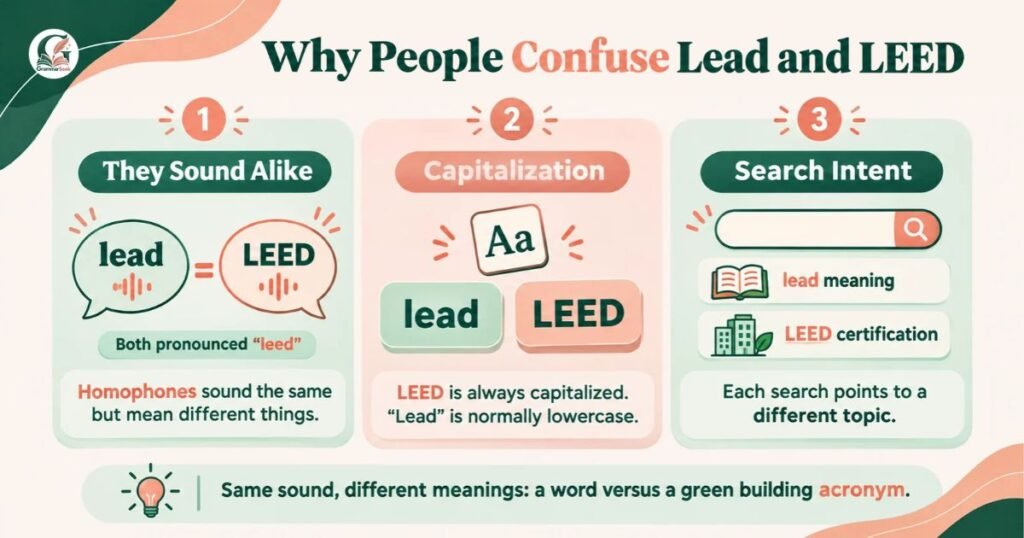
People often confuse lead and LEED because they sound alike, differ in capitalization, and can point to very different topics in a search. Knowing these distinctions makes it easier to understand “lead vs LEED” in context.
Homophones Explained
Homophones are words that sound the same but have different meanings, and sometimes different spellings. “Lead,” when it means to guide or direct, and “LEED” are both pronounced “leed.” Their shared pronunciation can cause confusion in writing and online searches, especially when someone is unsure whether to type “lead or LEED.”
Capitalization Confusion
LEED is always written in capital letters because it is an acronym for Leadership in Energy and Environmental Design. By contrast, “lead” is normally lowercase unless it begins a sentence or appears in a proper name. Incorrect capitalization can make readers mistake the English word for the LEED acronym, or the other way around.
Google Search Intent Differences
A search for “lead meaning” usually signals interest in the English word, while “LEED certification” usually relates to green building standards and construction. Explaining both meanings clearly helps readers find the information they need and makes the topic relevant to people searching for either term.
Other sound-alike words with different meanings are explained in faring vs fairing.
What Does Lead Mean?
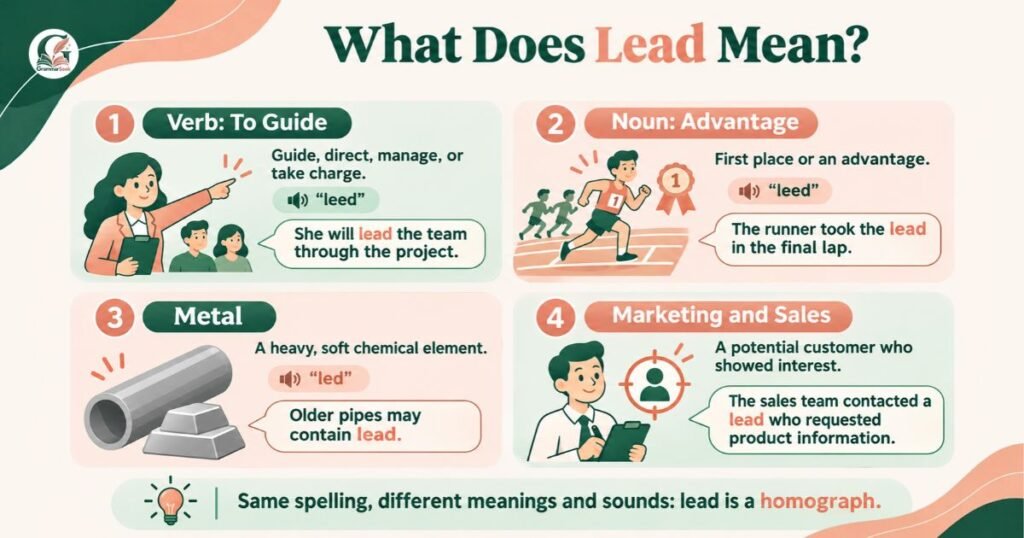
The meaning of lead depends on the context. It can refer to guiding or directing, holding an advantage, a heavy metal, or a potential customer in business. Its pronunciation also changes depending on which meaning is intended.
Lead as a Verb – To Guide
As a verb, lead means to guide, direct, manage, or take charge. For example, “She will lead the team through the project.” In this sense, lead is pronounced “leed.”
Lead as a Noun – Position of Advantage
As a noun, lead can mean first place or an advantage in a competition or situation. “The runner took the lead in the final lap.” Here, lead is also pronounced “leed.”
Lead as a Metal – Pronunciation Changes
Lead can refer to a heavy, soft chemical element. It was historically used in pipes and paint. The metal is pronounced “led,” unlike lead as a verb or a position of advantage. Because the same spelling has different meanings and pronunciations, lead is a homograph. For example, “Older pipes may contain lead.”
Lead in Marketing and Sales
In marketing and sales, a lead is a potential customer who has shown interest in a product or service. Businesses follow up with sales leads to see whether they can become customers. For example, “The sales team contacted a lead who requested product information.”
What Is LEED?
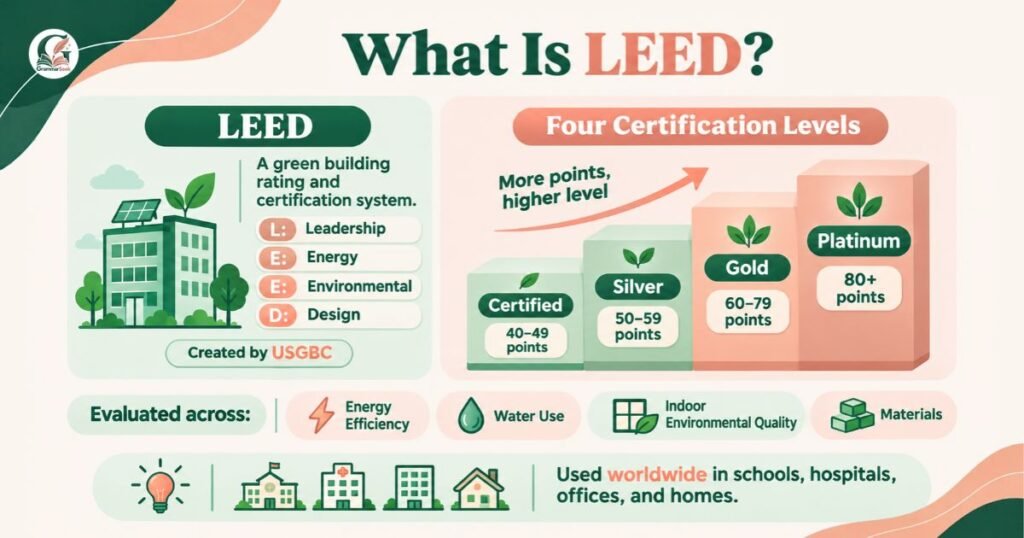
LEED is a green building rating and certification system used to evaluate sustainable design and construction. The acronym stands for Leadership in Energy and Environmental Design and should not be confused with the ordinary English word “lead.”
What LEED Stands For
LEED stands for Leadership in Energy and Environmental Design. The LEED rating system provides a framework for evaluating how environmentally responsible and sustainable buildings are, including their energy efficiency and water conservation.
Who Created It
The U.S. Green Building Council (USGBC) developed LEED to encourage sustainable construction and establish measurable green building standards. USGBC maintains and updates the rating system.
Why LEED Certification Matters
LEED evaluates buildings across sustainability categories such as energy efficiency, water use, indoor environmental quality, and materials. LEED certification can support more efficient use of resources, lower operating costs, and stronger environmental performance, though results vary by building and project.
LEED certification has four levels, based on the points a project earns:
| Level | Points Required |
| Certified | 40–49 |
| Silver | 50–59 |
| Gold | 60–79 |
| Platinum | 80+ |
Global Adoption and Impact
LEED is used internationally in many types of buildings, including schools, hospitals, offices, and homes. By providing a shared way to assess building sustainability, it helps promote sustainable construction and environmental awareness around the world.
Pronunciation Breakdown
Knowing the pronunciation differences between lead, led, and LEED can help prevent confusion when speaking and writing. Context helps readers identify the intended meaning and pronunciation.
/leed/ vs /led/
- For the verb lead, meaning to guide, and the noun lead, meaning an advantage, the lead pronunciation is /liːd/—like “leed.”
- The metal lead is pronounced /lɛd/, like “led.”
- The past-tense verb led also sounds like /lɛd/.
- LEED pronunciation is /liːd/, matching “lead” meaning to guide, not the metal.
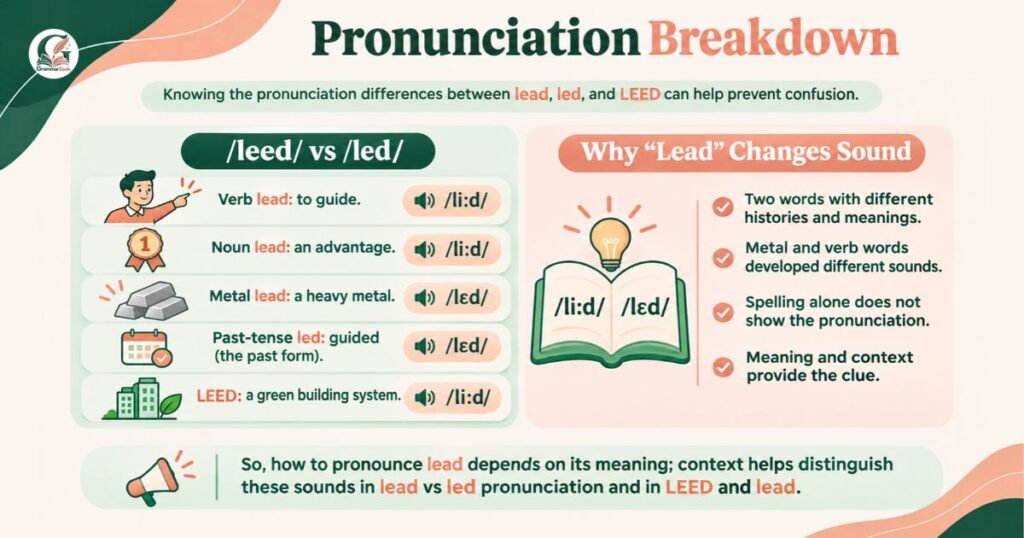
So, how to pronounce lead depends on its meaning; context helps distinguish these sounds in lead vs led pronunciation and in LEED and lead.
Why “Lead” Changes Sound
The spelling lead reflects two words with different histories and meanings. Over time, the metal-related word and the verb-related word developed different vowel sounds in English: /lɛd/ for the metal and /liːd/ for the verb. The spelling alone does not show which pronunciation is intended, so meaning and context provide the clue.
Just as the vowel sound separates the two meanings of “lead,” the stress pattern in “fourteen” and “forty” affects how people spell them, as shown in forteen vs fourteen.
Side-by-Side Comparison Table – Lead vs. LEED
A side-by-side comparison makes the difference between LEED and lead easier to understand. Although they share a similar sound in some contexts, their meanings, pronunciations, and uses are different.
| Category | Lead | LEED |
| Meaning | To guide, an advantage, a metal, or a potential customer | Leadership in Energy and Environmental Design, a green building certification system |
| Pronunciation | /liːd/ or /lɛd/, depending on the meaning | /liːd/ |
| Usage Field | Everyday English, business, sales, and chemistry | Architecture, construction, and sustainability |
| Capitalization | Usually lowercase, except at the beginning of a sentence or in a proper name | Always uppercase |
| Part of Speech | Verb or noun | Acronym used as a proper name |
The easiest way to remember the difference is that lead has several meanings and can have two pronunciations, while LEED always refers to the green building certification system and is pronounced like the verb lead.
Common Mistakes and How to Avoid Them
Confusion between lead and LEED can cause spelling and pronunciation mistakes in everyday writing, professional communication, and educational content. Understanding the meaning and context helps you choose the correct spelling and pronunciation.
Writing “leed” Instead of “lead”
“Leed” is not the standard spelling of the English word lead. Use lead for guiding or directing someone, being in front or having an advantage, and the metal, even when the word is pronounced like “leed.” For example: “She will lead the team,” “Our team has the lead,” and “The pipe contains lead.”
LEED is the uppercase acronym for Leadership in Energy and Environmental Design. In a building or sustainability context, “LEED certification” uses the acronym. These clues help resolve whether you mean lead or LEED and avoid a lead spelling mistake.
Misspellings like “leed” often come from spelling a word by sound or by a familiar pattern, and the same thing happens when people add an extra “t” to “writing,” as explained in writing or writting.
Mispronouncing the Metal
The metal lead is pronounced /lɛd/, like the past-tense verb “led.” The verb lead, meaning to guide, is pronounced /liːd/. In “lead pipe,” say “led pipe.” A simple memory tip: the metal rhymes with “red,” while the guiding verb rhymes with “seed.”
This distinction makes how to pronounce lead clearer and helps readers and speakers avoid confusion.
Pencil Lead or Led?
The material inside a pencil is commonly called pencil lead, but it is not actually made of the metal lead. It is made from graphite, a form of carbon, and clay. Despite its composition, the word is still spelled lead and pronounced /lɛd/, just like the metal. It is not spelled led, because led is the past tense of the verb lead. For example, you write “I need a pencil lead,” not “I need a pencil led.”
Capitalization Errors
One common mistake when writing about lead vs LEED is using the wrong capitalization. LEED is an acronym for Leadership in Energy and Environmental Design, so it should always appear in uppercase in formal writing. Writing it as Leed or leed is incorrect when referring to the certification system.
Lead is normally written in lowercase unless it begins a sentence or appears in a proper name. Before choosing the spelling, identify whether you mean the English word lead or the LEED green building certification.
Capitalization also separates a common word from a brand name, as in channel vs Chanel.
British English vs American English Spelling
In British English vs American English, lead and LEED are spelled the same way. Unlike regional variations such as color and colour, neither has a British or American spelling alternative. So the lead spelling is unchanged, whether you mean the verb, the noun referring to an advantage, or the metal; context tells readers which meaning applies.
For example, both British and American speakers write “lead the meeting.” The word is generally pronounced the same in this context, though accents can affect how it sounds.
LEED also stays uppercase in both varieties because it is an acronym for Leadership in Energy and Environmental Design. When choosing between lead or LEED, focus on the intended meaning rather than regional spelling differences.
For words that do change between American and British spelling, see traveler or traveller.
Examples in Real Sentences
Seeing lead and LEED in different contexts makes their meanings and usage easier to understand. The following examples show how to use each term correctly in academic writing, business communication, construction, and professional resumes.
Academic Writing
- The professor will lead the seminar next week.
- The new university library achieved LEED Gold certification for its sustainable design.
Business Context
- She took the lead during the contract negotiations.
- Our company headquarters is located in a LEED-certified office building.
Construction Context
- Workers replaced the old lead pipes in the basement.
- The developer hopes to achieve LEED Platinum certification for the new project.
Resume Writing
When describing a completed leadership role on a resume, use led, the past tense of lead:
- Correct: “Led a team of 12 engineers through a successful product launch.”
- Incorrect: “Lead a team of 12 engineers through a successful product launch.”
Use lead for present or future responsibilities, such as “Lead a team of 12 engineers.” Use led when describing an action that has already happened.
Other irregular verbs change form in the past tense too, as shown in past tense of seek.
Lead or Leed – Google Trends & Usage Data
Searches for “lead” cover several meanings, including guiding, the metal, and business terminology. “LEED” searches are mainly related to green building certification, architecture, and sustainable construction.
People searching for LEED or lead are often trying to understand the difference between the two terms. “Leed” is generally a misspelling, not a standard alternative spelling of either word.
For another example of how search interest can differ between two similar spellings, see hoodie or hoody.
Test Your Knowledge: Lead or LEED Quiz
Check your understanding of lead vs LEED with these five quick questions.
- Which term is always capitalized: lead or LEED?
- What is the past tense of “lead”?
- How is “lead” pronounced when referring to metal?
- What does LEED stand for?
- Is “leed” a standard English spelling?
Answer Key:
- LEED
- Led
- Like Bed
- Leadership in Energy and Environmental Design
- No
Final Takeaway
Lead and LEED may look alike, but context sets them apart: lead is an English word with several meanings, while LEED is a green building certification acronym. When choosing lead or LEED, remember: lowercase refers to the ordinary word, while capital letters identify the certification.
FAQs
What Is the Difference Between LEED and Lead?
Lead can mean to guide or direct someone, refer to a position of advantage, or describe the metal. LEED is a green building certification program; the name stands for Leadership in Energy and Environmental Design. The right spelling depends on the meaning.
Is It Lead or LEED Time?
Use lead time when you mean the time needed before something is ready or happens. Use LEED when referring to the green building certification program. The correct choice depends on the context.
What Are Two Meanings of Lead?
Lead can mean to guide or direct someone, as in “lead a team.” It can also mean a heavy metal; in this sense, it is pronounced “led.”
What Is the Past Tense of Lead?
The past tense of lead (meaning to guide) is led. For example, “She led the group.”
Is Student Lead or Led Correct in a Sentence?
Use led when describing what a student did in the past: “The student led the discussion.” Use student-led before a noun to describe something organized or guided by a student, as in “a student-led project.”
What’s a Synonym for Lead (the Verb)?
A common synonym for lead is guide. Depending on the sentence, direct may also fit.
Is Lead Spelled Differently in British English?
No. Lead is spelled the same in British and American English. British English spelling does not change the spelling of the verb or the metal.