
Contractor or Contracter: The Shocking Truth
When you’re writing about someone hired to do a job, one extra letter can cause confusion: Is it contractor or contracter? Contractor is the correct spelling, while contracter is incorrect.
Learn what contractor means, how to pronounce it, how to spell contractor correctly, and the simple spelling rule, with examples of professional usage. This guide makes the correct spelling of contractor easy to remember.
Quick Answer – Contractor or Contracter?
Use contractor, not contracter, in both American and British English. A contractor is a person or company hired under a contract to provide services. The word appears in terms such as building contractor, independent contractor, and government contractor.
The spelling can be confusing because contractor and contracter have similar pronunciation. Remember that contractor always ends in “-or”; contracter is not the correct spelling.
Contractor vs Contracter – Clear Comparison
Contractor is the only correct standard English spelling. It means a person or company hired under a contract to complete work or provide services. Common examples include a general contractor, an independent contractor, and a government contractor.
| Feature | Contractor | Contracter |
| Spelling | Correct | Incorrect |
| Dictionary status | Recognized English word | Not a standard English word |
| Meaning | A person or company hired under a contract | No accepted meaning |
| Usage | Used in professional and everyday writing | Should be avoided |
| Example | Building contractor | Incorrect spelling |
Is contracter a word? It is not an accepted spelling of the term and has no accepted dictionary definition. Choose contractor in emails, documents, and other writing.
Why Do People Spell It “Contracter”?
The misspelling “contracter” is easy to understand: contractor can sound as if it ends in “-er,” especially when spoken quickly. Familiar words like teacher and builder may also influence how people spell the similar-sounding ending.
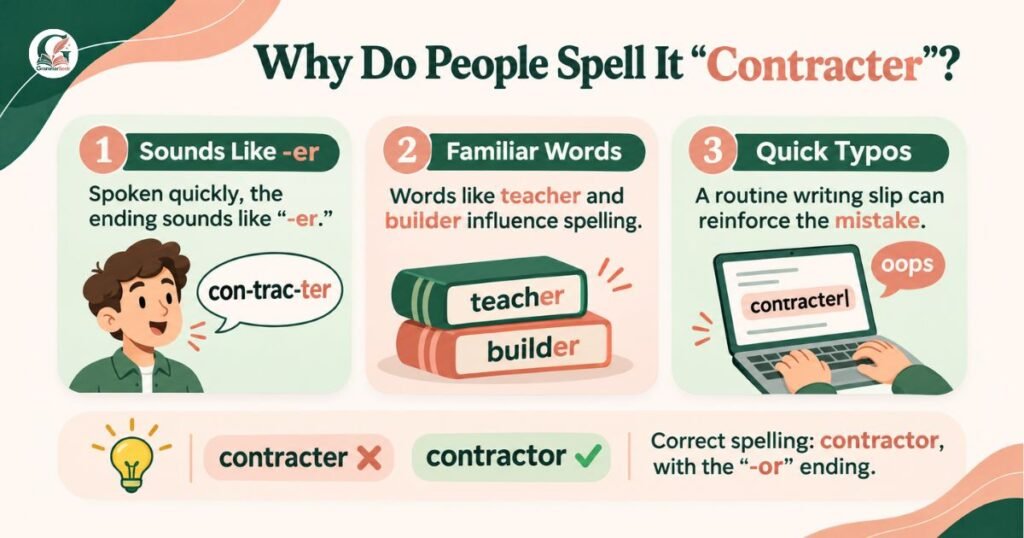
A quick typo or routine writing slip can reinforce the mistake. Contractor is the correct spelling, with the established “-or” ending. Keeping that pattern in mind helps distinguish it from “contracter.”
Words that sound alike are easy to mix up in writing, even when both spellings are real words, as in faring vs fairing.
The Grammar Rule Behind “-or” vs “-er”
Agent nouns name people who perform an action. Many are formed from verbs with an “-er” or “-or” ending: a teacher teaches, a builder builds, an actor acts, an editor edits, and an inspector inspects. These examples show the common pattern, but there is no absolute “-or vs -er spelling rule” that predicts every word.
For contractor spelling, start with the verb “contract.” The established form adds “-or,” making contractor, not contracter, the correct spelling. When in doubt about words ending in “-or and -er,” check the standard spelling of the specific word.
Another word where the “-er” and “-or” endings cause mix-ups is explained in trailer or trailor.
Different Types of Contractors
The different types of contractors are often defined by the work they do and who hires them.

General Contractor
A general contractor manages construction work and may coordinate trades and project tasks.
Contractor in Construction Meaning: In construction, a contractor is an individual or company hired to carry out building, renovation, repair, or other construction work under an agreement. A general contractor typically oversees the project and may coordinate subcontractors, such as electricians and plumbers.
Independent Contractor
An independent contractor provides services on their own behalf rather than as an employee.
Government Contractor
A government contractor performs work for a government agency under an agreement.
IT Contractor
An IT contractor handles technology projects such as software, systems, or technical support.
Contractors also work in fields such as law, design, marketing, and engineering. The legal definition of a contractor can vary by jurisdiction and context, but the common thread across these roles is an agreement to complete specific work for payment.
What Are Synonyms for Contractor?
Depending on the context, synonyms or related terms for contractor include builder, tradesperson, service provider, consultant, and freelancer. However, these words do not have exactly the same meaning. For example, a builder usually works in construction, while a freelancer typically provides services independently. Choose the term that best describes the person’s role and type of work.
When writing about different professionals or groups, it is also important to use plural forms correctly. Explore Plural of Chief to learn how to form the plural of another commonly used noun.
Contractor in Legal Context – Legal Meaning of Contractor
The legal meaning of contractor depends on the applicable law and the facts of the work arrangement. An independent contractor vs employee distinction often turns in part on control: who decides how the work is performed and when it is done. Contractors commonly have greater independence over methods and schedules, while employees may work under an employer’s direction.
A formal contract can set out the contractor’s duties and how and when payment is due. The arrangement may also differ in tax responsibilities and access to employee benefits: contractors generally manage their own tax obligations and are not treated as employees for benefits provided through the hiring business. These points can vary under applicable rules.
The label in a contract does not settle contractor classification by itself; the actual working relationship matters. In legal terms, a contractor is classified according to the applicable rules in the relevant jurisdiction. The correct spelling is “contractor,” not “contracter.”
Examples of Contractor in Sentences
Here are six examples showing how to use contractor correctly in everyday and professional writing:
- We hired a contractor to fix the broken porch steps.
- As an independent contractor, Luis sends an invoice for each project.
- The contractor prepared graphics for the company’s brochure.
- A government contractor supplied equipment for a public project.
- The contractor paved the road after the utility work was complete.
- Our general contractor coordinated the carpenters and electricians.

These contractor examples demonstrate the word’s use across several types of work, from home repairs to public projects. Remember that the correct spelling of contractor is “contractor,” not “contracter.”
Correct spelling is especially important in professional communication, including emails, reports, and business messages. See our guide on Message vs Messege to avoid another common spelling mistake.
Common Spelling Mistakes Similar to “Contracter”
Common English spelling errors can come from sounds, spelling patterns, or fast typing. For example, “adviser” and “advisor” are both accepted forms, while “ocurred” is incorrect; the standard spelling is “occurred,” with two “r”s after the “u.”
These examples help explain the contractor vs. contracter mix-up. Although the ending may sound like “er,” the correct spelling of contractor uses “-or.”
If you’re unsure how to spell the word, remember that the standard form is contractor, not contracter. A quick review before publishing or sending a message can help catch this kind of mistake.
Contracter is not the only spelling mistake that can occur when writers rely on how a word sounds. Check out Writing vs Writting to understand another frequently confused spelling pair.
Conclusion
When deciding between contracter or contractor, choose contractor. It is the standard English spelling for a person or business hired under a contract, and it follows the established “-or” pattern. Before publishing or sending a document, check that the word is spelled correctly. Keep it simple: use contractor in professional and everyday writing.
FAQs
Is It Contractor Or Contracter?
Contractor is the correct spelling in standard English. Contracter is a misspelling. Choose “contractor” in writing about someone hired to do work or provide services.
If you’re unsure how to spell contractor, remember that the correct form ends in “-or,” not “-er.”
Is Contracter Ever Correct?
As the ordinary English word, contracter is not correct; use contractor. A proper name or specialized title may differ, so verify the spelling when referring to one.
What Is The Plural Of Contractor?
Write contractors for more than one contractor. The contractor plural is formed by adding -s to contractor, as in “The contractors submitted their proposals.”
If you want to understand how plural forms work with other English nouns, read our guide to the Plural of Journey.
Is Contractor American Or British Spelling?
The spelling contractor is used in both US and British English. There is no American-versus-British spelling difference for this word.
What Does Contractor Mean?
A contractor is a person or company engaged to do specified work or provide services under an agreement. What the contractor is responsible for depends on the terms of that agreement.
What Type Of Word Is Contractor?
Contractor is a noun: it names a person or organization. In a sentence, it can refer to someone hired to carry out work, such as “We contacted the contractor.”
Why Is Contractor Spelled With “-Or”?
Contractor ends in “-or” because it follows a common pattern for agent nouns formed from verbs, such as actor, editor, and inspector. No rule predicts every “-or” or “-er” ending, so the safest approach is to remember that the standard spelling is “contractor,” not “contracter.”
What Is The Difference Between A Contractor And An Employee?
A contractor typically provides work or services under a contract; an employee works in an employment relationship with an employer. The details may vary, and the applicable rules or agreement can affect the distinction.
How Do You Pronounce Contractor?
In US English, say contractor as kuhn-TRAK-ter, with three syllables and emphasis on TRAK. Individual speakers may pronounce it with slight differences.