

Past Tense of Run: Is It Run or Ran?
The past tense of run can seem tricky, but knowing the difference between “run” and “ran” is crucial for anyone using the English language. While “run” serves as the present tense and the past participle, “ran” firmly identifies the simple past.
This guide will break down the nuances of this irregular verb, providing clarity on when to use each form. By understanding these distinctions, you’ll enhance your grammatical precision in everyday conversation.
Quick Answer
The past tense of “run” is “ran,” while the past participle is “run.”
For example,
- “She ran a marathon last year” uses “ran” as the simple past form.
- “They have run the race multiple times” illustrates the use of “run” as the past participle.
Use “ran” when referring to actions completed in the past, and “run” when paired with “have,” “has,” or “had.” This clear distinction helps ensure proper communication in both writing and conversation.
Why “Run” Becomes “Ran” (The Real Grammar Rule)
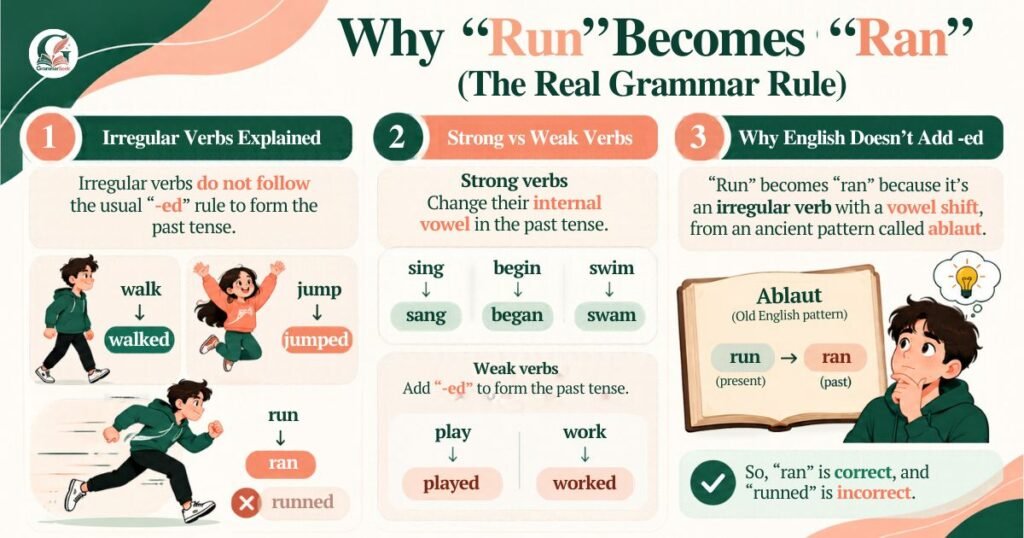
To understand why “run” becomes “ran,” we’ll look at irregular verbs, strong and weak verbs, and why “-ed” is not added to the verb.
Irregular Verbs Explained
Irregular verbs are those that do not adhere to the standard rule of forming the simple past tense by simply adding “-ed.”
For example, regular verbs like:
- “walk” transform into “walked”
- “jump” into “jumped.”
The verb “run” illustrates a deviation from this pattern, changing to “ran” in the past tense instead of following the expected formation of “runned.” This makes “run” an irregular verb.
The irregularity of verbs like “run” often serves to enhance the complexity of the English language, as they require memorization rather than predictable rules.
The past tense of “run,” which is “ran,” exemplifies this divergence, leading learners to recognize that not all verbs operate within the same grammatical framework.
Strong vs Weak Verbs
Strong verbs and weak verbs differ primarily in how they form their past tenses.
Strong verbs change their internal vowel, resulting in forms like:
- sing → sang
- begin → began
- swim → swam
This vowel change contributes to a more dynamic representation of action.
Weak verbs follow a more predictable pattern, typically adding “-ed” to create the past tense, as in:
- play → played
- work → worked
An interesting exception within the strong verb category is the verb “run,” which changes to “ran” in the past tense, illustrating the same vowel shift.
Understanding these differences is crucial for grasping the nuances of English verb conjugation, enhancing clarity and precision in writing.
Why English Doesn’t Add -ed Here
In English, the verb “run” becomes “ran” instead of “runned” due to a feature of irregular verbs. This transformation involves a vowel shift, where the internal vowel changes to indicate past tense, a process rooted in an ancient pattern called ablaut.
Unlike regular verbs, which simply take the -ed ending, many irregular verbs like “run” maintain these older patterns, emphasizing their historical origins.
When you’re referring to past actions, “ran” is the correct form, while “runned” is grammatically incorrect. Understanding these rules helps you grasp English verb forms.
All Forms of “Run” (V1, V2, V3, V4, V5 Table)
Understanding the various forms of the verb “run” enhances both writing and conversation. The verb showcases its versatility across different tenses, making it a crucial component in English.
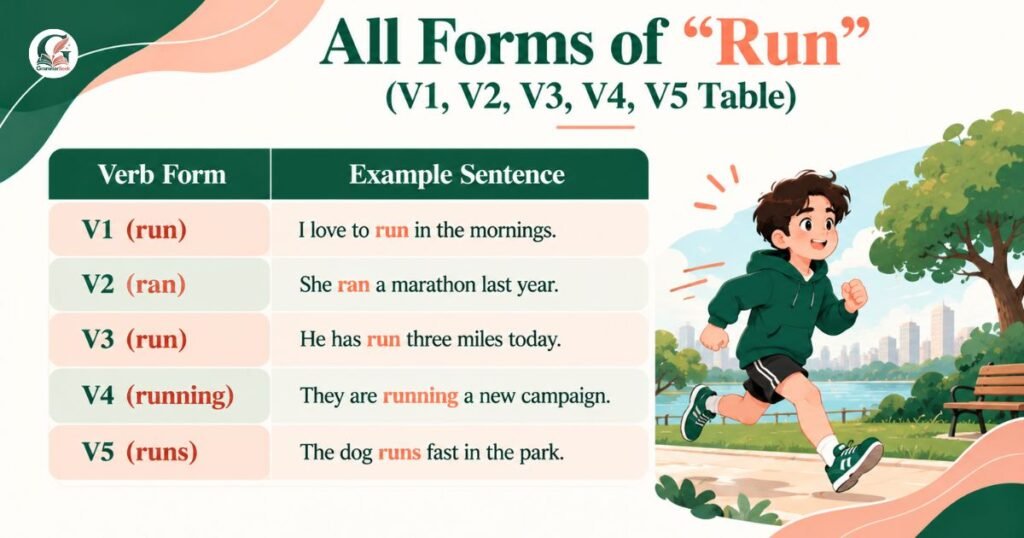
| Verb Form | Example Sentence |
| V1 (run) | I love to run in the mornings. |
| V2 (ran) | She ran a marathon last year. |
| V3 (run) | He has run three miles today. |
| V4 (running) | They are running a new campaign. |
| V5 (runs) | The dog runs fast in the park. |
These are the main verb forms of “run,” illustrating its usage in various contexts. The past tense of “run” is “ran,” while the past participle remains “run.” Such verb forms of “run”, from V1 to V5, are essential for mastering English grammar.
When to Use “Ran” vs “Run”
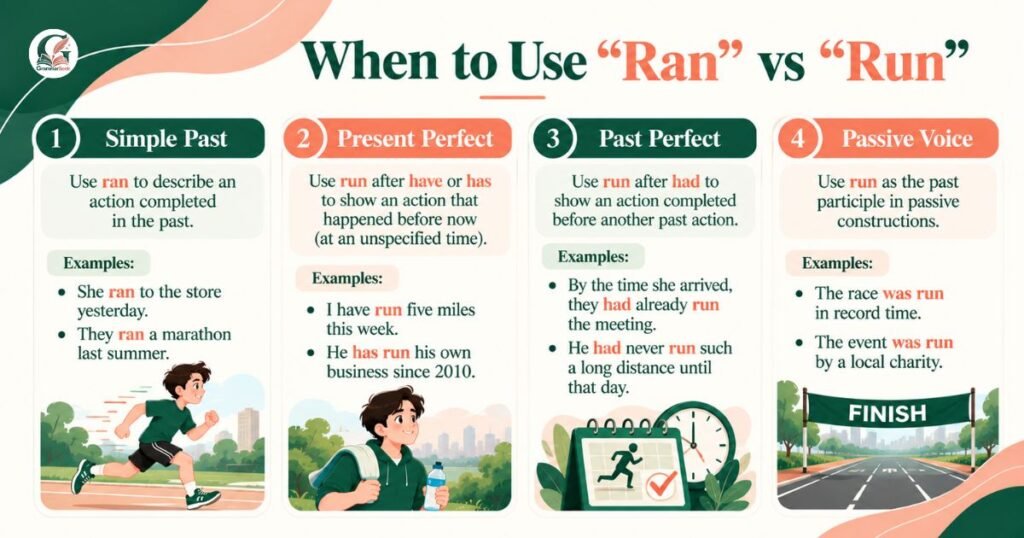
Here are a few examples of when to use ran vs when to use run.
Simple Past Examples
Use “ran” to describe an action completed in the past.
- She ran to the store yesterday.
- They ran a marathon last summer.
Present Perfect Examples
Use “run” after “have” or “has” to indicate an action that occurred at an unspecified time before now.
- I have run five miles this week.
- He has run his own business since 2010.
Past Perfect Examples
Use “run” after “had” to signify an action completed before another past action.
- By the time she arrived, they had already run the meeting.
- He had never run such a long distance until that day.
Passive Voice Examples
In passive constructions, “run” serves as the past participle.
- The race was run in record time.
- The event was run by a local charity.
Common Mistakes (And How to Avoid Them)
Understanding the past tense of “run” can trip up even seasoned English speakers.
A common mistake occurs with sentences like:
Incorrect: “Yesterday, I run five miles.”
Correct: “Yesterday, I ran five miles.”
Here, “ran” serves as the simple past tense of “run,” marking an action completed in the past.
Another frequent error is found in statements like:
Incorrect: “I have ran five miles.”
Correct: “I have run five miles,”
As “run” is the past participle used with “have” in perfect tenses.
Why Learners Confuse Them
Learners confuse Run and Ran due to following reasons:
- “Run” acts as both the base form and the past participle, creating a dual role that can be confusing.
- Being an irregular verb means it doesn’t follow the usual pattern of adding -ed for past tense.
- In fast speech, the distinction between “ran” and “run” can blur, making it easy to misinterpret or misspeak.
By recognizing these nuances, learners can improve their verb usage and navigate the complexities of English more confidently.
Memory Trick That Makes It Stick
Remember these two rules:
- “Yesterday → ran”
- “Have/has/had → run.”
The word “yesterday” indicates simple past tense, making “ran” the correct choice, while “run” functions as the past participle following auxiliary verbs like “have,” “has,” or “had.”
This forms a neat pattern:
- sing → sang → sung
- begin → began → begun
- swim → swam → swum
- run → ran → run

Each verb showcases a vowel change that helps differentiate the tenses. This pattern makes the difference between “ran” and “run” easier to remember.
10 Real-Life Example Sentences
These examples show how ran works as the simple past, while run appears as the past participle after have, has, or had and in passive constructions.
- I ran to the bus stop this morning.
- She has run several marathons.
- We ran out of milk yesterday.
- They have run into some unexpected problems.
- He ran the meeting last Friday.
- The restaurant is run by two brothers.
- I had run five miles before it started raining.
- She ran upstairs to get her phone.
- They have run the business for over ten years.
- The entire system is run by solar power.
Practice Quiz (Mini Test)
Test your understanding of the past tense of “run” with the following fill-in-the-blank questions. Choose ran or run to complete each sentence.
- Yesterday, she ___ to the store before it closed.
- They have ___ five miles this week.
- He had ___ five laps before sunrise.
- They ___ out of money last week.
- The race was ___ by professional athletes last year.
Answers
- ran
- run
- run
- ran
- Run
Explore More English Topics
Keep improving your English with these helpful guides. Learn how long is soon when interpreting everyday expressions.
Explore the differences between antithesis vs juxtaposition and simile vs metaphor.
You can also discover the correct plural of chief and learn whether writing or writting is the correct spelling.
Conclusion
The verb “run” is an irregular verb with specific forms in different tenses. The past tense of “run” is “ran,” which should be used for the simple past context. The past participle of “run” remains “run,” and this form is utilized after “have,” “has,” or “had.”
Understanding the distinction between run vs ran is essential for accurate verb usage. Master these forms to ensure proper English grammar in your writing.
FAQs
What Is The Past Tense Of Run?
The past tense of run is ran. Use ran for a completed action in the simple past. For example: “She ran to the store yesterday.”
What Is The Past Participle Of Run?
The past participle of run is run. It is used with auxiliary verbs such as have, has, and had. For example: “I have run five miles.”
Is Runned Correct?
No, runned is not the standard past tense of run. The correct past tense is ran, while run is the past participle.
Why Is The Run Irregular?
Run is an irregular verb because it does not form its past tense by adding -ed. Instead, its forms are run → ran → run.
When Do I Use Ran?
Use ran for the simple past when describing an action that happened in the past. For example: “He ran five miles yesterday.”
When Do I Use Run?
Use run as the past participle after have, has, or had. For example: “She has run three miles” and “They run before sunrise.”
What Are The Three Forms Of Run?
The three main forms are run (base form), ran (simple past), and run (past participle).
Is Run The Past Tense Or Past Participle?
Run is the base form and past participle, but it is not the simple past. The simple past form is ran.
What Is The Difference Between Run And Ran?
Ran is the simple past form, while run is the base form and past participle. Use ran for simple past actions and run after have, has, or had.