
And vs Or Difference: Simple Guide With Examples
Understanding the difference between and and or is essential for clear communication in English. These two simple words serve distinct purposes.
“And” connects or adds items, while “or” presents choices or alternatives. For example, saying “I want coffee and tea” means you want both, but “I want coffee or tea” suggests you want one or the other.
Knowing when to use and vs or can prevent misunderstandings in both writing and conversation.
Quick Answer – And vs Or
In English grammar, “and” connects items or ideas, showing addition. For example, “Apples and oranges are both fruits.” “Or” presents a choice between alternatives, as in “Would you prefer tea or coffee?” Remember: and = together; or = choice.
What Does And Mean?
The word “and” is a simple yet powerful conjunction in English grammar. It connects related words, phrases, or sentences, allowing us to add information effortlessly. By using “and,” we create a sense of unity among items or ideas, making our communication clearer.

For Example:
- “cats and dogs” connects two nouns
- “She is happy and cheerful” joins two adjectives.
In both cases, “and” includes both elements rather than presenting a choice. Understanding the use of “and” helps you connect ideas clearly and express your meaning accurately.
The same idea of including two people at once shows up in polite phrases, such as thank you both vs thanks to both of you.
What Does Or Mean?
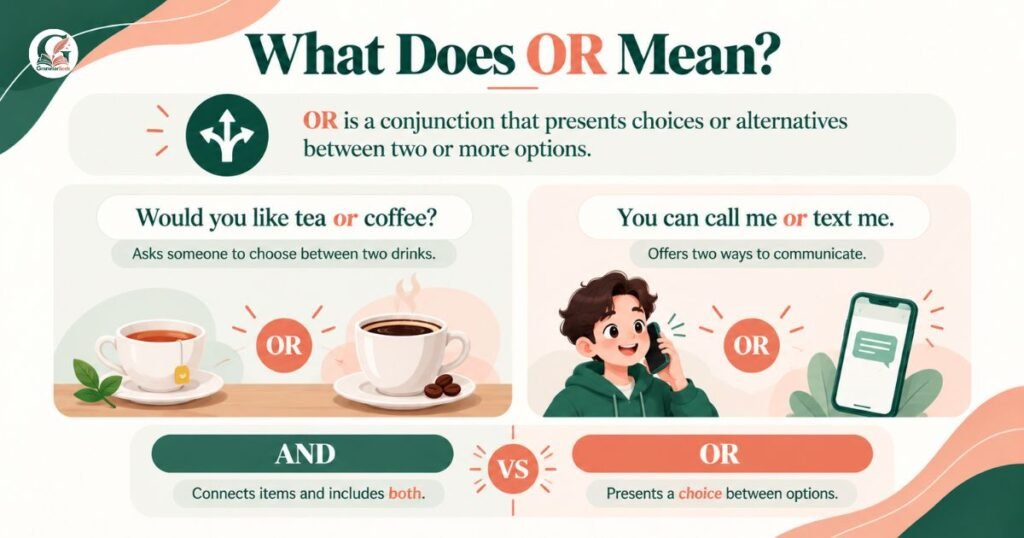
In English grammar, “or” is a conjunction that presents choices or alternatives between two or more options. It allows the speaker or writer to indicate that only one of the listed possibilities needs to be chosen.
For Example:
- “Would you like tea or coffee?” asks someone to choose between two drinks.
- “You can call me or text me” offers two ways to communicate.
Understanding the difference between and and or is essential. While “and” connects items to suggest that both are included, “or” emphasizes a choice between options.
When deciding which to use, remember that “or” is perfect for presenting alternatives, while “and” is used to combine ideas. This clarity helps facilitate better communication by ensuring that your audience grasps the intended meaning effectively.
And vs Or: Key Differences (Easy Table)
Understanding the difference between “and” and “or” is easy when you compare their meanings and uses. Both are conjunctions, but they serve different purposes in English grammar.
Here’s a simple comparison table illustrating their key differences:
| Aspect | And | Or |
| Meaning | Combines items or ideas | Presents alternatives |
| Purpose | Adds information | Offers choices |
| Usage | Includes items together | Indicates one or more possible options |
| Example | I like apples and bananas. | Would you like tea or coffee? |
| Memory tip | Together | Alternative |
Understanding the difference between or and and helps you choose the right conjunction and communicate clearly.
A helpful memory tip is: “and = together, or = alternative.” This insight can clarify when to use “and vs or,” making your sentences clearer and more precise.
When to Use And (With Real Examples)
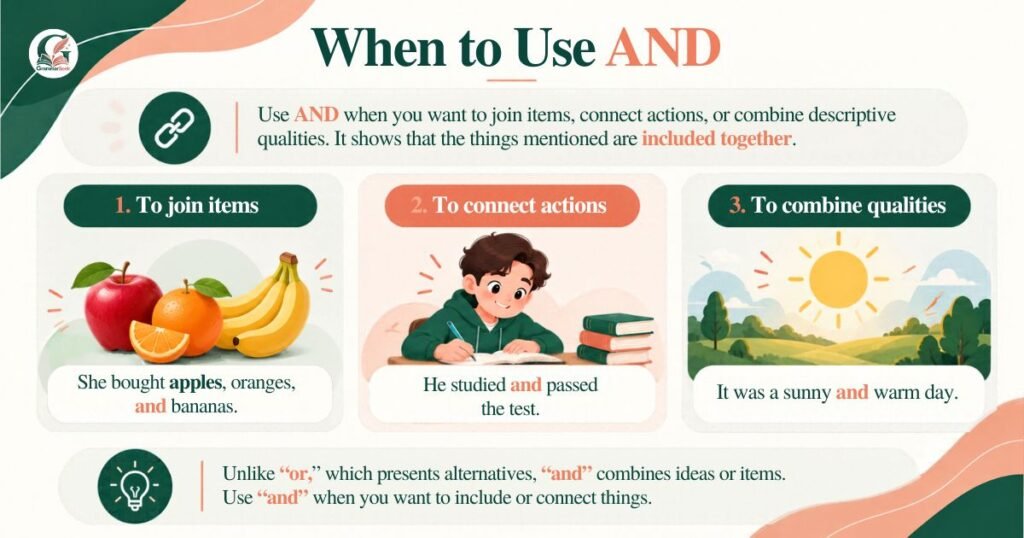
Use and in English grammar when you want to join items, connect actions, or combine descriptive qualities. It shows that the things mentioned are included together.
Examples of And
- To join items: She bought apples, oranges, and bananas.
- To connect actions: He studied and passed the test.
- To combine qualities: It was a sunny and warm day.
Unlike “or,” which presents alternatives, “and” combines ideas or items. When deciding when to use “and” vs. “or,” use “and” when you want to include or connect things.
When “and” joins two past actions, as in “He ran and jumped,” both verbs need the correct form, which you can review in past tense of run.
When to Use Or (With Real Examples)
Use “or” in English grammar when presenting choices, alternatives, or options. It helps people understand the available possibilities in questions and everyday conversations.

Examples of Or
- To offer choices: Would you like chocolate cake or ice cream?
- To present alternatives: Should we have pasta or pizza tonight?
- To offer time options: We can meet at 3 PM or 4 PM.
Unlike “and,” which combines items or ideas, “or” presents alternatives. When deciding when to use “and” vs. “or,” use “or” to offer options or express a choice.
“Or” is also common in multiple-choice questions, where the phrase which of the following asks you to pick one option from a list.
And vs Or in Real-Life Situations
Understanding and vs. or in daily conversation helps you communicate clearly. These words can change the meaning of a sentence, even when everything else stays the same.
1. At a Restaurant
- “I want rice and chicken.” – You want both items.
- “I want rice or chicken.” – You are presenting a choice between the two.
2. While Shopping
- “Buy apples and oranges.” – Buy both types of fruit.
- “Buy apples or oranges.” – Choose either type of fruit.
3. Making Plans
- “We can watch a movie and have dinner.” – Both activities are included in the plan.
- “We can watch a movie or have dinner.” – The sentence presents two alternatives.
4. Choosing Drinks
- “Would you like tea and coffee?” – The question offers both drinks.
- “Would you like tea or coffee?” – The question presents a choice between the drinks.
These real-life examples of or vs. and show how a small word can change a sentence’s meaning. Understanding the difference between and and or in simple English helps you express your intentions clearly and avoid confusion in everyday conversations.
Common Mistakes with And and Or
Many people make mistakes when using “and” and “or” in everyday situations. A common mistake with “and” and “or” is choosing the wrong conjunction and changing the intended meaning.
- Using “and” to offer a choice: “Would you like pizza and salad?” asks about both dishes. If you want to present alternatives, say, “Would you like pizza or salad?”
- Using “or” when both items are required: “You need eggs or milk” suggests alternatives. If a recipe requires both ingredients, write, “You need eggs and milk.”
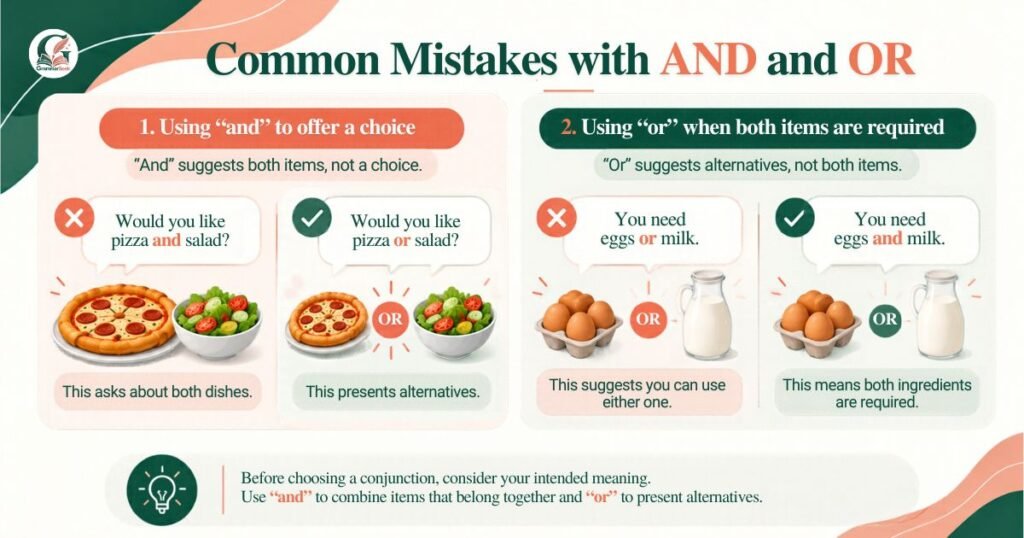
To avoid these mistakes, consider your intended meaning before choosing a conjunction. Use “and” to combine items that belong together and “or” to present alternatives. This simple rule helps you use “and” and “or” correctly in everyday communication.
Understanding the nuanced use of “and” versus “or” helps avoid confusion and ensures clear communication, especially in providing choices or compiling lists.
Another common mistake in English is confusing words that look or sound similar. A well-known example is of course or ofcourse, a spelling error that many writers make.
Can You Use “And” and “Or” in the Same Sentence?
Yes, you can use “and” and “or” in the same sentence when done correctly. Both conjunctions serve different purposes. “And” adds items or ideas together, while “or” presents choices or alternatives.
Examples:
- “You can have pizza or pasta, and we can serve a salad on the side.” Here, “or” offers a choice between two meals, while “and” adds a salad.
- “You can watch a movie, or you can stay home and read a book.” Here, “or” presents two alternatives, while “and” connects two actions.
Understanding how to use and and or correctly in English helps you create clear and engaging sentences. By mixing these conjunctions thoughtfully, you can enhance your writing and communication skills.
Advanced Tip: Inclusive Or vs Exclusive Or
When discussing the concepts of inclusive or and exclusive or, it’s essential to understand the fundamental differences in their meanings.
- Exclusive or refers to situations where only one of the options can be true or chosen.
For example, if someone says, “You can have tea or coffee,” it implies you must choose one, but not both. In this case, if you pick tea, coffee is off the table, highlighting the clear delineation in choice. - Inclusive or allows for both options to be valid at the same time.
For example, “You can have tea or coffee or both.” In this scenario, choosing both tea and coffee is perfectly acceptable.

In everyday English, the context usually determines whether “or” allows one option or both. Recognizing this distinction helps you understand the meaning of a sentence and avoid confusion.
And vs Or in Writing vs Speaking
The difference between or vs and matters in both writing and speaking. In everyday conversation, people often use these words more casually, allowing for ambiguity. In formal writing, choosing the correct conjunction helps avoid confusion.
For example:
- And: “Please bring apples and oranges.” This means both items are needed.
- Or: “Please bring apples or oranges.” This presents a choice between the two.
Understanding and vs or meaning can help reduce confusion and improve clarity in conversations, ensuring the intended message is received accurately.
Whether you are speaking or writing, knowing when to use “and” vs. “or” helps make your message clear and accurate. In professional writing, precise word choices are especially important to prevent misunderstandings.
Writers also use “or” to set contrasting ideas side by side, a technique explored in antithesis vs juxtaposition.
Quick Practice Sentences (Test Yourself)
Test your understanding of “and” vs. “or” with these simple fill-in-the-blank exercises. Choose the correct word for each sentence.
- Would you like pizza ____ pasta for dinner?
- I have both a cat ____ a dog.
- Would you prefer chocolate ____ vanilla ice cream?
- She reads books ____ watches movies.
Answer Key
- or
- and
- or
- and
Remember, “and” connects items or actions, while “or” presents choices or alternatives. Practicing the use of “and” and “or” in sentences can help you understand the difference and use both conjunctions correctly. Keep practicing!
Beyond choosing the right conjunction, the feeling your words carry matters too, which is the focus of connotation vs denotation.
Conclusion
Understanding the difference between and and or in English grammar is crucial for clear communication. While “and” connects or adds items and ideas, “or” gives choices or alternatives.
This simple distinction helps you express your thoughts more accurately. By knowing when to use each word, you can avoid confusion and improve your writing. So, remember to practice using and vs. or correctly in your sentences.
FAQs
When to Use And vs Or?
Use “and” when you want to include both items or ideas, indicating that both are true or needed. Use “or” when you want to show a choice between items or ideas, meaning that only one needs to be true or selected.
What is the Difference Between And and Or?
The word “and” combines two or more ideas, indicating that all of them are included. In contrast, “or” presents a choice between two or more options, allowing for one or the other to be selected.
When Should I Use And Instead of Or?
Use “and” when you want to combine items or ideas, indicating that all of them are included. Use “or” when you want to present a choice between options, suggesting that only one can be selected.
Can I Use And and Or in The Same Sentence?
Yes, you can definitely use “and” and “or” in the same sentence. Just be sure to structure your sentence clearly so that the meaning is easy to follow.