Plurals of Ox and Fox: Why “Oxen” and “Foxes” Are Both Correct
Not sure whether to write oxes or oxen? In English grammar, the plural of ox is oxen, an irregular plural, while the plural of fox is foxes, formed by adding -es. This guide explains the rules for plurals of ox and fox, the words’ history, common mistakes, and examples to help you use both forms correctly.
Quick Answer – Plurals of Ox and Fox
The plural of ox is oxen, an irregular form inherited from Old English. The plural of fox is foxes, made by adding -es to a noun ending in x.
These words follow different plural patterns, so use oxen for more than one ox and foxes for more than one fox. Choosing the correct plurals of fox and ox keeps your writing clear and grammatically accurate.
What Are the Plurals of Ox and Fox?
English forms the plural of ox with -en, producing the irregular plural oxen. The plural of fox is foxes: because fox ends in -x, it takes -es rather than a simple -s. This is a regular pattern for nouns ending in -x.
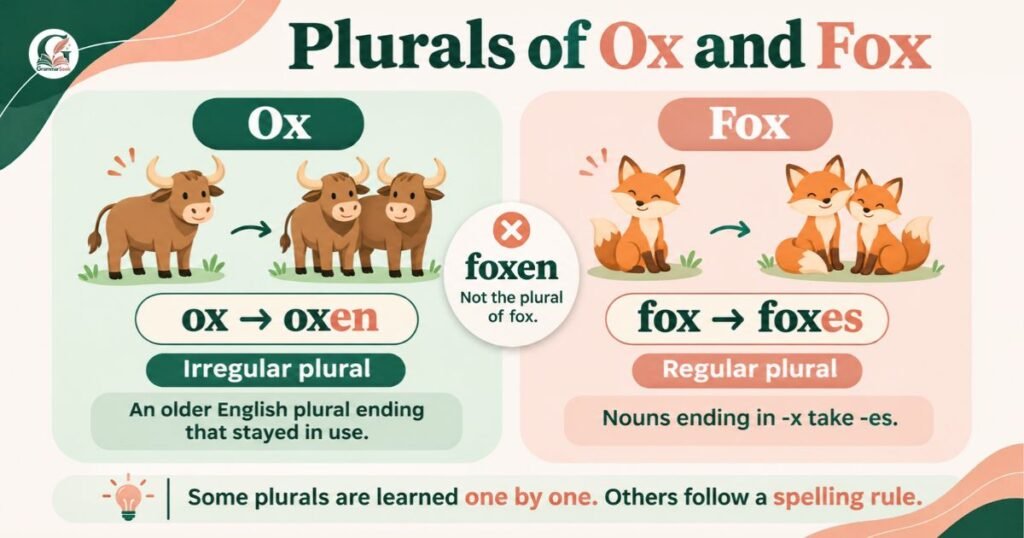
The difference reflects two parts of English plural rules. Oxen carries an older plural form that remained in use, while foxes follows the regular spelling pattern. Fox does not become foxen because the -en pattern applies to ox, not to nouns ending in -x as a group.
Historically, oxen comes from an older English plural ending, and foxes uses the established -es ending. These examples show why some plurals must be learned as individual forms while others follow a predictable spelling rule.
Plurals of Fox and Ox at a Glance
The plural forms of ox and fox follow different rules:
| Singular | Plural | Noun type | Plural rule |
| ox | oxen | Irregular | Uses the older -en ending. |
| fox | foxes | Regular | Add -es to nouns ending in -x. |
The correct forms are oxen and foxes. Oxes and foxs are common mistakes. Learning plural rules helps you choose the correct form when writing and speaking.
Why Is the Plural of Ox “Oxen” Instead of “Oxes”?
The plural of ox is oxen, a plural form that dates back to Old English. At the time, speakers used the ending -en to make some nouns plural, so oxen followed a pattern that was once more common than it is today.
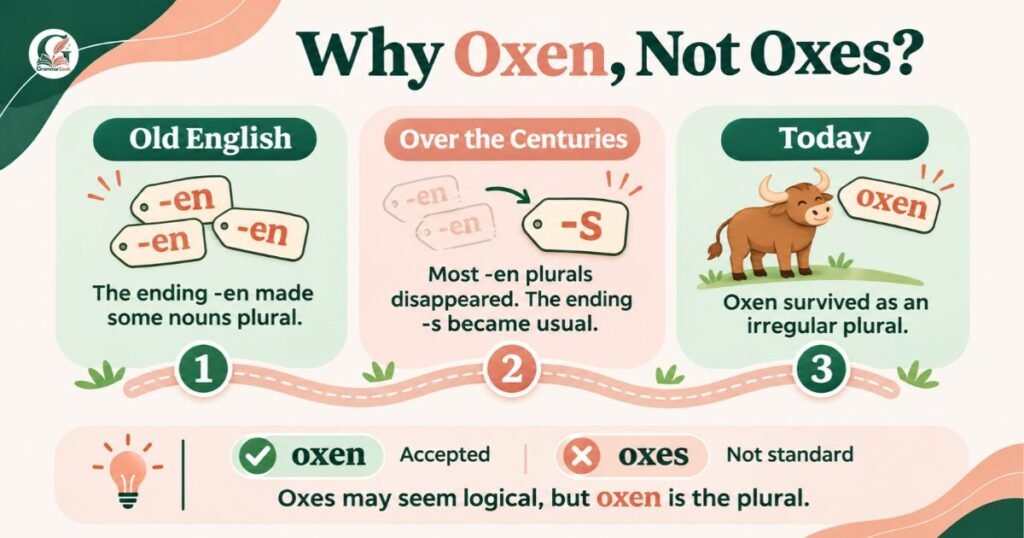
Over the centuries, most -en plurals disappeared as English plural forms changed. Oxen survived, while the regular ending -s became the usual choice for new plurals.
Because ox does not take that standard ending, it is an irregular plural noun. Oxes may seem logical by today’s rules, but it is not the standard plural; oxen remains the accepted form.
Why Does Fox Become Foxes?
To make fox plural, add -es: fox → foxes. This is the English plural rule for nouns ending in -x. The same -es ending applies to nouns ending in -x, -ch and -sh, such as:
- box → boxes
- tax → taxes
- branch → branches
- bush → bushes
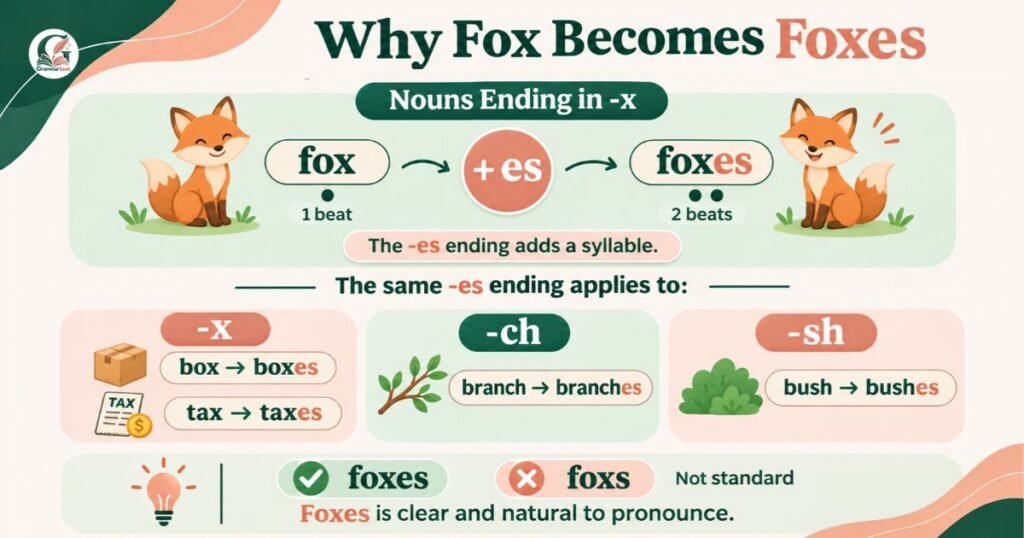
Writing foxs does not follow the standard spelling pattern for nouns ending in -x. The -es ending adds a syllable, making foxes clear and natural to pronounce.
Other plural spelling rules, such as the one for nouns ending in “y”, are explained in plural of journey.
Why Don’t Ox and Fox Follow the Same Plural Rule?
The difference between ox and fox reflects two layers of English plural rules. Oxen is an irregular plural inherited from an older English pattern. Foxes follows the modern rule for nouns ending in -x: add -es to form the plural.
Many English plural forms changed as the language developed, but some older forms survived. Oxen is one of them; fox did not keep that older ending and takes the usual spelling for an -x noun instead. For that reason, foxen is not the standard plural, foxes is.
Regular and Irregular Plural Nouns Explained
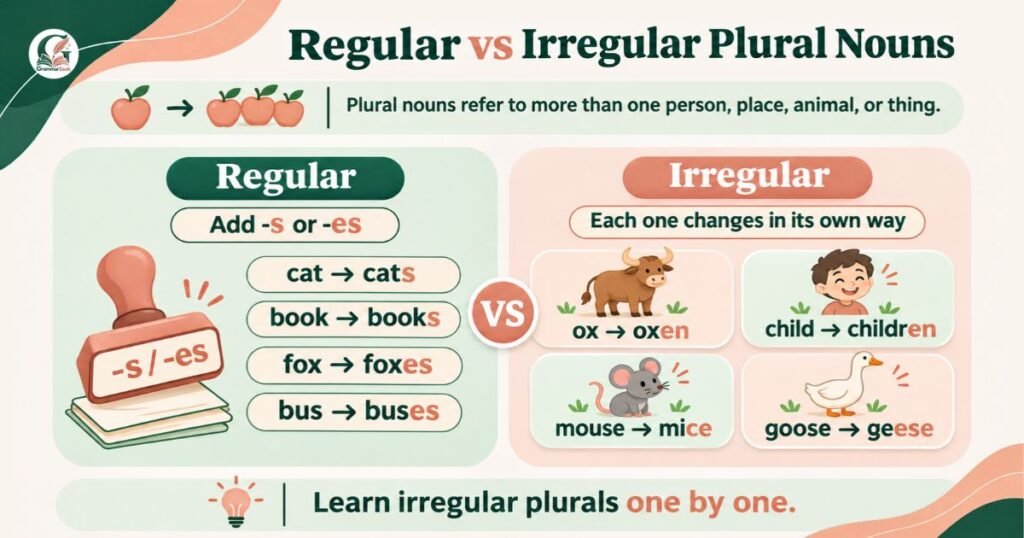
Plural nouns refer to more than one person, place, animal, or thing. They are mainly regular or irregular, depending on how their form changes.
Regular Plural Nouns
Regular plural nouns usually form the plural by adding -s or -es to the singular noun. For example:
- Fox → Foxes
- Cat → Cats
- Bus → Buses
- Book → Books
Irregular Plural Nouns
Irregular plural nouns do not follow the usual -s or -es pattern. They change in different ways, so it helps to learn their plural forms:
- Ox → Oxen
- Child → Children
- Mouse → Mice
- Goose → Geese
Recognizing these patterns helps you choose the correct plural form and improve your English grammar and writing.
Not every noun that resembles an irregular one follows it, as with “human,” whose plural is “humans” and not “humen,” as explained in humans or humen.
Common Mistakes With the Plurals of Ox and Fox
Learners often confuse the plurals of ox and fox because the words form their plurals in different ways. The correct forms are:
- Ox → oxen (correct); oxes (incorrect)
- Fox → foxes (correct); foxs and foxen (incorrect)
Use oxen for more than one ox. Oxes is incorrect because the standard plural is oxen. Use foxes for more than one fox: add -es to the end.
Foxs does not follow this spelling pattern, and foxen incorrectly uses the plural ending found in oxen. Check a trusted dictionary if you are unsure, and practice using both words in sentences.
Example Sentences Using Ox, Oxen, Fox, and Foxes
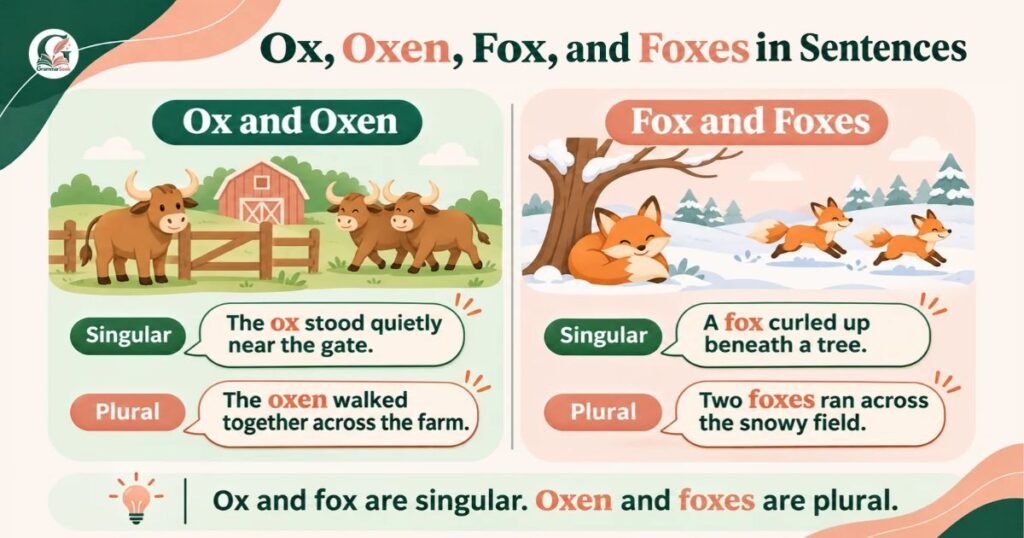
Ox and fox each name one animal, so they are singular nouns. Oxen and foxes are the correct plural forms.
Examples with Ox and Oxen
- The ox stood quietly near the gate.
- The oxen walked together across the farm.
- A farmer brushed the ox before work.
- The oxen drank water from a trough.
Examples with Fox and Foxes
- A fox curled up beneath a tree.
- The foxes played near their den.
- I spotted a fox beside the trail.
- Two foxes ran across the snowy field.
Practicing these sentences helps readers remember the plurals of ox and fox.
Similar English Nouns With Unusual Plurals
Many nouns form their plural by adding -s or -es, but ox is an exception: its plural is oxen. It belongs to a group of irregular plural nouns with unusual plurals that change in different ways.
| Singular | Plural |
| Ox | Oxen |
| Child | Children |
| Mouse | Mice |
| Goose | Geese |
| Man | Men |
| Woman | Women |
| Tooth | Teeth |
| Foot | Feet |
The contrast is oxen versus foxes: oxen is irregular, while foxes is the regular plural of fox, made by adding -es. Recognizing these patterns helps you use plural nouns correctly and avoid common mistakes.
Nouns ending in “f” add another layer of plural doubts, as in plural of chief and plural of chef.
Why English Has Irregular Plurals
English irregular plurals reflect how the language changed over hundreds of years. In Old English, nouns used several different plural endings. Over time, most nouns adopted the regular plural endings -s or -es, which are common in modern English.
Some frequently used words kept older forms instead. For example, ox becomes oxen, child becomes children, and goose becomes geese. These irregular plural nouns survived in modern English because people continued to use them.
Regular practice, along with an understanding of English grammar history, can make these forms easier to remember.
Verbs have irregular forms that survived in the same way, as shown in past tense of run.
Quick Grammar Tips to Remember
The plurals of ox and fox are easy to mix up, but each has a clear form. Keep this short list handy:
- Ox → oxen is an irregular plural.
- Fox → foxes is a regular plural; nouns ending in -x usually add -es.
- Oxes, foxs, and foxen are incorrect. When in doubt, check a reliable dictionary.
Memory Trick: oxen has the unique -en ending, while foxes is made by adding -es to fox.
Final Comparison Table
Here’s a quick comparison of how to form the plural of ox and the plural of fox.
| Feature | Ox | Fox |
| Singular | Ox | Fox |
| Plural | ✅ Oxen | ✅ Foxes |
| Type | Irregular noun | Regular noun |
| Plural Rule | Uses -en | Adds -es |
| Correct Form | ✅ Oxen | ✅ Foxes |
| Incorrect Form | ❌ Oxes | ❌ Foxs and Foxen |
This table is a quick grammar reference for choosing the correct plural forms of fox and ox.
Conclusion
The plural of ox is oxen, an irregular plural inherited from Old English; the plural of fox is foxes, formed by adding -es to a noun ending in -x. These words show that English plural rules can vary.
Remember: ox is the exception, while fox follows the regular spelling pattern. Practice both forms in example sentences, and watch out for “oxes” and “foxs.”
FAQs
What Is The Plural Of Ox?
The plural of ox is oxen. This is an irregular plural noun because it retains an older irregular plural form rather than following the usual -s or -es pattern.
What Is The Plural Of Fox?
The plural of fox is foxes. Since fox ends in x, it takes -es under the regular spelling rule.
Is The Plural Of Ox “Oxes” Or “Oxen”?
The standard plural is oxen. Oxes is not the standard form; ox has an irregular plural.
Why Isn’t The Plural Of Fox “Foxen”?
Foxen is not the standard plural of fox. The correct form is foxes, made by applying the regular -es rule to a word ending in x.
Is “Oxen” Singular Or Plural?
Oxen means more than one ox, so it is plural. Ox is the singular form.
Are Oxen Still Used Today?
Yes. Oxen are still used today, particularly in farming and historical contexts.
Is It Correct To Say “Oxes”?
No, oxes is not correct in standard English. Use oxen as the plural of ox.
What Is The Plural Form Of “Ox”?
Use oxen as the plural form of ox. Ox is singular, and oxen is its irregular plural.
What Is The Plural Form Of “Fox”?
The plural form of fox is foxes. It follows the regular -es spelling rule for words ending in x.