Stopped or Stoped? Which Spelling Is Correct? The Ultimate Grammar Guide
When you’re writing about something that already happened, one small spelling choice can make you pause: is it stopped or stoped? The correct spelling is “stopped,” but the extra consonant can be easy to miss.
This guide explains the consonant-doubling rule used to form the past tense of stop and shows why the final consonant ‘p’ is doubled before adding “-ed.” Understanding this pattern can help you spell similar words correctly and avoid common mistakes in everyday writing.
Quick Answer: Stopped or Stoped?
For stopped or stoped, stopped is correct in both American and British English. Stoped is incorrect.
When adding -ed to stop, double the final p before adding the ending: stop → stopped.
For Example:
- The car stopped at the light.
- She stopped to check the map.
Understanding the Basics of Stopped or Stoped
The correct spelling is stopped, not stoped. Many regular verbs form the past tense by adding -ed:
- walk → walked
- clean → cleaned
When a one-syllable verb ends in a consonant-vowel-consonant pattern with a short vowel sound, like stop, the final consonant is doubled before -ed is added.
Comparison Table: Stopped or Stoped
| Form | Grammatical form | Meaning | Example | Correctness |
| stop | Base form | To cease moving or doing something | Please stop the car. | Correct |
| stopped | Past tense or past participle | Ceased moving or doing something | The car stopped at the light. | Correct |
| stoped | Incorrect spelling of stopped | Intended to mean “ceased” | The car stoped at the light. | Incorrect |
So, when choosing between stoped or stopped, use stopped for the past tense and past participle. This spelling follows the consonant-doubling rule.
Not every verb forms its past tense with “-ed”, as shown in past tense of run and past tense of seek.
Stopped or Stoped: Why Is “Stopped” Correct?
The correct spelling is stopped, not stoped. The word follows a spelling rule for one-syllable verbs: when a verb ends in a short vowel followed by a single consonant, double the final consonant before adding -ed or -ing.
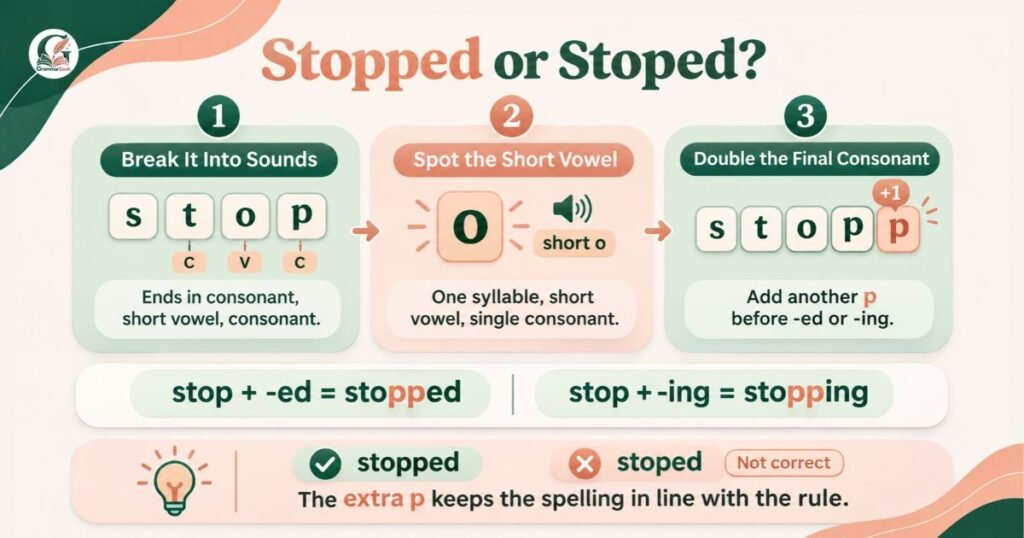
To see how the rule works, break stop into its sounds: s-t-o-p. It has a consonant-vowel-consonant pattern, and the o is a short vowel. Add another p, then add -ed: stop → stopped. The same doubling applies with -ing: stopping.
So, when choosing between stopped or stoped, use stopped. The extra p keeps the spelling in line with the consonant-doubling rule.
The Consonant-Doubling Rule Explained
The spelling stopped follows a simple consonant-doubling rule. Double a verb’s last consonant before adding a vowel-starting suffix such as -ed or -ing when the verb has one syllable and ends in one vowel followed by one consonant. All three conditions must be true.
| Base verb | Past tense | Present participle |
| stop | stopped | stopping |
| plan | planned | planning |
| drop | dropped | dropping |
| hug | hugged | hugging |
| slip | slipped | slipping |
This pattern also explains forms such as planned and slipping.
The rule has exceptions and regional differences, as shown in targetted or targeted and traveler or traveller.
Stopped or Stoped in Everyday English
Here are a few examples of “stopped” in common situations.
Stopped Examples in Everyday Conversations
- “I stopped to check the time.”
- “They stopped laughing when the movie began.”
- “We stopped at a restaurant for lunch.”
Examples of Stopped in School
- “Maya stopped to sharpen her pencil.”
- “The students stopped talking when class started.”
- “The teacher stopped the lesson to make an announcement.”
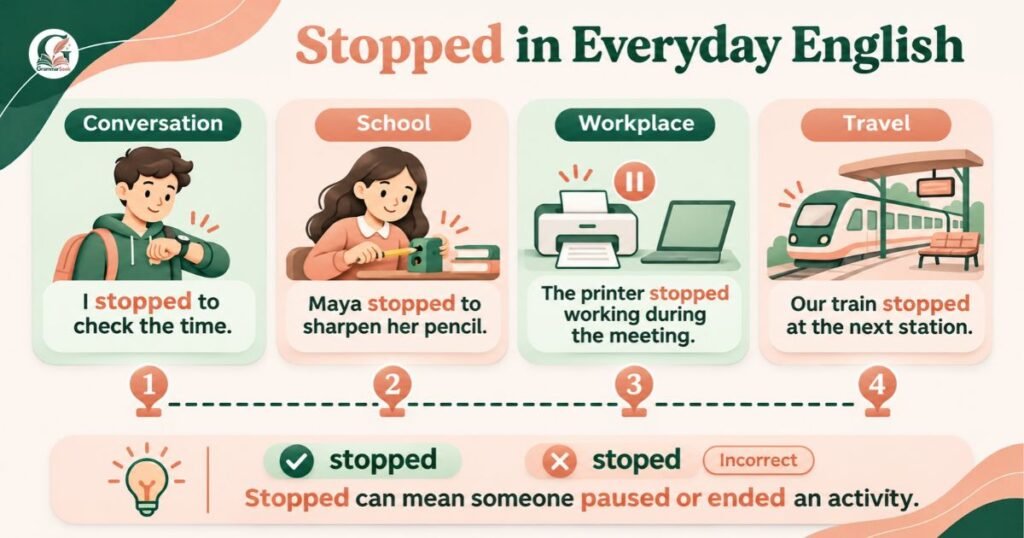
In everyday English, stopped can mean that someone paused or ended an activity.
Workplace Examples of Stopped
- “I stopped by the office to pick up a form.”
- “The printer stopped working during the meeting.”
- “The software stopped responding.”
Stopped Examples in Traveling
- “Our train stopped at the next station.”
- “We stopped for directions on the way to the hotel.”
- “The bus stopped near the museum.”
When choosing between stopped or stoped, use stopped: it is the correct spelling, while stoped is incorrect.
Correct Meanings and Uses of Stopped
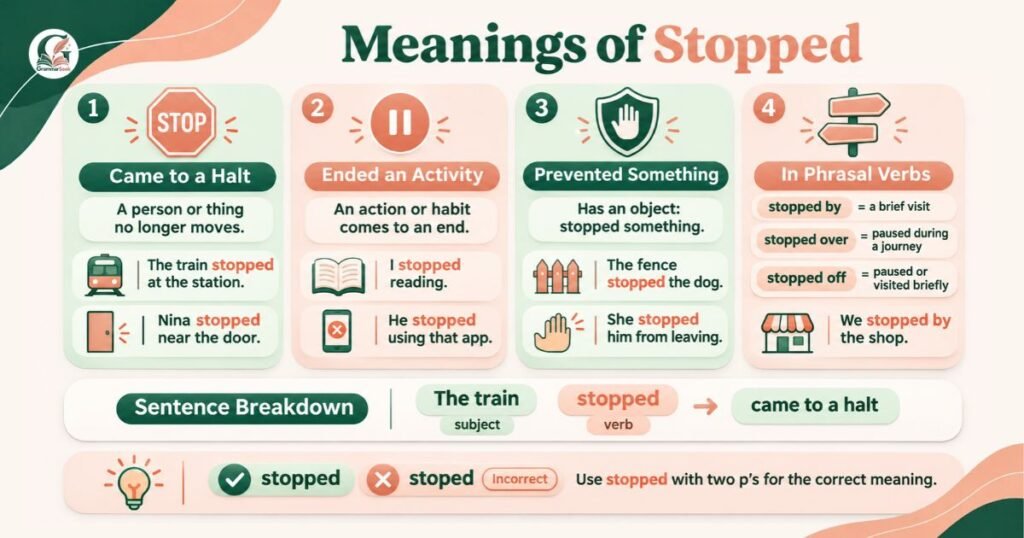
1. Stopped Means “Came to a Halt”
Here, stopped describes a person or thing that no longer moves.
Examples:
- “The train stopped at the station.”
- “Nina stopped near the door.”
Sentence breakdown: In “The train stopped,” the train is the subject, stopped is the verb, and the meaning is that the train came to a halt.
2. Stopped Means “Ended an Activity”
Use this meaning when an action or habit comes to an end.
Examples:
- “I stopped reading.”
- “They stopped playing.”
- “He stopped using that app.”
3. Stopped Means “Prevented Something”
When stopped has an object, it can mean that someone or something prevented an action or event.
Examples:
- “The fence stopped the dog.”
- “The police stopped the robbery.”
- “She stopped him from leaving.”
4. Stopped in Phrasal Verbs
The meaning changes in common expressions: stopped by means made a brief visit, stopped over means paused during a journey, and stopped off means paused or visited briefly along the way.
Examples:
- “We stopped by the shop.”
- “He stopped over in Chicago.”
- “I stopped off for lunch.”
For spelling, use stopped, not stoped; this answers the common “stopped or stoped” question.
Test Tip for Remembering Stopped or Stoped
The correct past-tense spelling is stopped, not stoped. Use this quick checklist to remember why:
- Is the base word stop?
- Are you changing it to the past tense?
- Are you adding -ed?
When all three answers are yes, double the final p: stop → stopped. Remember the rule: one short vowel followed by one final consonant means double the consonant before adding -ed.
Case Study: Business Email Example
Suppose an employee is emailing a client to report that a production line is no longer working. The wording should be clear and polished.
- Before: “The production line has stoped, and we are checking the issue.”
- After: “The production line has stopped, and we are checking the issue.”
Stopped and stoped may look similar, but only “stopped” is correct. A spelling mistake can affect the reader’s impression of the sender’s attention to detail, even when the rest of the email is clear.
Grammar Authority: What Do Dictionaries Say?
For the past tense of stop, trusted dictionaries point to one standard spelling: stopped. This settles the common question of stopped vs stoped.
- Merriam-Webster lists stopped as the past tense and past participle.
- Cambridge Dictionary identifies stopped as the standard form.
- Oxford Learner’s Dictionary likewise recognizes stopped.
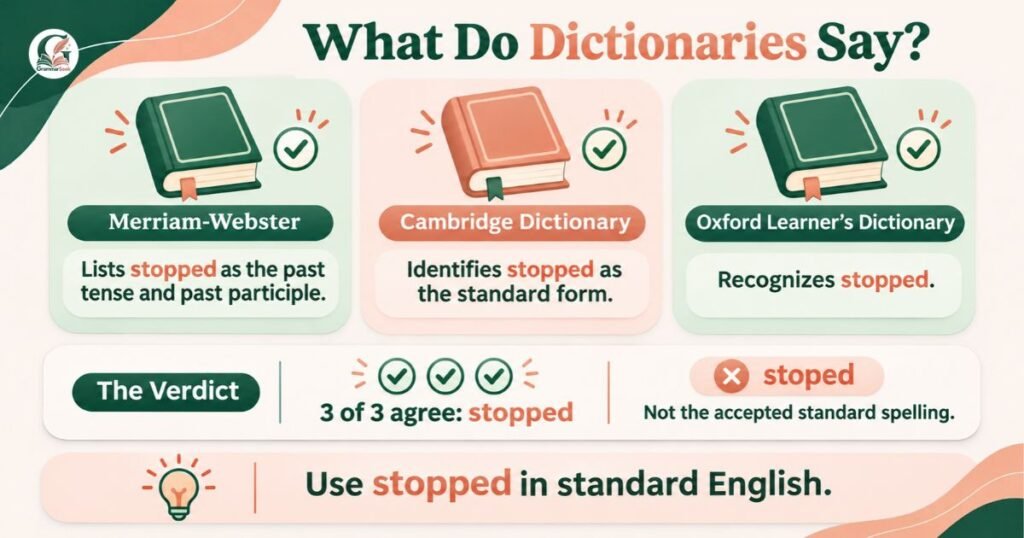
Stoped is not the accepted standard spelling. Because all three references agree, use stopped in standard English.
Common Mistakes When Choosing Stopped or Stoped
Fast Typing
Typing at speed can cause a missed letter or an incomplete spelling check. The past tense of stop has a double p, so stoped is incorrect. Read the whole sentence once before submitting it.
- Incorrect: We stoped at the store after work.
- Correct: We stopped at the store after work.
Autocorrect Problems
Autocorrect does not always identify errors, particularly when a typo forms another valid word. It can also change a word that was correct in context. Review suggested changes and confirm that the sentence still says what you mean.
If you are unsure whether to write stopped or stoped, choose stopped as the standard past-tense spelling.
Lack of Grammar Knowledge
Not knowing common verb patterns can lead to misspellings. In many short verbs with a final consonant-vowel-consonant pattern, double the last consonant before -ed or -ing: stop becomes stopped, while plan becomes planned. The same doubling is used in beginning and running. These regular examples make the spelling pattern easier to remember.
Influence from Other Languages
English spelling rules may differ from those in a writer’s first language. As a result, familiar patterns from another language can affect how a person spells English words. Checking a dictionary or trusted example can clarify the standard form.
Similar Grammar Mistakes
| Incorrect | Correct | Reason |
| stoped | stopped | Double p before -ed |
| begining | beginning | Double n before -ing |
| planed (when you mean the past tense of plan) | planned | Planned means arranged or prepared something. Planed is also a legitimate English word (the past tense of plane) |
| runing | running | Double n before -ing |
| it’s | its | Its is possessive; it’s means it is |
| your | you’re | You’re means you are |
| than | then | Than compares; then refers to time or order |
| loose | lose | Loose means not tight; lose means misplace or fail to win |
Doubling a letter that should not be doubled causes the opposite mistake in writing or writting.
Usage in Different Contexts: Stopped or Stoped
Everyday Conversation
Use stopped to say that someone or something came to a halt, quit an activity, or no longer worked. Stopped is the correct past tense of stop; stoped is incorrect.
- “The car stopped at the light.”
- “Maya stopped eating when she felt full.”
- “The fan stopped during the night.”
Correct spelling makes everyday messages easy to understand.
Professional Writing
In workplace notes, stopped clearly reports a pause or an ended task. Accurate spelling also gives emails and records a polished appearance.
- “The call stopped when the connection failed.”
- “We stopped using the older template.”
- “The machine stopped after the final order.”
Academic Writing
Academic writing uses stopped for actions, observations, and processes that came to an end. Correct spelling helps keep formal writing clear.
- “The survey stopped accepting responses on Friday.”
- “The reaction stopped after the solution cooled.”
- “The class stopped measuring the sample when time ran out.”
Creative Writing
Writers can use stopped to shape a scene or signal a shift. Spelling it correctly keeps readers from being distracted.
- “The horse stopped beside the gate.”
- “He stopped laughing when he heard the knock.”
- “Rain stopped before dawn.”
Social Media and Text Messages
Short posts still benefit from standard spelling: write stopped, not stoped.
- “I stopped by the shop after work.”
- “Our game stopped loading again.”
- “We stopped chatting to watch the match.”
In every context, the doubled p marks the correct past-tense form.
Why Correctly Choosing Stopped or Stoped Matters
Clear Communication
When you are deciding between stoped or stopped, use stopped. It is the correct past tense of stop, while stoped is incorrect.
- Correct: “Maya stopped walking when she saw the sign. ”
- Incorrect: “Maya stoped walking when she saw the sign. ”
Correct spelling lets readers follow the point without being pulled away by an error.
Professionalism
In emails, job applications, and workplace messages, spelling is part of the impression your writing makes. A careful proofread helps show attention to detail and keeps the focus on your qualifications, request, or update. Checking common past-tense forms is a simple step toward clear, professional communication.
Writing Accuracy
Consistent spelling makes writing easier to read and helps it feel credible and complete. In academic work, accuracy can support a polished submission and help your ideas come through. Keep these benefits in mind:
- Clearer reading
- Greater credibility
- More polished assignments
- Fewer distracting errors
Better Digital Communication
Online content also benefits from standard spelling. It supports content quality, reader trust, and a smoother user experience. Accurate spelling can contribute to clear, consistent SEO content, though it cannot promise a search ranking.
Special Exception: Is There Ever a Time When “Stoped” Is Correct?
The rare word stoped belongs to mining. It is the past tense of stope, a specialized term for an underground excavation where miners extract ore.
Example: “The miners stoped the deposit to extract the ore.”
Outside technical mining literature, stoped is unlikely to be the intended spelling. In everyday, business, academic, and general writing, the past tense of stop is stopped. So, when deciding between stopped vs. stoped, use stopped unless you are writing about mining.
Memory Tricks for Remembering Stopped or Stoped
The past tense of stop can be easy to spell when you remember what happens to its final consonant. Use these three quick cues when writing the word.
Trick 1: Short Vowel + Single Consonant
For a short-vowel word ending in one consonant, double the final consonant before adding -ed. In stop, the short o comes before a single final p, so the spelling changes like this:
Stop → Stopped
Trick 2: Think of Similar Verbs
- Stop → Stopped
- Drop → Dropped
- Plan → Planned
- Hug → Hugged
These verbs share a short vowel followed by one final consonant, which doubles before -ed.
Trick 3: Say It Aloud
Say “stop, stopped” aloud and picture the second p appearing in the spelling. Think: “Past means an extra P.” For stopped vs. stoped, choose stopped for the everyday verb stop. Stoped is incorrect.
Quick Recap Checklist: Stopped or Stoped
For the past tense and past participle of stop, double the final p: use stopped. Check each point below:
| Question | If Yes → Use |
| Is the base verb stop? | stopped for its past forms |
| Are you writing about an action that happened in the past? | stopped |
| Are you using the past participle of stop? | stopped |
| Have you accidentally written stoped? | stopped |
| Are you writing in standard everyday English? | stopped |
The spelling stoped applies only in a rare, specialized mining context, derived from stope.
Practice Exercise and Quick Quiz: Stoped or Stopped?
Fill in the Blanks
Complete each sentence with the correct past-tense or past-participle form of stop.
- The taxi ___ outside the hotel.
- Our team has ___ for a short break.
- The driver ___ when a pedestrian crossed the street.
- Leo ___ eating sweets during the week.
- I ___ to pick up the mail yesterday.
Answer Key
- stopped
- stopped
- stopped
- stopped
- stopped
Choose the Correct Sentence
Select the sentence with the correct spelling. Stopped is correct in ordinary English; stoped is not.
- A. The rain stoped before noon. B. The rain stopped before noon.
- A. Nina stopped the timer. B. Nina stoped the timer.
- A. We stoped at the café after work. B. We stopped at the café after work.
Answer Key
- B — The rain stopped before noon.
- A — Nina stopped the timer.
- B — We stopped at the café after work.
Conclusion
When choosing between stopped or stoped, remember that stopped is the correct spelling in standard English. The final p doubles before adding -ed, just as it does in planned, dropped, and hugged.
Keep this simple rule in mind:
Short vowel + single final consonant + -ed = double the consonant.
Stop → Stopped.
Understanding this pattern will help you avoid this common spelling mistake and use the correct form confidently in everyday writing.
FAQs
Which Is Correct: Stopped Or Stoped?
Stopped is the correct spelling in standard English. Stoped is a misspelling. The past tense of stop is formed by doubling the final p and adding -ed: “We stopped at the red light.”
Is “Stopped” A Word?
Yes. Stopped is a standard English word and the past-tense and past-participle form of stop. For example, “The bus stopped near the station.” The spelling has two ps before -ed.
What Does Stopped Mean?
Stopped means that someone or something ended an action, movement, or process. It is the past tense of stop. For example, “She stopped talking” means she was talking and then ended that action.
Is “Stoped” Ever Accepted?
In everyday English, stoped is incorrect when used as the past tense of stop. However, stoped is a rare technical term in mining, derived from stope. In ordinary writing, always use stopped.
Why Stopped Has Two P?
The consonant-doubling rule explains the spelling: when a one-syllable verb ends in one consonant preceded by one short vowel, the final consonant is doubled before adding -ed.
Is Stopped A Regular Verb?
Yes. Stop is a regular verb because its past tense follows a standard pattern: add -ed. The final p doubles first, giving stopped. Other forms include “has stopped” and “had stopped.”
Is “Stopped” Used In Both American And British English?
Yes. Stopped is the standard spelling in both American and British English. The spelling does not change between these varieties. Use stopped for the past tense and past participle of stop in either one.
Is Stopped Correct Grammar?
Yes, stopped is grammatically correct when used as the past tense or past participle of stop. The right form depends on the sentence. For example, “They stopped” is past tense; “They have stopped” uses the past participle.
How Can I Avoid Writing “Stoped” By Mistake?
Remember the consonant-doubling rule: stop ends in one consonant after one vowel, so double p before adding -ed. Check for two ps when proofreading: stopped is correct; stoped is not.