Hustle or Hussle? The Correct Spelling (With Clear Rule)
The terms hustle and hussle often create confusion among writers and readers. A common example of this mix-up appears in phrases like “side hustle,” which highlights the importance of clarity in spelling.
This guide clarifies whether to use hustle or hussle which spelling is correct and provides a helpful rule for differentiation. Understanding the correct terms in the English language is essential for effective communication. Equip yourself with this knowledge to elevate your writing and impress your readers.
Quick Answer – Hustle or Hussle
The correct spelling is hustle. It’s commonly used in phrases like “side hustle,” denoting additional work or effort outside one’s main job. While hussle might appear in intentional brand names or artistic expressions, it is not recognized as standard English. Always use the word “hustle” in formal writing.
Why “Hussle” Looks Right (But Isn’t)
The spelling “hussle” may catch the eye, but it deviates from the established norm of “hustle.” Here are a few reasons why “Hussle” looks correct but is actually a misspelling.
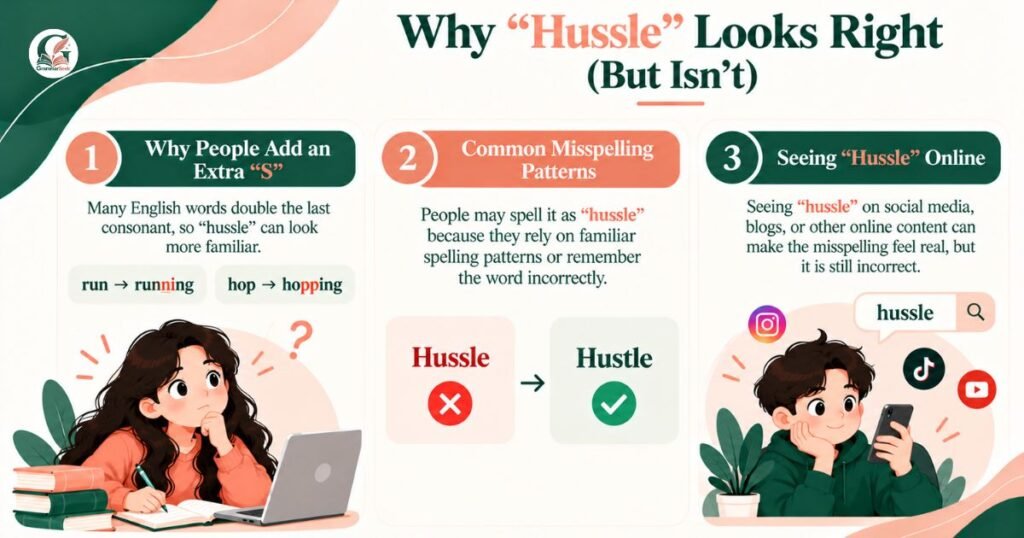
Why People Add an Extra “S”
The spelling “hussle” may seem intuitively correct to some due to the prevalence of doubled consonants in English. Words like “running” and “hopping” create a visual familiarity that can lead to the misconception that “hustle” follows the same rule.
This mistaken pattern makes the extra “s” feel more comfortable, as if it belongs there, inviting users to unconsciously replicate the spelling habits found in other common words.
The spelling of hustle is unique in its standard form, reflecting an important distinction that “hussle” does not uphold.
Common Misspelling Patterns
People may misspell hustle as hussle because they rely on familiar spelling patterns or remember the word incorrectly.
Once the incorrect spelling is repeated or seen elsewhere, it can become easier to remember, even though “hustle” remains the standard spelling.
Seeing “Hussle” Online
Seeing “hussle” repeatedly across various online content can create an uncanny sense of familiarity, making the misspelling feel almost legitimate.
This frequent exposure can lead many to view “hussle” as an acceptable variation, yet it remains a clear departure from standard English. The correct spelling is undeniably “hustle,” which maintains its integrity and meaning.
Familiarity does not equate to correctness, and embracing accurate language strengthens our communication.
What Does Hustle Actually Mean?
To fully understand the correct spelling of hustle, Hustle or Hussle, it is important to know the meaning of Hustle. Here is what hustle means as a verb, as a noun and in slangs.
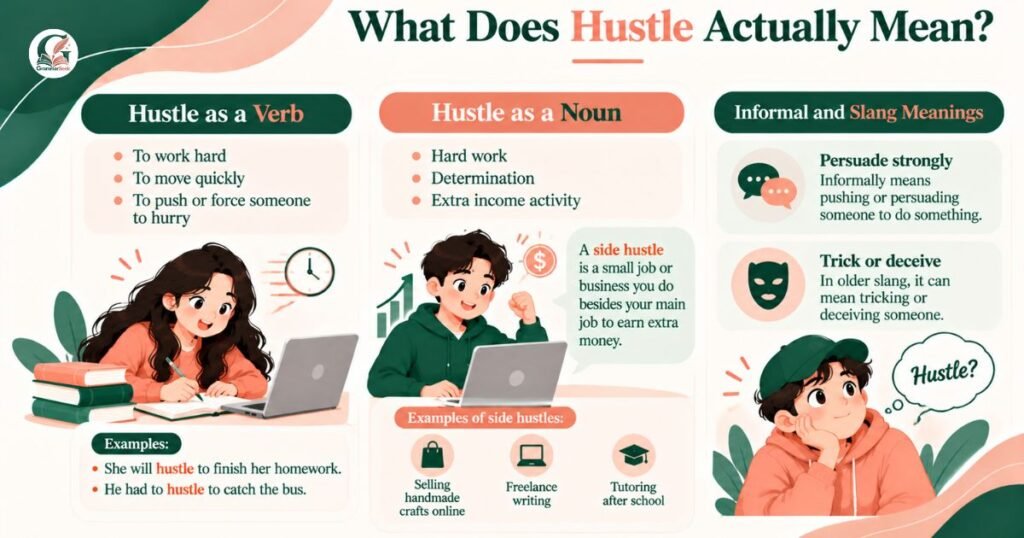
Hustle Meaning As a Verb
As a verb, hustle means:
- To work hard
- To move quickly
- To push or force someone to hurry
Example:
- She will hustle to finish her homework.
- He had to hustle to catch the bus.
Hustle Meaning As a Noun
As a noun, hustle has powerful meanings in modern English:
- Hard work
- Determination
- Extra income activity
The phrase side hustle is very popular. A side hustle means a small job or business you do besides your main job to earn extra money.
Examples:
- Selling handmade crafts online
- Freelance writing
- Tutoring after school
Informal and Slang Meanings of Hustle
In informal English and Slangs, hustle can also mean:
- Persuade strongly: “Hustle” can informally mean persuading or pushing someone to do something.
- Trick or deceive: In older slang, “hustle” can mean tricking or deceiving someone.
Slang meanings can shift and evolve, revealing the dynamic nature of language.
Is “Hussle” Ever a Real Word?
The term “hussle” is not recognized as a standard English word; it is merely a misspelling of “hustle.” While “hustle” conveys a sense of hard work and determination, “hussle” is often seen in contexts where phonetics play a role in branding or identity.
Most notably, it appears in the name of the late rapper Nipsey Hussle, blending cultural significance and personal identity, yet it does not redefine the conventional spelling of the word.
Misspelling vs Stylistic Spelling
The use of “hussle” as a stylistic choice can be compelling in creative contexts but should not be confused with the actual term “hustle.” This distinction underscores the importance of maintaining linguistic standards while allowing for creative expression in proper names and brands.
- Use “hustle” in normal writing.
- Use “Hussle” when it is part of a specific proper name or brand.
Hustle in Modern Culture
The phrase “side hustle” has surged in popularity, reflecting a cultural shift towards entrepreneurship and alternative income streams.
This term encapsulates a growing mindset where individuals seek financial independence and creative fulfillment outside traditional 9-to-5 jobs. People are increasingly exploring various avenues to supplement their income and realize their passions.
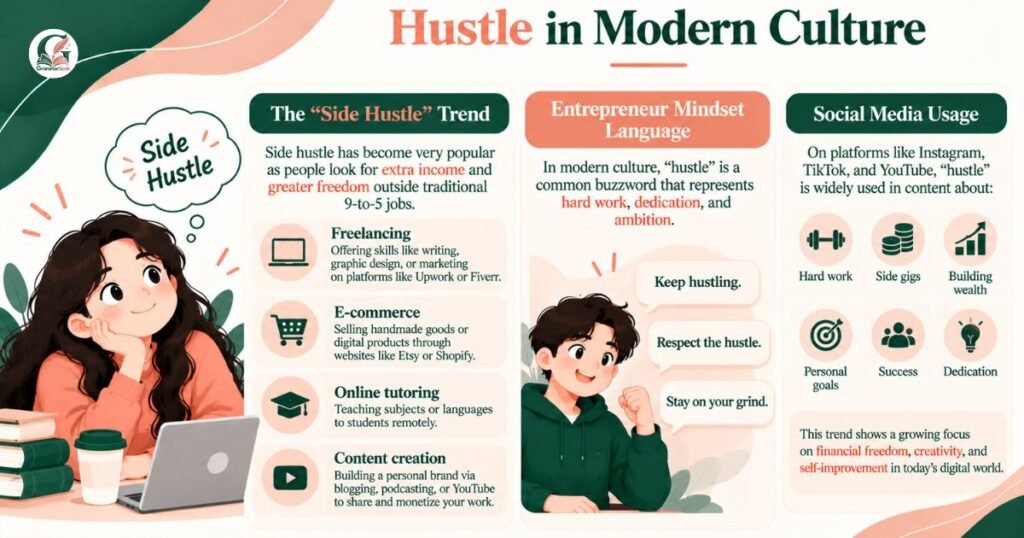
The “Side Hustle” Trend
Here are some popular avenues associated with side hustles:
- Freelancing: Offering skills in writing, graphic design, or marketing on platforms like Upwork or Fiverr.
- E-commerce: Selling handmade goods or digital products through websites like Etsy or Shopify.
- Online tutoring: Leveraging expertise in subjects or languages to teach students remotely.
- Content creation: Building a personal brand via blogging, podcasting, or YouTube to monetize insights and experiences.
This trend underscores a broader desire for flexibility and innovation, enabling individuals to tailor their professional lives to their unique aspirations and strengths.
Entrepreneur Mindset Language
In modern culture, “hustle” has become a powerful buzzword in the entrepreneurial community.
Motivational and entrepreneur use phrases like:
- Keep hustling.
- Respect the hustle.
- Stay on your grind.
Here “hustle” often refers to hard work and dedication.
Social Media Usage
In today’s digital age, “hustle” is commonly used on social media in content. Hustle is used in content about:
- hustle culture
- the daily grind
- building wealth
Creators on On Instagram, TikTok, and YouTube use it when discussing:
- hard work
- side gigs
- business
- personal goals
- shaping perceptions of success
- dedication across platforms
That is one of the reasons why confusion about Hustle or Hussle continues.
Pronunciation Guide (So You Never Misspell It Again)
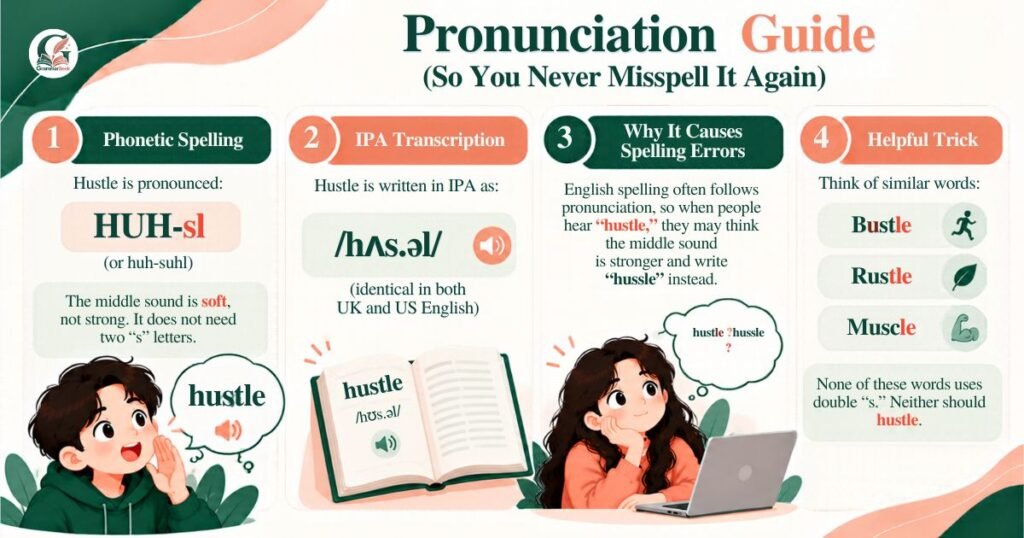
Correct pronunciation helps correct spelling. Here is the Pronunciation Guide for “Hustle” so you never misspell it again as “Hussle”.
Phonetic Spelling
Hustle is pronounced:
HUH-sl (or huh-suhl)
The middle sound is soft, not strong. It does not need two “s” letters.
IPA Transcription of Hustle:
/ˈhʌs.əl/ (identical in both UK and US English)
Why Pronunciation Causes Spelling Errors
English spelling often runs parallel to pronunciation, leading to mistakes like writing “hustle” as “hussle.” When individuals hear the term “hustle”, they might perceive it as having a stronger emphasis on its middle syllable. This assumption often results in the incorrect pronunciation of “hussle.”
In English, spelling and pronunciation don’t always align precisely. It’s best to rely on the dictionary spelling: hustle.
Helpful Trick:
Think of similar words like:
- Bustle
- Rustle
- Muscle
None of them uses double “s.” Neither should hustle.
Origins and Etymology of Hustle
The word “hustle” traces its origins to the Dutch term “husselen”, meaning “to shake” or “to toss”.
Over time, the term evolved in English to capture a wider array of meanings, including:
- Push roughly
- Move quickly
- Work hard
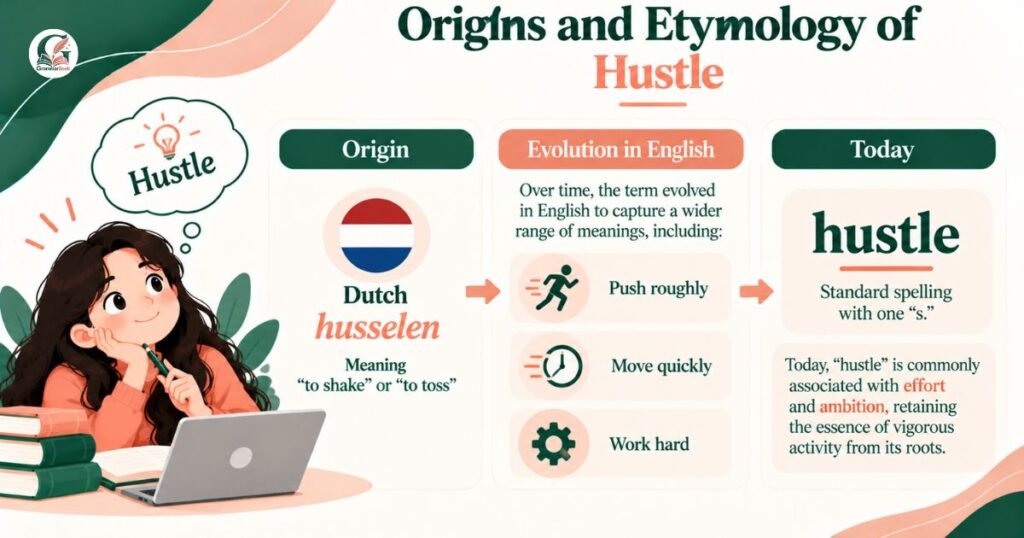
Today, the standard spelling is “hustle” with one “s,” retaining the essence of vigorous activity that characterized its roots. This evolution underscores how language adapts to societal values, transforming a simple concept of movement into a symbol of modern ambition and resilience. “Hustle” is commonly associated with effort and ambition. Despite these changes in meaning, the standard spelling remains “hustle,” with one “s.”
Common Mistakes and Quick Fix Table
Below is a comparison table that highlights the common errors (hussle vs hustle, side hustle or side hussle, hussling or hustling) along with their correct forms and explanations.
| Wrong | Correct | Why |
| hussle | hustle | Standard spelling uses one “s” |
| side hussle | side hustle | The phrase uses the correct spelling of “hustle” |
| hussling | hustling | The base word is spelled “hustle” with one “s” |
Eliminating the extra “s” effectively rectifies these spelling mistakes.
Improving your English becomes easier when you understand common spelling differences and expressions. Learn whether to use long term or long-term and discover the correct form of of course or ofcourse. You can also explore cancellation vs cancelation to make your writing clearer and more accurate.
Conclusion: Hustle vs Hussle
The correct standard English spelling is “hustle,” while “hussle” is a misspelling, except when referring to a specific brand or proper name. “Hustle” frequently appears in expressions like “side hustle” and denotes both hard work and the act of moving swiftly.
Remember to use “hustle” when you intend to convey the standard English meaning. Staying accurate enhances your writing. Make sure to choose the right spelling next time you use this term.
FAQs
Is It Hustle Or Hussle?
The correct spelling is “hustle,” which refers to a vigorous effort to achieve a goal, often in the context of work or entrepreneurship. “Hussle” is a common misspelling and is not recognized in standard English.
Is “Hussle” Ever Acceptable?
The term “hussle” is often considered an informal or incorrect spelling of “hustle.” In standard English, “hustle” is the accepted spelling and conveys meanings related to working hard or moving quickly. While “hussle” may be encountered in various contexts, such as brand names or music, it does not have recognized legitimacy in formal writing or standard dictionaries.
What Is Hussle And Hustle?
“Hussle” is often seen as a misspelling of “hustle,” which refers to making a determined effort to achieve goals, often in a fast-paced or energetic manner. Hustle emphasizes hard work, persistence, and the drive to overcome obstacles in both personal and professional life.
What Is Correct, Hassle Or Hustle?
The correct terms “hassle” and “hustle” refer to different concepts. “Hassle” often describes minor annoyances or difficulties, such as dealing with red tape or other inconveniences.”Hustle” typically implies energetic effort or hard work, often with a focus on achieving goals or making money. Understanding the distinction between these words can enhance your communication in various contexts.
What Does Hussle Mean?
“Hustle” refers to putting in hard work and effort towards achieving a goal or success, often in a determined and vigorous manner. It’s commonly associated with entrepreneurship and the grind of pursuing one’s ambitions, frequently encompassing side jobs or extra efforts to earn money.