
Long Term or Long-Term: The Complete Grammar & Usage Guide
The phrases “long term,” “long-term,” and “longterm” are often misused, leading to confusion as to when to use long term or long-term. Understanding the subtle differences between these terms is essential for clear communication, whether you’re drafting an email or crafting an essay.
In this guide, we will clarify the difference between “long term”, “long-term” and “longterm”. We’ll cover grammatical roles, hyphenation rules, and provide examples to ensure you grasp the correct usage effortlessly.
Quick Answer – Long Term or Long-Term
Long term, without a hyphen, is a noun phrase that refers to an extended duration, while long-term is an adjective used to describe something that is persistent or lasting. The variant longterm is generally considered incorrect in standard English usage.
Is Longterm Correct?
No. “Longterm” (one word) is incorrect in standard English and should be avoided in formal writing. Always write it as two words or hyphenated.
This common point of confusion arises from the casual tone of modern communication, where people may inadvertently blend terms for brevity.
Merging two words into one is a similar mistake in of course or ofcourse, where the one-word form is also incorrect.
When to Use Long Term
Use “long term” (two words, no hyphen) when it functions as a noun phrase. It is typically used after prepositions like “in,” “over,” and “for.”
For example:
- In the long term, this plan will save money.
- Investing wisely will pay off in the long term.
When to Use Long-Term
“Long-term” with a hyphen acts as a compound adjective that modifies a noun. “Long-term” is used when describing something that pertains to an extended duration.
For example:
- She made a long-term commitment.
- She has long-term goals that require careful planning.
One-Line Grammar Rule You Can Memorize
To simplify, memorize this one-line grammar rule: use “long term” as a noun phrase and “long-term” when modifying a noun as an adjective.

This distinction not only clarifies your writing but also reinforces good grammar habits that contribute to effective communication.
What Does Long-Term Mean?
“Long-term” is a hyphenated compound adjective used before a noun to describe something that lasts or continues over an extended period. The hyphen plays a crucial role here, joining the words “long” and “term” so that they function as a single adjective.
For example, long-term plan describes a plan intended for an extended period, while long-term goals refers to goals that take time to achieve. Similarly, long-term investment describes an investment intended to be held for an extended period.
The key rule is simple: when long and term work together as an adjective before a noun, use the hyphenated form long-term.
What Does Long Term Mean?
“Long term” is a two-word noun phrase that refers to an extended period or duration, emphasizing future implications and consequences. It commonly appears in expressions such as in the long term, over the long term, and for the long term.
For example:
- In the long term, this decision may be beneficial.
- Over the long term, small changes can make a difference.
- They are planning for the long term.
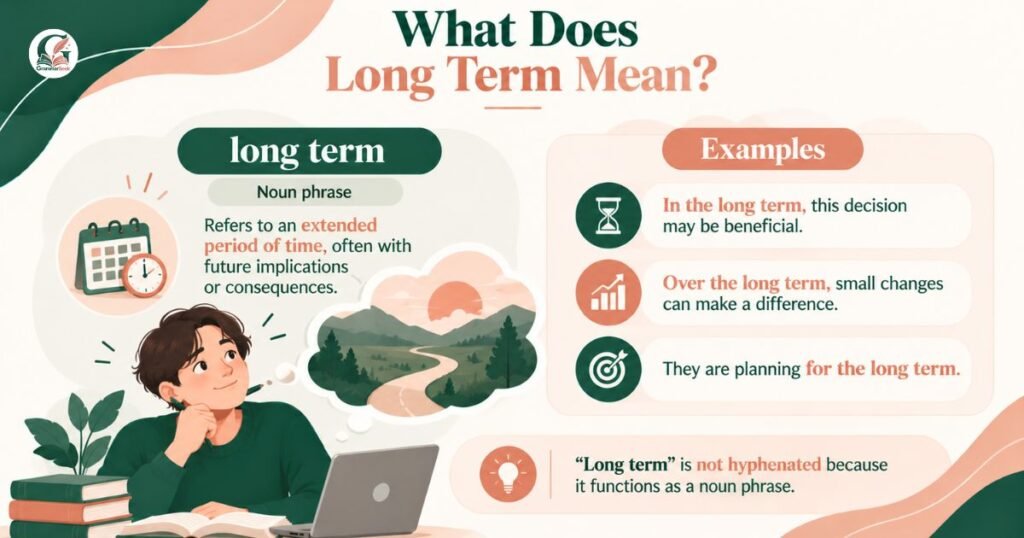
It’s important to note that “long term” is not hyphenated because it functions as a noun phrase. This distinguishes it from “long-term,” the hyphenated form that acts as an adjective before a noun, such as in “long-term goals.”
For another expression about time and duration, see how long is soon.
The Simple Grammar Rule (Easy Memory Trick)
The easiest way to remember long term vs. long-term is this: use long-term with a hyphen when it comes before a noun and acts as an adjective, as in long-term goals or long-term plans.
Use long term without a hyphen when it functions as a noun phrase referring to a period of time, as in in the long term or over the long term.
Easy Rule: If long-term modifies a noun, use the hyphen. If long term stands as a noun phrase, leave it unhyphenated.
The same before-the-noun hyphen rule applies to other compound adjectives, as explained in well deserved or well-deserved.
Long Term vs Long-Term vs Longterm (Side-by-Side Comparison)
Here is a quick side-by-side comparison table to understand the difference between long term, long-term and longterm.
| Form | Grammatical Function | Example | Correct? |
| long term | Noun phrase | In the long term | Yes |
| long-term | Hyphenated adjective | A long-term strategy | Yes |
| longterm | Non-standard one-word form | — | No |
Long term is a two-word noun phrase used to refer to an extended period of time.
Long-term is a hyphenated adjective used before a noun.
Longterm is not standard English and should be avoided.
Why Do People Get Confused?
People often confuse long term, long-term, and longterm because the first two forms look almost identical while serving different grammatical functions. Long term functions as a noun phrase referring to an extended period of time, while long-term is a hyphenated adjective used before a noun.
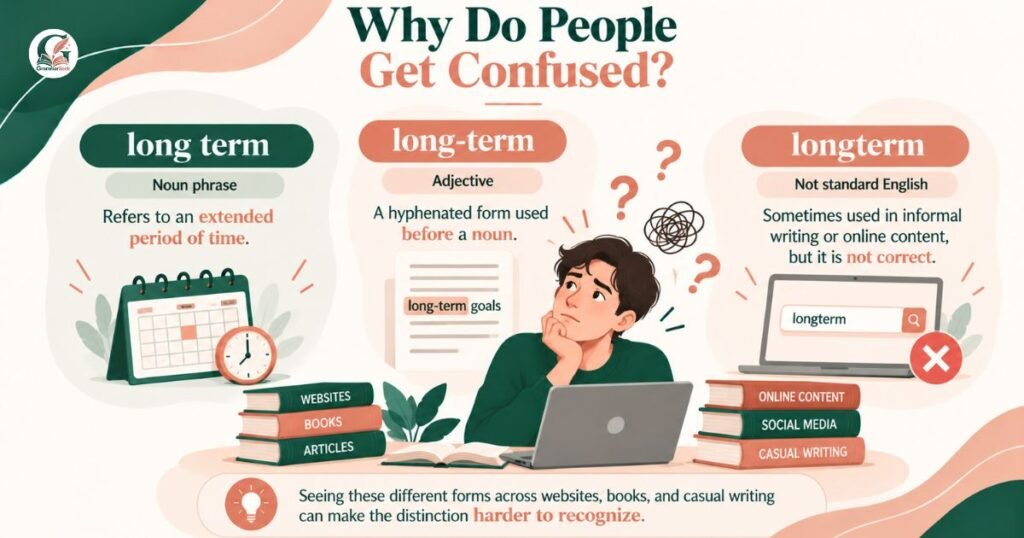
Another source of confusion is longterm, which some people use as a one-word spelling. Although it may appear in informal writing or online content, it is not standard English.
Seeing these different forms across websites, books, and casual writing can make the distinction harder to recognize.
Common Mistakes Writers Make
One common mistake writers make is using longterm as a single word. In standard usage, it should always be long-term when functioning as an adjective, and long term when used as a noun phrase.
For example:
Incorrect: The longterm effects are unknown.
Correct: The long-term effects are unknown.
Another common mistake is writing in the long-term instead of in the long term. The phrase should maintain its noun form to clearly convey the intended meaning.
For example:
Incorrect: In the long-term, we expect growth.
Correct: In the long term, we expect growth.
The key is to identify how the expression functions in the sentence: long-term is the adjective form, while long term is the noun phrase.
Real-Life Usage Examples
Here are some common examples showing how long-term and long term are used in sentences.
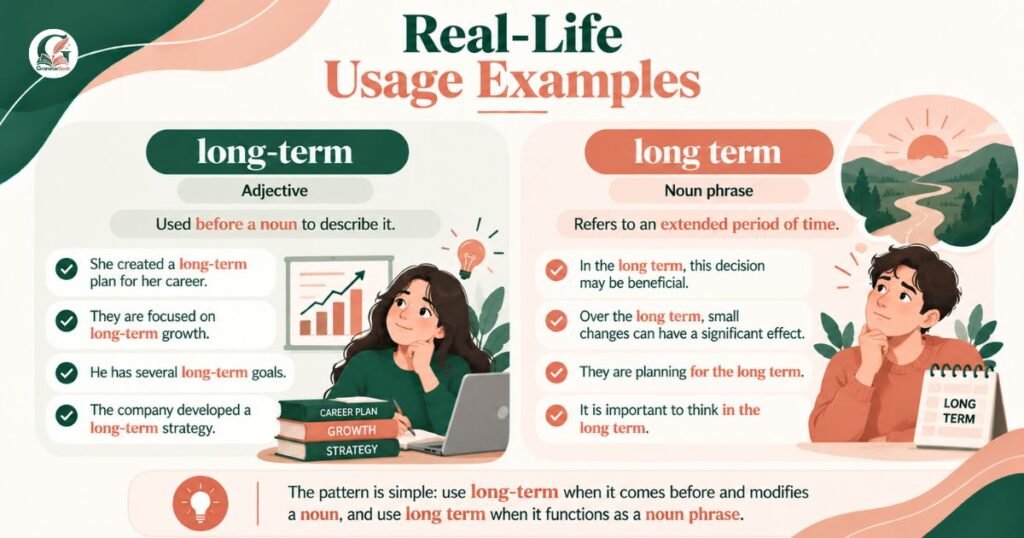
Examples of Long-Term
- She created a long-term plan for her career.
- They are focused on long-term growth.
- He has several long-term goals.
- The company developed a long-term strategy.
Examples of Long Term
- In the long term, this decision may be beneficial.
- Over the long term, small changes can have a significant effect.
- They are planning for the long term.
- It is important to think in the long term.
The pattern is simple: use long-term when it comes before and modifies a noun, and use long term when it functions as a noun phrase.
Quick Grammar Test (Interactive Section)
Test your understanding of long term vs. long-term by choosing the correct form in each sentence.
Questions
- The company has adopted a new strategy for _____ growth.
a) long term
b) long-term - In the _____, we expect significant improvements in efficiency.
a) long term
b) long-term - The researchers analyzed data _____ to understand the effects of climate change.
a) over the long term
b) over the long-term - This decision could have negative consequences in the _____, so we must be cautious.
a) long term
b) long-term - She aims to develop _____ solutions that will benefit the community.
a) long term
b) long-term
Answer Key
- b) long-term – It functions as an adjective modifying growth.
- a) long term – It functions as a noun phrase in the expression in the long term.
- a) over the long term – The expression over the long term uses the noun phrase the long term, so no hyphen is needed.
- a) long term – The expression in the long term uses long term as a noun phrase.
- b) long-term – It functions as a hyphenated adjective modifying solutions.
Quizzes like this often use the phrase “which of the following” in multiple-choice questions, as explained in which of the following.
Conclusion
The difference between long term and long-term is straightforward and essential for clarity in writing. Always use “long-term” with a hyphen when it serves as an adjective preceding a noun.
Use “long term” without a hyphen when it acts as a noun phrase, such as in “in the long term.” Remember that “longterm” as a single word is not considered standard English. By adhering to these guidelines, you can enhance the precision of your writing.
FAQs
Is Long-Term Always Hyphenated?
The term “long-term” is only hyphenated when it functions as an adjective preceding a noun. For example, you would say “long-term goals” or “long-term investment.”
Is It Long Term Or Long-Term?
Both are correct. The correct usage of long term vs. long-term depends on the grammatical context in which the phrase is used.
Can I Write Longterm?
No, longterm is incorrect. In standard English, the correct term is long-term or long term.
What Is The Difference Between Long Term And Long-Term?
The difference between “long-term” and “long term” lies primarily in their grammatical usage. “Long-term” is an adjective, meaning it describes a noun by indicating something that extends over an extended period. “Long term” is a noun phrase that refers to a span of time.
Why Is Hyphen Used In Long-Term?
The hyphen in “long-term” serves to link two words, creating a compound adjective that conveys a unified concept.
Is Long Term Hyphenated In AP Style?
Yes, long-term is hyphenated in AP style when used as a compound adjective before a noun, but open (two words) otherwise.