
Message vs Messege: Which Spelling Is Correct?
The word message is the correct spelling, while messege is a common misspelling. This error often arises due to phonetic misinterpretation, where the double “s” can easily be confused with the double “e.” Understanding the proper spelling is essential, as clear communication hinges on accuracy in writing.
In this guide, we will explore the meaning and correct usage of “message,” provide examples, and share a simple spelling tip to help you avoid this common mistake. Get ready to master the difference as we dive into the details of message vs messege and clarify the correct spelling of message.
Quick Answer – Message or Messege
“Message” is the correct spelling, while “messege” is an incorrect misspelling and not a standard English word. A message refers to information communicated from one person to another through various mediums, speech, writing, email, or text.
Understanding the correct spelling of “message” is vital for effective communication, especially in professional and digital contexts.
Message vs Messege at a Glance
Here is a quick comparison table between message and messege to understand which is correct, message or messege. Using the correct spelling of message can enhance readability and comprehension.
| Aspect | Message | Messege |
| Correct spelling | Yes | No |
| Standard English word | Yes | No |
| Dictionary status | Recognized | Not recognized as the standard spelling |
| Acceptable in English | Yes | No |
| Use in professional writing | Appropriate | Should be avoided |
| Spelling status | Correct | Misspelling |
The term “message” is the standard spelling used in both formal and informal contexts, ensuring clear understanding in written communication. “Messege” is simply a misspelling and does not hold any significance in the English language.
What Does “Message” Mean?
A “message” simply refers to information communicated from one person to another. As a noun, it encompasses various forms of communication, including texts, emails, letters, phone calls, conversations, voicemails, or exchanges on social media.

Examples:
- I received your message this morning.
- She left a message on my voicemail.
- The manager sent a message to the team.
Is Messege a Real Word?
The term messege is not recognized as a standard English word; it is simply an incorrect spelling of “message.” Most dictionaries do not list “messege” because it carries no separate meaning or formal definition.
Its presence online typically arises from simple typographical errors or informal writing, particularly in texts and social media comments.
When asking, “is messege a word,” it’s important to remember that the conventional understanding of the language does not support it.
While one may encounter “messege” in various contexts, this does not legitimize it as part of the English lexicon. Understanding this distinction can help avoid common pitfalls in writing and communication.
Why Do People Confuse Message and Messege?
People often confuse message with messege because the pronunciation of message does not make the spelling immediately obvious, especially for English learners.
Fast typing also plays a significant role; fingers may slip, resulting in unintentional letter substitutions.
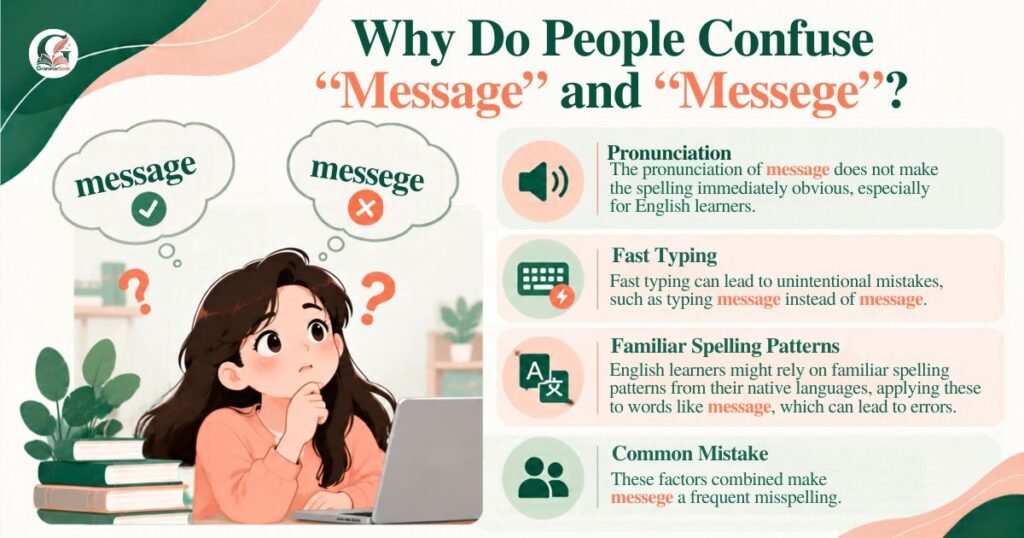
English learners might rely on familiar spelling patterns from their native languages, applying these to words like “message,” which can lead to errors.
These factors combined illustrate why this particular misspelling occurs frequently. Understanding these nuances can enhance our appreciation for language learning challenges.
How to Remember the Correct Spelling of Message
One effective mnemonic for remembering the correct spelling of “message” is to break it down into parts: “mess + age = message.” This highlights that the middle vowel is “a,” not “e,” helping to reinforce the correct spelling.
To reinforce the spelling, try writing the word repeatedly and using it in familiar phrases, consider “send a message,” “text message,” “audio message,” and “instant message.”
Such repeated exposure to the word will not only make it easier to remember, but it will also help you avoid the common misspelling “messege.”
Engaging with the word in this way is a practical and effective strategy for remembering the correct spelling of message.
Examples of Message in Sentences
Here are a few examples of message in different contexts to make it easy for you to understand and remember the correct spelling of message.

Formal Examples
- Thank you for your message regarding the project.
- We received your message and will respond shortly.
- Your message has been forwarded to the appropriate department.
Informal Examples
- I sent you a message yesterday.
- Did you get my message?
- She replied to my message immediately.
Workplace Examples
- The manager shared an important message with the team.
- Please read the company message before the meeting.
- Employees received a safety message via email.
Common Misspellings of Message
The term “message” is often misspelled in various ways, with common errors including:
- Messege
- Mesage
- Messge
- Messsage
- Messeage
Among these, “messege” stands out as a frequent culprit, likely stemming from how people pronounce the word.
Such misspellings often occur due to confusion over pronunciation, missing letters, or unintentional typing errors, such as repeating or swapping characters.
Understanding these common misspellings can help sharpen your writing skills. When proofreading, take a moment to double-check your work and replace any incorrect forms with the standard spelling: “message.”
Related Communication Terms
The term “message” appears in several common communication terms.

Text Message
A text message is a short, written communication sent via mobile devices. It is commonly used for quick, informal exchanges among friends or colleagues.
Voice Message
A voice message is an audio recording left for the recipient when they are unavailable to take a call. This method is frequently used in voicemail systems to convey information more personally than text.
Instant Message
Instant messaging is a real-time text-based communication through the internet. It is often utilized in both professional settings and social platforms to facilitate immediate discussions.
Direct Message
A direct message (DM) refers to private messaging on social media platforms. It allows users to communicate one-on-one without others seeing the conversation, fostering more private interactions.
Message vs Other Frequently Misspelled Words
“Message” can be confused with similar-looking or related words. Here is a quick comparison of message vs other frequently misspelled words.
Message vs Massage
A message is information communicated to someone, while a massage is a treatment involving rubbing or kneading the muscles and tissues of the body.
Message vs Mesage
The correct spelling is “message,” with two s’s, while “mesage” lacks this letter and is simply incorrect.
Message vs Messenger
A message is the content being communicated, whereas a messenger is the person or medium delivering that content.
Understanding these distinctions can enhance clarity in both written and verbal communication.
Message Pronunciation Guide
The pronunciation of message can sometimes contribute to spelling confusion.
American English: /ˈmɛs.ɪdʒ/ or MES-ij
British English: Very similar to American English
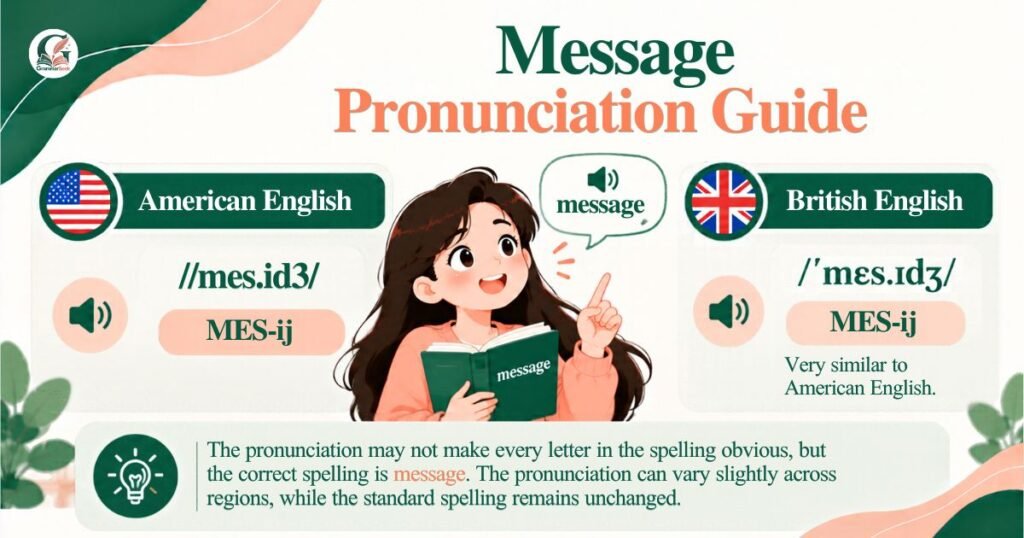
The pronunciation may not make every letter in the spelling obvious, but the correct spelling is message. The pronunciation can vary slightly across regions, while the standard spelling remains unchanged.
Explore More English Topics
Keep improving your English with these helpful guides.
Learn whether of course or ofcourse is correct and discover the right spelling of long term or long-term.
You can also explore how long is soon and learn the correct spelling of writing or writting.
You can also check out the correct plural of chief and discover the difference between thank you both vs thanks to both of you.
Conclusion
Message is the correct spelling, while messege is an incorrect misspelling. The term message refers to any information shared through texts, emails, conversations, and more.
Understanding the difference between message vs messege is crucial for effective communication.
Always remember the correct spelling of message to avoid confusion in your writing. Make it a habit to always use “message”, not “messege”.
FAQs
Is Messege a Word?
No, “messege” is not a correct word in English; it’s a common misspelling of “message.” The term “message” refers to a significant piece of information communicated between individuals, whether in written, spoken, or digital form.
How Do You Spell Message Correctly?
The correct spelling of the word is indeed “message.” This term refers to a communication or information conveyed from one person to another, typically through spoken or written forms. It can also encompass digital communications, such as texts or emails.
Why Is Messege Incorrect?
The word “messege” is incorrect because it doesn’t match the way the word “message” is spelled in standard English. English has specific rules and conventions for spelling, which help ensure clear communication. “Message” is the accepted spelling found in dictionaries and grammar references.
What Does Message Mean?
A message is a way to share information between people. It can be spoken, written, or even communicated through gestures and signals.
What Is The Plural Of Message?
The plural of message is messages. For example, if you send several notes or texts, you might say, “I have received many messages.”
Is Message A Noun Or A Verb?
The word “message” is mainly used as a noun. As a noun, it refers to a piece of information that is communicated, whether in writing or spoken.
In modern language, especially with the rise of digital communication, “message” is also used as a verb. People often say things like “I will message you later” to mean they will send a message to someone.