

Traveler or Traveller? The Correct Spelling Explained Clearly
When it comes to the terms traveler and traveller, it’s essential to note that both variations are valid; however, their usage differs based on regional English.
American English opts for the single-L spelling “traveler,” while British English maintains the double “l” with “traveller.” Recognizing this difference is significant for anyone aiming to write accurately across different audiences.
This guide will help you understand whether to use traveler or traveller, the rules governing their spelling, and why consistency matters in effective communication.
Quick Answer – Traveler or Traveller
Both traveler and traveller are correct and have the same meaning. In the traveler vs. traveller spelling difference, “traveler” is standard in American English, while “traveller” is standard in British English. Choose the spelling that matches your audience.
Traveler vs Traveller (Side-by-Side Comparison Table)
Here is a quick side by side comparison table between Traveller and Traveler to understand the difference between them at a glance.
| Feature | Traveler | Traveller |
| Correct Spelling | Correct | Correct |
| English Variant | American English | British English |
| Regional Usage | United States | United Kingdom, Canada, Australia, and other regions following British spelling |
| Dictionary Examples | Merriam-Webster | Oxford English Dictionary |
| Example Sentence | She is a frequent traveler. | She is a frequent traveller. |
| Present Participle | Traveling | Travelling |
| Past Tense | Traveled | Travelled |
| Meaning | A person who travels | A person who travels |
Both terms convey the same meaning: a person who journeys from one place to another. However, choosing the correct spelling greatly depends on your audience. For American contexts, “traveler” is preferable, while “traveller” is used for British readers.
Why Do British and American English Spell It Differently?
The difference in spelling between traveler and traveller, as well as traveling and travelling, stems from regional spelling conventions shaped by cultural influences.
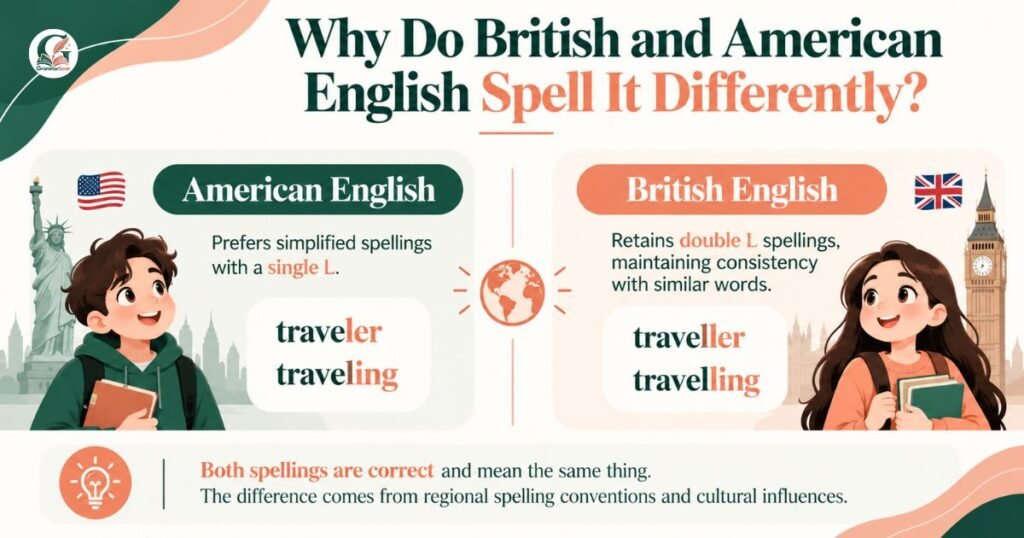
In American English, a preference for simplified spellings emerged as part of a broader movement towards a more phonetically straightforward language, championed by figures like Noah Webster. This led to the adoption of single-L forms, which are now standard in the U.S. and align with the trend of streamlining English for ease of use.
British English retains the double-L forms, maintaining consistency with other words that follow similar patterns, such as cancelled vs canceled. While both spellings are correct and pronounced the same way, these conventions reflect a deeper sense of regional identity and audience targeting.
Whether you choose traveler or traveller, the essential meaning and the richness of the language remain intact, showcasing the fascinating diversity within English as it adapts to different cultural contexts.
The Double Consonant Rule (The Real Grammar Rule Behind It)
The Double Consonant Rule highlights how English spelling varies between American and British forms.
In American English, words like “traveler,” “traveling,” and “traveled” drop the extra “l.” British English retains the double consonant, using “traveller,” “travelling,” and “travelled.”
This pattern is consistent across other common words, showcasing a divide in spelling preferences influenced by historical usage and regional norms.
Another clear example lies in the words canceled and cancelled. American English simplifies it to a single “l,” while British English maintains the double “l.” The same applies to labeling vs labelling.
The same single-L versus double-L pattern is covered in cancellation vs cancelation.
Traveling or Travelling? (Related Word Forms)
American and British English use different spellings for several related forms of “travel.”
In American English, the correct forms are:
- traveling
- traveled
- traveler
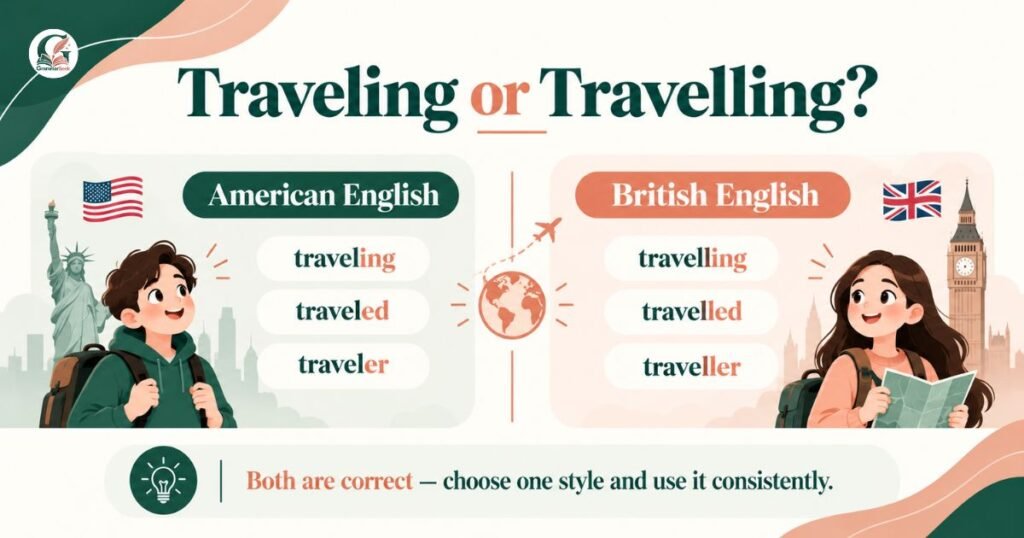
British English typically uses:
- travelling
- travelled
- traveller
The meaning remains the same; only the spelling differs. These variations explain why readers often search for “traveling vs travelling” and “traveled vs travelled.”
When writing articles or business content, follow one spelling style consistently. Choose American or British English based on your target audience, and avoid mixing US and UK spelling rules within the same piece. Both forms are correct, so consistency matters more than which version you choose.
Where Each Spelling Is Used (Global Usage)
In American English, the preferred spelling is “traveler”. This form is commonly used in the United States, particularly in travel literature, advertising, and related contexts. It often conveys a modern or straightforward feel, aligning with the broader trend of simpler spellings found in American English.
“Traveller” is used in British English and is widely accepted in countries like the UK, Australia, and India. Canadian English presents a unique case where both spellings can be found, depending on regional preferences.
While both traveler and traveller are entirely correct, choosing between them should be guided by your audience’s location and their preferred writing style, ensuring clarity and connection in your communication.
Word choice also differs between American and British English, as with everyday terms like “trash,” “garbage,” and “rubbish” in trash vs garbage.
Which Spelling Should You Use in Professional Writing?
In professional writing, it’s essential to choose the correct spelling of traveler or traveller, as it reflects your attention to detail and audience awareness.

For Academic Writing
For academic writing, always adhere to your school or journal’s style guide, which may specify one spelling over the other. This not only aligns your work with institutional standards but also enhances your credibility as a writer.
For Business Communication
For business communication, consistency with your company’s branding is key. If your organization emphasizes a particular spelling, stick with that across all documents to maintain a professional image.
For Online Content
When it comes to online content, consider your target audience: US-focused websites should predominantly use “traveler,” while those aimed at UK readers should lean towards “traveller.” Select the spelling that aligns with your context, ensuring clarity and professionalism in your writing.
The same consistency applies when choosing a spelling for product pages and SEO content, as in hoodie or hoody.
Examples of Traveller and Traveler in Sentences
Here are simple examples of traveler and traveller usage in American and British English:
- American English: She is an experienced traveler who visits Europe every year.
- British English: She is an experienced traveller who visits Europe every year.
- American English: The traveler booked his flight early.
- British English: The traveller booked his flight early.
- American English: The traveler packed light for the weekend trip.
- British English: The traveller packed light for the weekend trip.
- American English: Every traveler needs a valid passport for international travel.
- British English: Every traveller needs a valid passport for international travel.
In all these examples both traveller or traveler carry the same meaning, referring to someone who journeys from one place to another.
American English uses one “L,” while British English typically uses two. Comparing both forms side by side makes the traveler vs traveller spelling difference easier to understand.
Common Mistakes People Make
One of the most common traveler vs traveller mistakes is mixing American and British spellings in the same document. American English uses “traveler” while British English typically uses “traveller”. Mixing these forms can make your writing look inconsistent.
Another mistake is using the wrong plural form. The plural forms differ: Americans use “travelers,” while Britons use “travellers,” highlighting the necessity of picking one style and adhering to it throughout your writing.
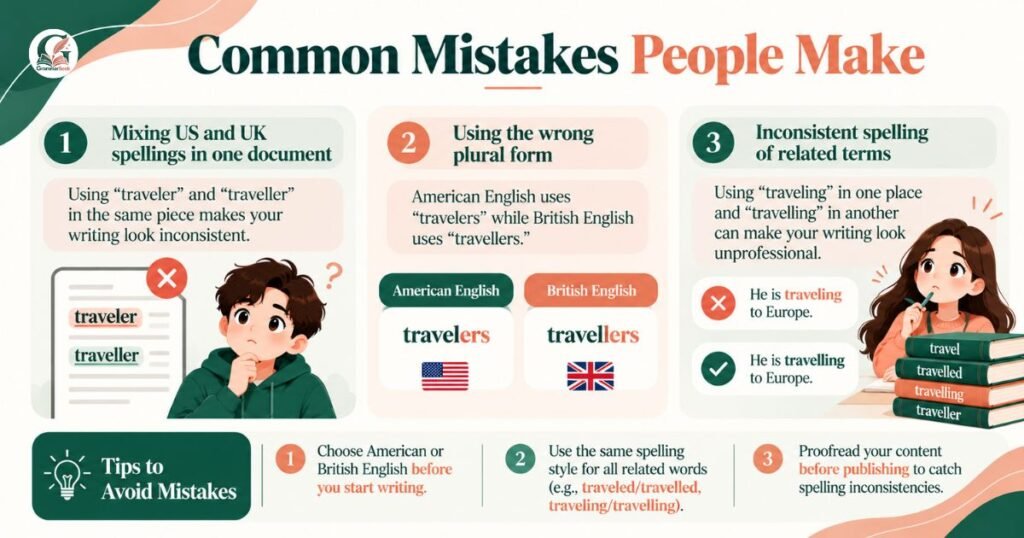
Another common mistake is the inconsistent spelling of related terms. For example, while one might use “traveling” in one place, they may mistakenly switch to “travelling” elsewhere in the same document. To maintain professionalism and coherence in your work, opt for either US or UK spelling style and apply it uniformly.
Here are three practical tips to avoid these mistakes:
- Choose American or British English before you start writing.
- Use the same spelling style for all related words, including “traveled/travelled” and “traveling/travelling.”
- Proofread your content before publishing to catch spelling inconsistencies.
Following these simple steps helps keep your writing clear, professional, and consistent.
For another travel-related word where plural spelling causes confusion, see plural of journey.
Final Rule to Remember
To make it easier to remember which spelling to use, consider the simple memory trick:
“one L for the US, two Ls for the UK.”
In American English the preferred spelling is traveler, while British English uses traveller.
Both spellings are correct and have the same meaning; only the regional spelling differs. When choosing between traveler or traveller, consider your target audience and use the preferred spelling consistently throughout your writing.
Explore More English Topics
Improve your English spelling and grammar with these helpful guides.
Learn the correct spelling of hustle or hussle and understand whether long term or long-term is correct.
You can also explore what kind of vs what kinds of and learn whether of course or ofcourse is the correct spelling.
Conclusion
The choice between “traveler” and “traveller” comes down to the variety of English you are using. “Traveler” is the spelling for American English, while “traveller” fits British English.
Remember the handy trick: one L for the US and two Ls for the UK. Both terms convey the same meaning and are correct in their respective contexts. Choose the spelling that suits your audience and stick to it for clarity.
FAQs
Is Traveler Wrong In The UK?
It is not wrong, but it is not standard. In the UK, the standard spelling is “traveller,” with two “l’s.”
Is Traveller Wrong In The US?
It is not wrong, but it is not standard. In the United States, the term “traveler” is the standard spelling used in American English. The spelling “traveller” is more commonly found in British English.
While both spellings are correct within their respective contexts, using “traveler” in the U.S. is advisable, as it aligns with American conventions.
Which Spelling Is More Common Worldwide?
There is no definitive answer to which spelling is more common worldwide. “Traveler” is standard in American English, while “traveller” is standard in British English and is also used in many countries that follow British spelling conventions. Both spellings are correct, so choose the one that matches your target audience.
Why Does American English Drop One “L”?
American English drops one “L” in words like “traveler” primarily due to the influence of Noah Webster, who was a key figure in shaping American spelling in the 19th century. He believed in making English simpler and more consistent. This led to the adoption of single “L” in certain words to differentiate American English from British English.